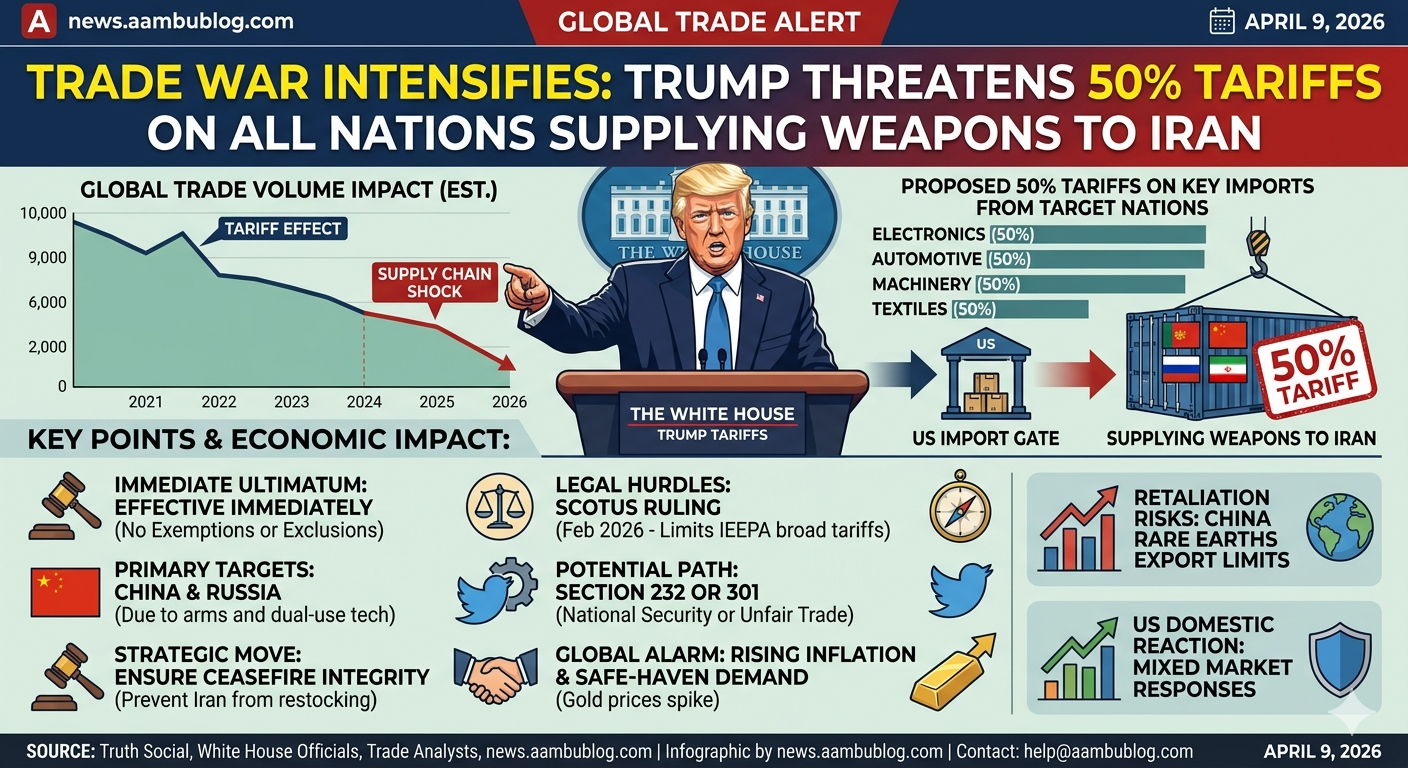
In a move that has sent shockwaves through global markets, US President Donald Trump announced yesterday, April 8, 2026, that any country found supplying military weapons to Iran will face an immediate 50% tariff on all goods sold to the United States.
The announcement came just hours after a fragile 2-week ceasefire was brokered with Tehran, signaling that while the “shooting war” may have paused, the “economic war” is just beginning.
1. The Ultimatum: “No Exclusions, No Exemptions”
Trump took to his Truth Social platform to deliver the message, stating that the move is designed to ensure Iran cannot use the current ceasefire to restock its military inventory.
- The Directive: Every single item—from electronics and cars to textiles—exported by an “arms-supplying nation” to the US would be hit with the 50% duty.
- Effective Date: The President declared these tariffs “effective immediately,” though legal experts are currently debating the specific authority being used.
2. Who Is in the Crosshairs?
While the President did not name specific countries, the global community is looking at two major players:
- China: As Iran’s largest trading partner and a provider of dual-use technologies, China is the primary target. This could reignite the “Great Trade War” that defined much of 2024 and 2025.
- Russia: Despite existing sanctions, reports suggest Russia has continued drone and missile collaborations with Iran. These new tariffs could effectively sever the remaining direct trade links between Moscow and Washington.
3. The Legal Hurdle: Supreme Court vs. The President
A critical detail for your business readers is the current legal tension in Washington.
- The SCOTUS Ruling: In February 2026, the US Supreme Court ruled that the President cannot use the International Emergency Economic Powers Act (IEEPA) to impose broad global tariffs without Congressional approval.
- Potential Path: To bypass this, the Trump administration may look to invoke Section 232 (National Security grounds) or Section 301 (Unfair Trade Practices), though these usually require months of investigation.
4. Economic Impact: Global Supply Chain Alarm
Market analysts are warning that if implemented, these tariffs could cause:
- Inflation Spike: Prices for consumer goods in the US could rise sharply as importers pass the 50% cost onto American families.
- Safe-Haven Demand: Gold prices have already seen a surge as investors flee to safe assets amid the uncertainty of a renewed trade war.
- Retaliation: There are fears that China may retaliate by restricting exports of critical minerals and rare earths needed for EV batteries and tech manufacturing.
5. Strategy or Sabotage?
Some diplomats believe the 50% threat is a negotiation tactic. By pairing the tariff threat with an offer for “Tariff and Sanctions relief” if Iran agrees to a new nuclear deal, Trump is using the “Carrot and Stick” approach to force a permanent settlement before the 2-week ceasefire expires.
Frequently Asked Questions (FAQ)
Q1. Will these tariffs affect India?
Currently, no. India does not supply military weapons to Iran. In fact, reports suggest the US administration recently reduced “reciprocal tariffs” on Indian imports from 50% down to 18%, suggesting a strengthening trade bond between Washington and New Delhi.
Q2. What is a “50% Tariff” in simple terms?
If a product costs $100 to import, a 50% tariff adds a $50 tax that the importer must pay to the US government. This usually results in the product price jumping to $150 or more for the final customer.
Q3. How did the stock market react?
US tech stocks saw a slight dip due to their reliance on Chinese supply chains, while domestic American manufacturing and “Buy American” labeled companies saw a modest gain.
For real-time trade war alerts: help@aambublog.com