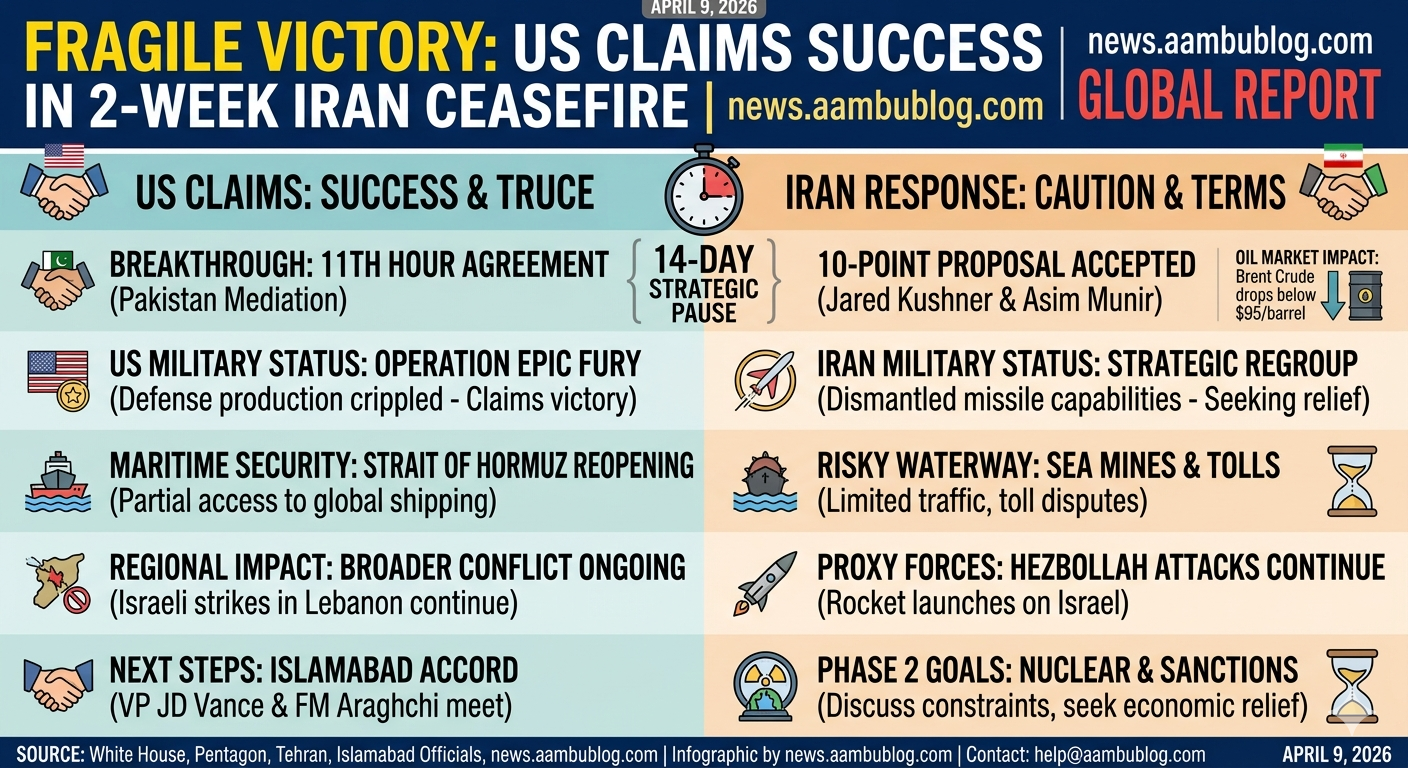
In a dramatic turn of events, the United States and Iran have agreed to a two-week “strategic pause” in hostilities. Announced just 90 minutes before a critical US deadline, the ceasefire has brought temporary relief to a world on the brink of total war. While the White House claims a “capital V” military victory, experts warn that the deal remains exceptionally fragile due to ongoing regional strikes.
1. The Eleventh Hour Agreement
The ceasefire was brokered through intensive backchannel diplomacy led by Pakistan.
- The Deadline: US President Donald Trump had set a strict ultimatum for Tuesday night, threatening to target Iranian infrastructure if the Strait of Hormuz was not reopened.
- The Announcement: Trump took to Truth Social to confirm he had accepted a 10-point proposal presented by Pakistan as a “workable basis for negotiation.”
- Immediate Halt: Both nations have agreed to stop direct missile and drone strikes for 14 days to allow for high-level talks in Islamabad.
2. “Operation Epic Fury”: The US Claim of Success
US Defense Secretary Pete Hegseth hailed the ceasefire as a decisive success for American forces.
- Military Dominance: Hegseth stated that the US campaign, codenamed Operation Epic Fury, had successfully dismantled Iran’s ballistic missile capabilities and naval assets.
- “They Begged”: The Pentagon claims that Iran sought the ceasefire because their defense production infrastructure was crippled.
- Strategic Leverage: The US military remains at high readiness in the region, signaling that any violation of the truce will met with a “heavy response.”
3. The Strait of Hormuz: A Risky Reopening
A core component of the deal is the restoration of global oil flow through the Strait of Hormuz.
- The Current Status: Iran has agreed to allow commercial shipping to resume, but it remains a dangerous zone.
- Sea Mine Threats: On Thursday, April 9, Tehran announced “alternative routes” within the strait, citing the presence of sea mines as a risk to main shipping lanes.
- The Toll Factor: Disputes remain over Iran’s new practice of charging “transit fees” for ships passing through the waterway—a condition the US has yet to officially recognize.
4. Why the Truce is “Fragile”
Despite the ceasefire between the US and Iran, the broader regional conflict continues to boil:
- Lebanon Conflict: Israel has stated it does not consider Lebanon covered by the US-Iran truce. Massive Israeli strikes on Beirut continued on Wednesday, killing over 180 people.
- Hezbollah’s Stance: Hezbollah launched fresh rocket attacks on northern Israel on Thursday, marking the first major violation of the “spirit” of the de-escalation.
- Unresolved Goals: Major objectives, such as the complete dismantling of Iran’s nuclear program and permanent maritime security, have yet to be addressed in the Phase 2 negotiations.
5. What to Watch for in the Coming Days
- Islamabad Accord: High-level delegations, including US Vice President JD Vance and Iranian Foreign Minister Abbas Araghchi, are expected to meet in Islamabad this weekend.
- Oil Market Volatility: While prices have dipped below $95/barrel, any flare-up in Lebanon or the Strait could send prices soaring again.
- Negotiation Window: The world has exactly 14 days to turn this temporary halt into a permanent peace settlement.
Frequently Asked Questions (FAQ)
Q1. Who mediated the US-Iran ceasefire?
Pakistan served as the primary mediator. Overnight negotiations involved Pakistani Army Chief Asim Munir, US special envoys Jared Kushner and Steve Witkoff, and Iranian officials.
Q2. Is the 2026 Iran War over?
No. This is a temporary 14-day ceasefire. Phase 2 of the negotiations aims for a more permanent 45-day window to discuss nuclear constraints and sanctions relief.
Q3. Are shipping lanes in the Middle East safe now?
Not entirely. While the strait is “reopening,” the UN and International Maritime Organization (IMO) warn that ship operators must carefully assess the risk of sea mines and regional proxy attacks.
For real-time geopolitical alerts: help@aambublog.com