Welcome to your daily global update. The geopolitical landscape in the Middle East is currently experiencing unprecedented volatility. With the ongoing military conflict involving the US, Israel, and Iran, the region is facing severe economic and humanitarian shifts that are rippling across the globe. Here are the top five news stories dominating the Middle East today.
1. Conflicting Claims Over Ceasefire as US-Israel Strikes on Iran Continue
In a prime-time address from the White House, US President Donald Trump claimed that the US and Israel had achieved rapid, devastating victories, stating that Iran’s naval capabilities had been neutralized.
- The Claims: President Trump announced that the Iranian government had reached out to seek a ceasefire. He also warned that operations could continue intensely for another two to three weeks if a permanent deal is not reached.
- The Rebuttal: Iran’s Foreign Ministry immediately dismissed the ceasefire claims as “false and baseless,” asserting that Tehran has not initiated any surrender negotiations.
2. The Strait of Hormuz Blockade Sparks a Global Trade Crisis
The global supply chain is facing severe disruption as maritime navigation through the critical Strait of Hormuz has essentially come to a halt.
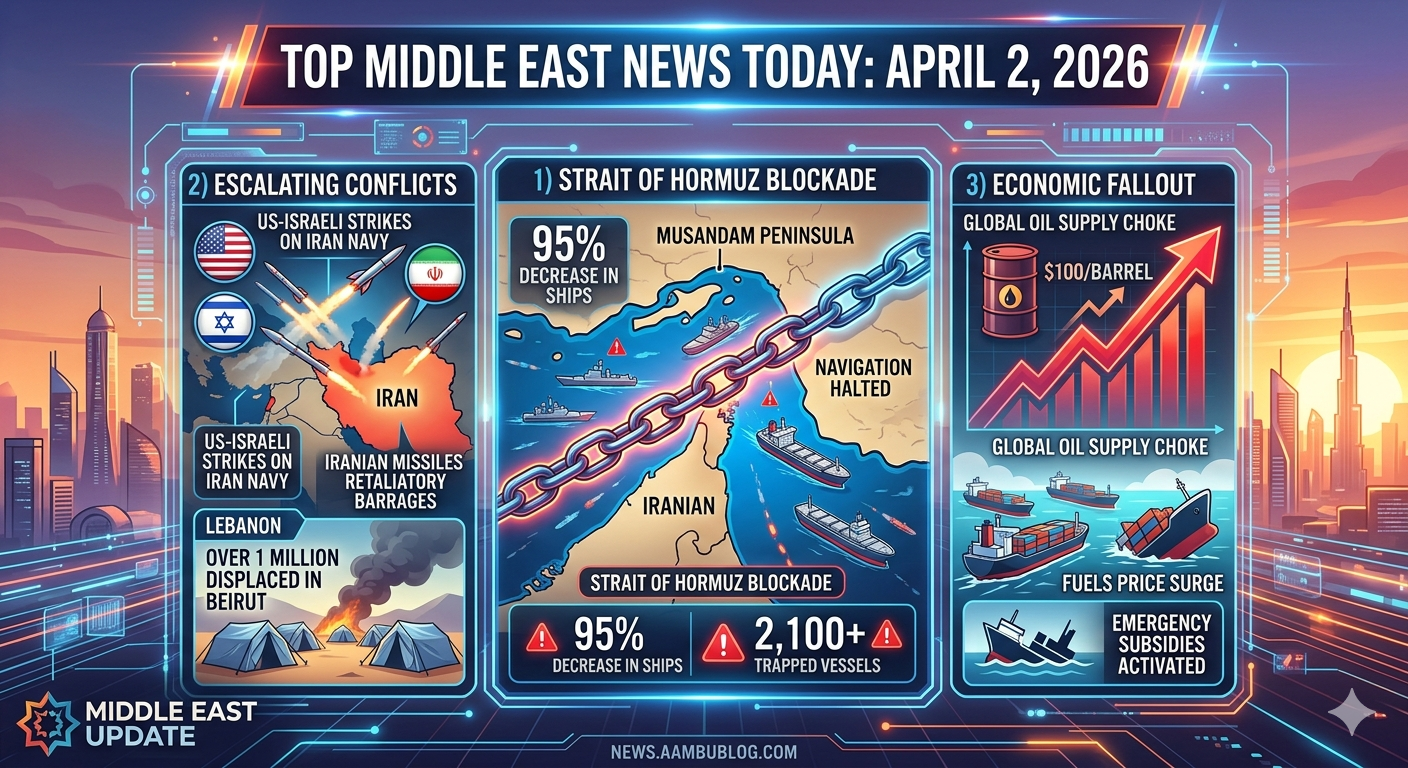
- The Blockade: According to a new UN report, there has been a 95% decrease in vessels passing through the strait, with over 2,100 ships currently trapped in the Gulf due to the blockade.
- Economic Impact: This chokehold on 20% of the world’s oil supply has caused global crude prices to surge past $100 a barrel, prompting nations like South Korea to pass emergency subsidies to protect their citizens from skyrocketing fuel costs.
3. Iran Launches Massive Retaliatory Missile Barrages
In response to the allied strikes, Iran’s military has initiated a new wave of heavy ballistic missile and drone attacks across the region.
- The Targets: Major missile salvos were fired toward Israel, triggering widespread sirens. Additionally, drone strikes caused fires at fuel tanks at Kuwait’s international airport, and a commercial tanker was reportedly struck off the coast of Doha, Qatar.
- Regional Anxiety: The expanding radius of these retaliatory strikes has raised alarm bells globally, prompting countries like China and Pakistan to draft a joint five-point proposal aimed at forcing immediate peace talks.
4. Strikes Cripple Iran’s Largest Steel Complex
The economic warfare accompanying the military strikes has reached Iran’s core industrial sectors.
- The Damage: Joint US and Israeli strikes heavily targeted the Mobarakeh Steel Company in the Chaharmahal and Bakhtiari province.
- Why it Matters: Mobarakeh is not only Iran’s largest industrial company but also the biggest steel complex in the entire Middle East. This attack serves as a major blow to the cornerstone of Iran’s domestic economy and manufacturing capabilities.
5. Massive Humanitarian Crisis Unfolds in Beirut
The conflict has heavily spilled over into neighboring Lebanon, creating a severe internal displacement crisis.
- The Displacement: Following wide-scale Israeli military strikes on Hezbollah infrastructure in southern Lebanon, over 1 million civilians have fled their homes.
- The Capital’s Strain: Beirut is currently bursting at the seams as displaced families seek shelter in makeshift tents, schools, and public squares, stretching local humanitarian aid resources to their absolute breaking point.
Frequently Asked Questions (FAQs)
Q1: Why is the Strait of Hormuz so important to the global economy?
Ans: The Strait of Hormuz is the world’s most important oil chokepoint. Approximately 20% of all global crude oil consumption passes through this narrow waterway. When it is blocked or heavily restricted, global fuel prices spike immediately, which drives up inflation worldwide.
Q2: What is the proposed China-Pakistan peace plan?
Ans: Following the escalating conflict, China and Pakistan put forward a five-point diplomatic proposal. The core tenets include ceasing all hostilities, opening an immediate window for peace talks, protecting civilian infrastructure, and prioritizing the reopening of the Strait of Hormuz to stabilize international energy security.
Q3: How are neighboring Gulf countries reacting to the strikes?
Ans: Neighboring nations like Kuwait, Qatar, and the UAE are on high alert. With drone strikes causing damage to regional fuel depots and commercial shipping, these nations are heavily bolstering their domestic security and pleading with the UN Security Council to intervene and de-escalate the situation.
Q4: Will this conflict affect fuel prices in India?
Ans: Yes. Because India imports a massive percentage of its crude oil from the Middle East, a prolonged closure of the Strait of Hormuz and soaring international Brent crude prices will inevitably lead to higher domestic petrol, diesel, and commercial LPG costs.