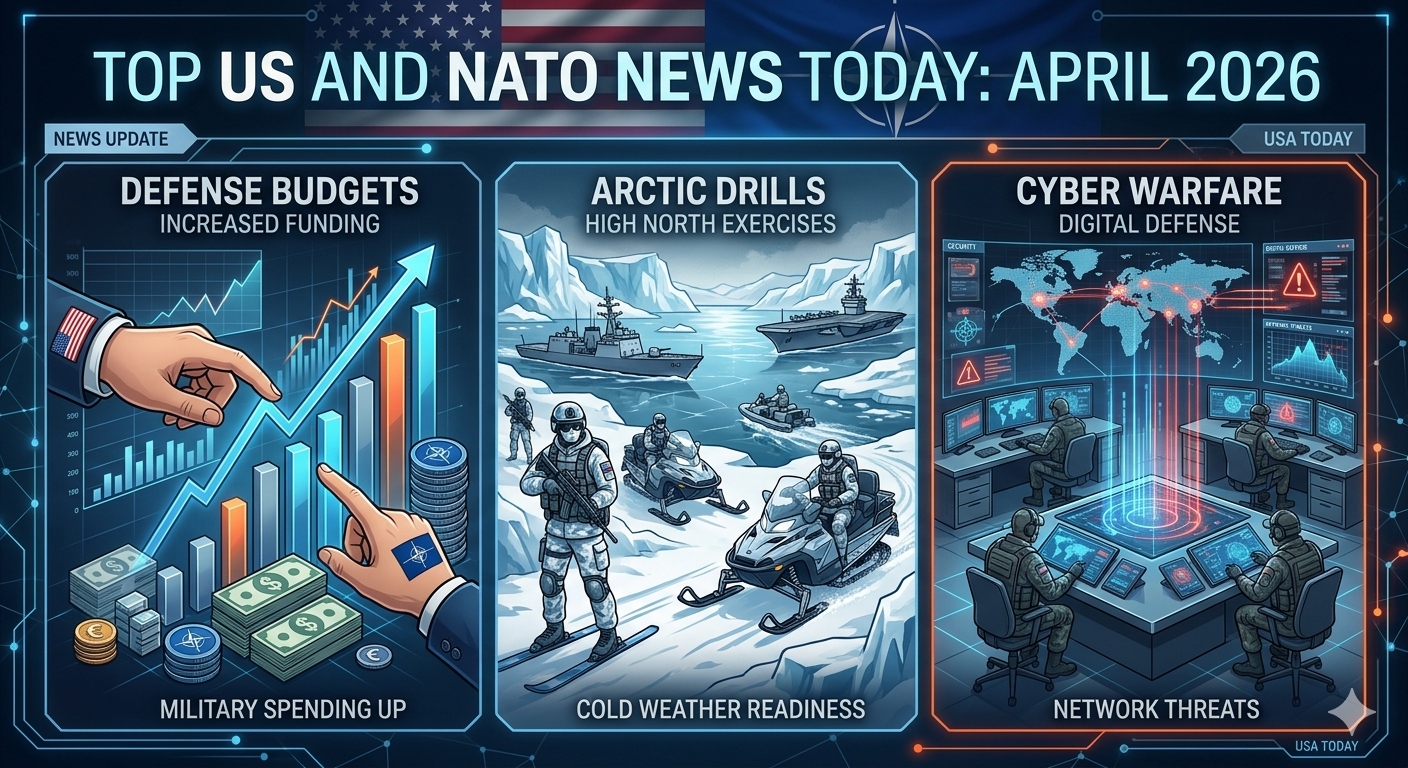
Welcome to your daily global defense update. The transatlantic alliance is undergoing massive shifts as the United States and NATO adapt to a rapidly changing global security environment. From intense debates over defense spending to preparing for next-generation warfare, here are the top five news stories defining the US-NATO relationship today.
1. US Pushes NATO Allies for a 3% Defense Spending Target
The United States is applying new diplomatic pressure on its European allies to significantly increase their military budgets.
- The Demand: For years, the baseline target for NATO members was to spend 2% of their GDP on defense. The US administration is now formally pushing to raise that mandatory baseline to 3%.
- The Justification: US defense officials argue that the 2% metric is outdated given the escalating costs of modern weapons systems, artificial intelligence integration, and the dual security threats in Eastern Europe and the Indo-Pacific.
2. “Operation Nordic Shield”: Massive Arctic Military Drills Begin
The US and NATO have kicked off one of the largest joint military exercises ever conducted in the high north.
- The Operation: Over 40,000 troops, primarily led by US, Norwegian, and newly integrated Swedish and Finnish forces, are participating in live-fire exercises across the Arctic Circle.
- The Strategic Goal: As the polar ice melts, the Arctic is becoming a highly contested region for shipping routes and resources. This drill is a direct show of force to counter growing Russian and Chinese naval activities in the polar region.
3. NATO Unveils US-Backed AI Cyber Command Center
Warfare is moving into the digital realm, and NATO is upgrading its defenses accordingly.
- The Launch: NATO has officially inaugurated a massive, state-of-the-art Cyber Defense and AI Command Center, heavily funded and supported by the US Department of Defense and American tech contractors.
- The Mission: The center is designed to predict, detect, and neutralize state-sponsored cyberattacks, election interference, and massive disinformation campaigns targeting democratic institutions across the alliance.
4. The US Reconfigures Troop Deployments on NATO’s Eastern Flank
The Pentagon has announced a major restructuring of its military footprint in Europe.
- The Shift: The US is moving away from temporary troop rotations and establishing more permanent, highly fortified bases in Poland, Romania, and the Baltic states.
- Advanced Weaponry: These new permanent bases will be equipped with next-generation Patriot missile defense systems and advanced drone swarms to heavily fortify NATO’s eastern borders against any potential incursions.
5. Ukraine’s NATO Integration Roadmap Updated
While full NATO membership remains a complex ongoing process, the US and NATO leadership have announced a new “Strategic Security Umbrella” for Ukraine.
- The Agreement: This new roadmap streamlines the integration of Ukraine’s military with NATO standards, allowing for faster weapons transfers, joint intelligence sharing, and extensive training programs led by US forces.
Frequently Asked Questions (FAQs)
Q1: What is NATO, and what is the US’s role in it?
Ans: NATO (North Atlantic Treaty Organization) is a political and military alliance of European and North American countries created to guarantee the freedom and security of its members. The United States is the largest and most powerful member, providing the bulk of the alliance’s military capabilities and funding.
Q2: Why is the US demanding 3% GDP spending from NATO allies?
Ans: The US believes that the global security threat level has risen drastically. Modernizing militaries to defend against cyber threats, hypersonic missiles, and space-based warfare is incredibly expensive. The US wants European nations to shoulder a larger share of this financial burden.
Q3: Why are the Arctic drills (Operation Nordic Shield) so important?
Ans: The Arctic is opening up due to climate change, creating new, shorter global trade routes and exposing untapped natural resources. Russia and China are heavily investing in icebreakers and Arctic military bases. NATO’s drills ensure the alliance can operate in extreme cold and protect these vital new maritime routes.
Q4: How does the new AI Cyber Command Center protect countries?
Ans: Modern attacks often target a country’s power grids, banking systems, or election integrity rather than physical borders. The AI Command Center uses advanced machine learning to detect these digital threats in real-time and block them before they can cripple a nation’s infrastructure.