In a historic achievement for India’s energy sector, Union Minister Pralhad Joshi announced on April 8, 2026, that India has officially become the third-largest country globally in terms of renewable energy installed capacity. By surpassing Brazil, India has solidified its position as a global leader in the transition to clean energy, trailing only behind China and the United States.
1. The Global Leaderboard: India Breaks into the Top 3
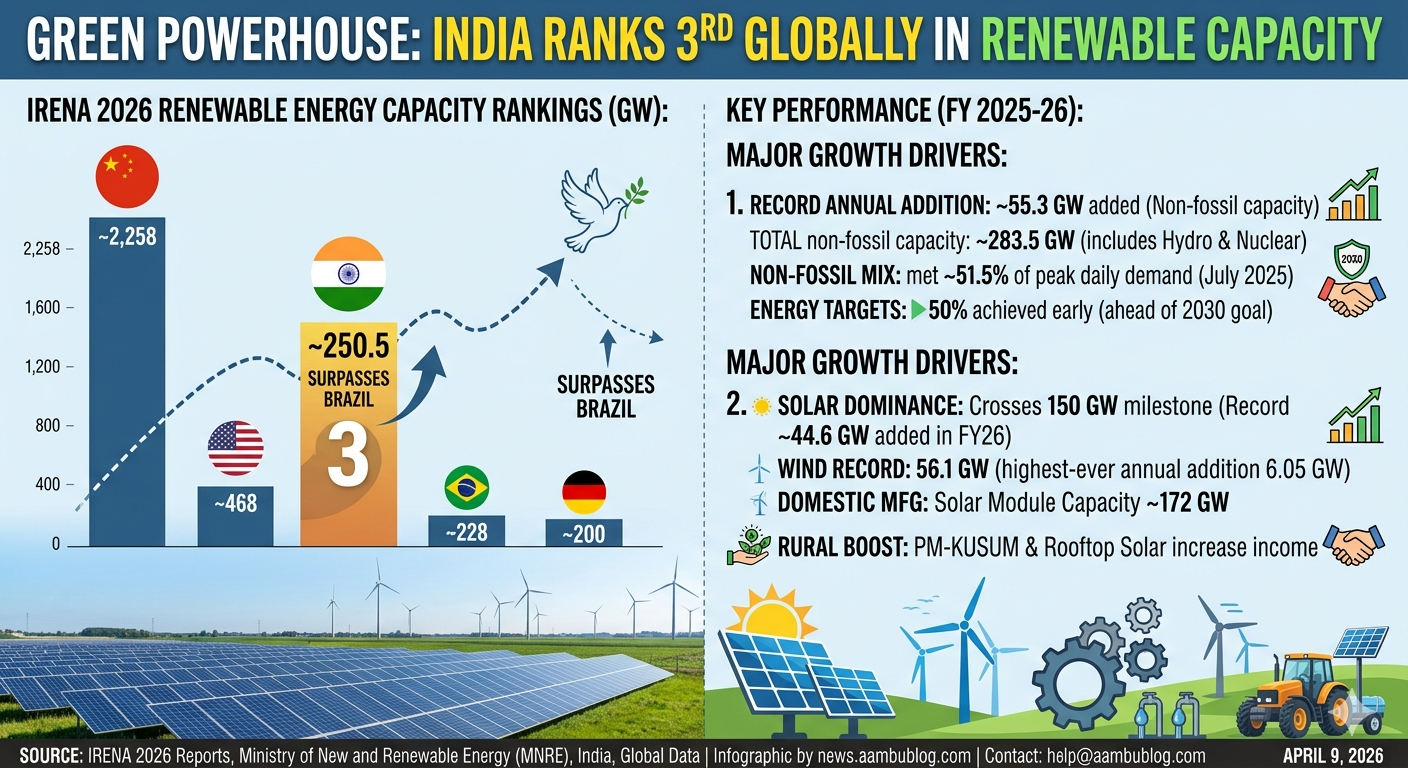
According to the IRENA Renewable Energy Statistics 2026, India has climbed the rankings based on its rapid infrastructure development.
| Rank | Country | Installed Capacity (GW) |
|---|---|---|
| 1 | China | 2,258.02 |
| 2 | USA | 467.92 |
| 3 | India | 250.52 (as of Dec 2025) |
| 4 | Brazil | 228.20 |
| 5 | Germany | 199.92 |
Note: Data reflects status as of December 2025/early 2026.
2. A Record-Breaking Fiscal Year (2025-26)
The fiscal year ending March 31, 2026, has been the most successful year in India’s renewable history.
- Massive Addition: India added a staggering 55.3 GW of non-fossil fuel capacity in a single year—nearly double the previous record of 29.5 GW.
- Total Non-Fossil Milestone: As of April 2026, India’s total non-fossil fuel capacity (including Nuclear) stands at 283.46 GW.
- Ahead of Schedule: India achieved its goal of 50% non-fossil fuel power capacity in June 2025, reaching this landmark five years ahead of the 2030 Paris Agreement target.
3. Solar and Wind: The Growth Engines
- Solar Dominance: India has crossed the 150 GW milestone in solar power. This includes a massive surge in utility-scale projects and decentralized energy like rooftop solar.
- Wind Record: Wind energy capacity reached 56.09 GW, with 6.05 GW added in the last year alone—the highest-ever annual addition for the sector.
- Distributed Energy: Schemes like PM-KUSUM (7.6 GW) and Rooftop Solar (8.7 GW) have empowered rural and urban households to become energy producers.
4. Strategic Energy Security
With global oil prices fluctuating due to the Strait of Hormuz crisis and West Asia tensions, this domestic green energy surge provides critical security:
- Reducing Imports: Increased reliance on solar and wind is helping India cut its multi-billion dollar oil import bill.
- Railway Electrification: India has achieved nearly 100% electrification of its broad-gauge railway network, powered increasingly by renewable sources.
- Peak Performance: In July 2025, renewables met a record 51.5% of India’s total daily electricity demand.
Frequently Asked Questions (FAQ)
Q1. What contributed most to this 3rd place ranking?
The primary driver was the record-breaking addition of 44.6 GW of solar power in FY 2025-26, supported by strong government policies and a massive jump in domestic solar module manufacturing (now at 172 GW).
Q2. Is India on track for its 2030 targets?
Yes. Having achieved the 50% non-fossil capacity milestone five years early, India is now well-positioned to reach its goal of 500 GW by 2030.
Q3. How does this affect the common consumer?
The shift to renewables, combined with battery storage, is leading to lower daytime charging costs for EVs and reduced electricity bills for households using rooftop solar.
For more Environment & Economy updates: help@aambublog.com