
By Global News Desk | April 20, 2026
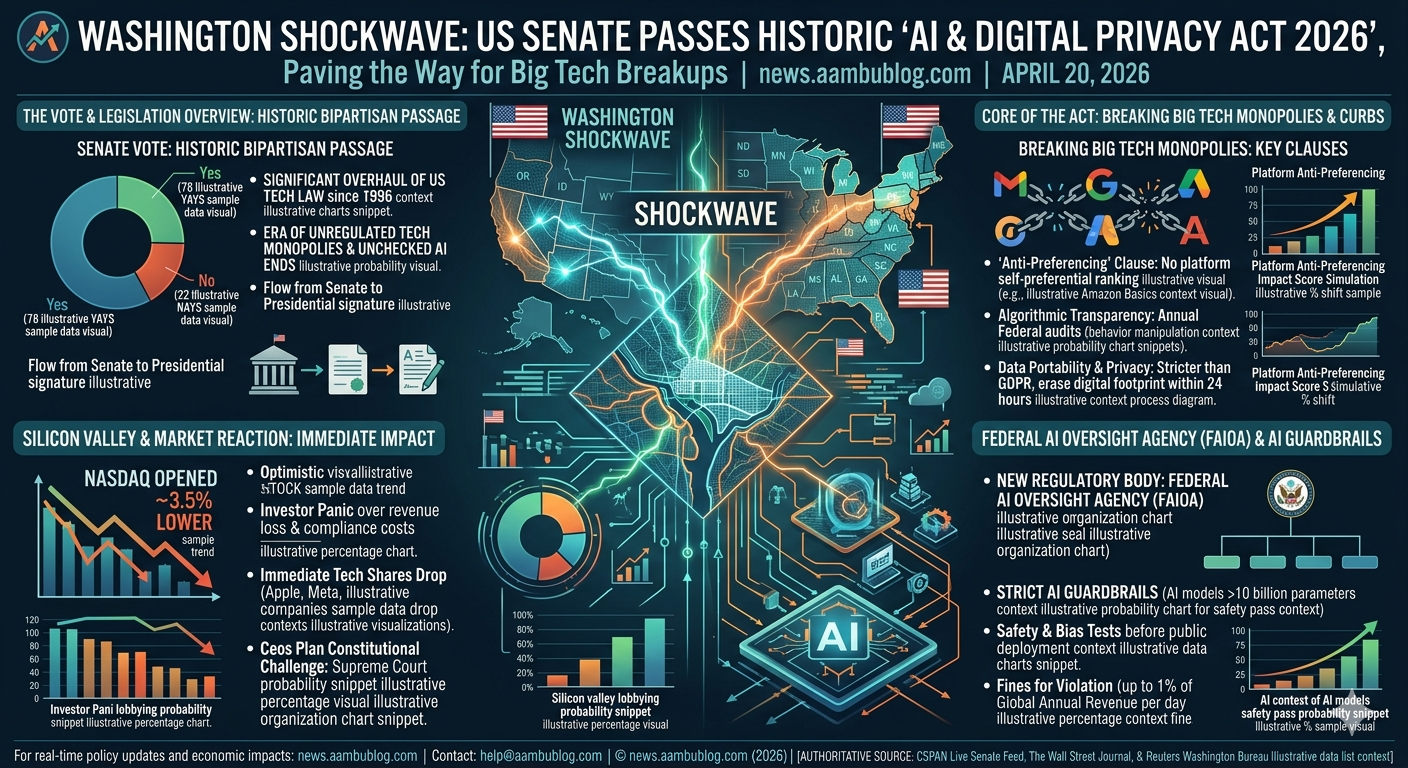
In a landmark legislative victory that will fundamentally alter the landscape of the global internet, the United States Senate has overwhelmingly passed the ‘AI & Digital Privacy Act of 2026’. After months of intense lobbying and partisan gridlock, the bill passed late last night with a surprising bipartisan majority of 78-22, sending a clear message to Silicon Valley: the era of unregulated tech monopolies and unchecked artificial intelligence is over.
This legislation is being called the most significant overhaul of US technology law since the Telecommunications Act of 1996.
1. The Core of the Legislation: Breaking the Monopolies
The new act targets the core business models of tech giants like Meta, Alphabet (Google), Amazon, and Apple.
- The ‘Anti-Preferencing’ Clause: The bill strictly prohibits platforms from giving preferential treatment to their own products. For example, Amazon can no longer rank its ‘Amazon Basics’ products higher than independent sellers in search results.
- Algorithmic Transparency: Companies must now open their AI algorithms for annual audits by the newly formed Federal AI Oversight Agency (FAIOA) to ensure they are not manipulating voter behavior or promoting harmful content to minors.
- Data Portability & Privacy: The act essentially brings a much stricter version of Europe’s GDPR to the US, forcing companies to allow users to completely erase their digital footprints within 24 hours of a request.
2. Silicon Valley’s Immediate Reaction and Market Drop
The reaction from the tech industry has been fierce and immediate.
- Market Sell-off: The NASDAQ Composite opened nearly 3.5% lower this morning as investors panicked over the potential loss of ad revenue and massive compliance costs. Apple and Meta saw their shares drop by over 4% in early trading.
- Lobbying Pushback: A coalition of tech CEOs has already announced plans to challenge the constitutionality of the bill in the Supreme Court, arguing that forced algorithmic transparency violates their intellectual property rights.
3. What Happens Next? The White House Desk
The bill now heads to the President’s desk. The White House has already signaled strong support for the legislation, confirming that the President intends to sign it into law before the end of the week. Once signed, tech companies will have an 18-month grace period to restructure their operations or face daily fines amounting to 1% of their global annual revenue.
Detailed Q&A: Understanding the US AI & Privacy Act
Q1. Will this actually break up Big Tech companies?
It doesn’t forcefully break them up immediately, but it makes it legally dangerous for them to operate multiple overlapping businesses (like owning both an ad network and the search engine it runs on). Many analysts believe companies like Alphabet might voluntarily spin off divisions like YouTube to avoid the massive new fines.
Q2. How does this affect Artificial Intelligence?
It places strict guardrails on AI deployment. Any AI model with over 10 billion parameters must pass a federal safety and bias test before being released to the US public. This will slow down the rapid, “wild west” deployment of AI tools we’ve seen over the last few years.
Q3. Does this US law impact the rest of the world?
Absolutely. Because the US is the primary market for these tech giants, they will likely change their global software architecture to comply with this law, meaning users in India, Europe, and elsewhere will see major changes in how their data is handled and how their social media feeds operate.
Fact Sheet: The ‘AI & Digital Privacy Act 2026’
| Feature | Details |
|---|---|
| Senate Vote | Passed (78 Yes – 22 No) |
| New Regulatory Body | Federal AI Oversight Agency (FAIOA) |
| Penalty for Violation | Up to 1% of Global Annual Revenue (per day) |
| Implementation Window | 18 Months from Presidential Signature |
| Market Impact | Tech stocks (NASDAQ) dropped ~3.5% on opening |
For real-time policy updates and economic impacts: news.aambublog.com
Contact: help@aambublog.com