Welcome to today’s global news update. Japan, the world’s fourth-largest economy, is currently navigating a complex mix of domestic economic shifts, major parliamentary decisions, and growing geopolitical tensions in Asia. Here are the top five news stories coming out of Japan today.
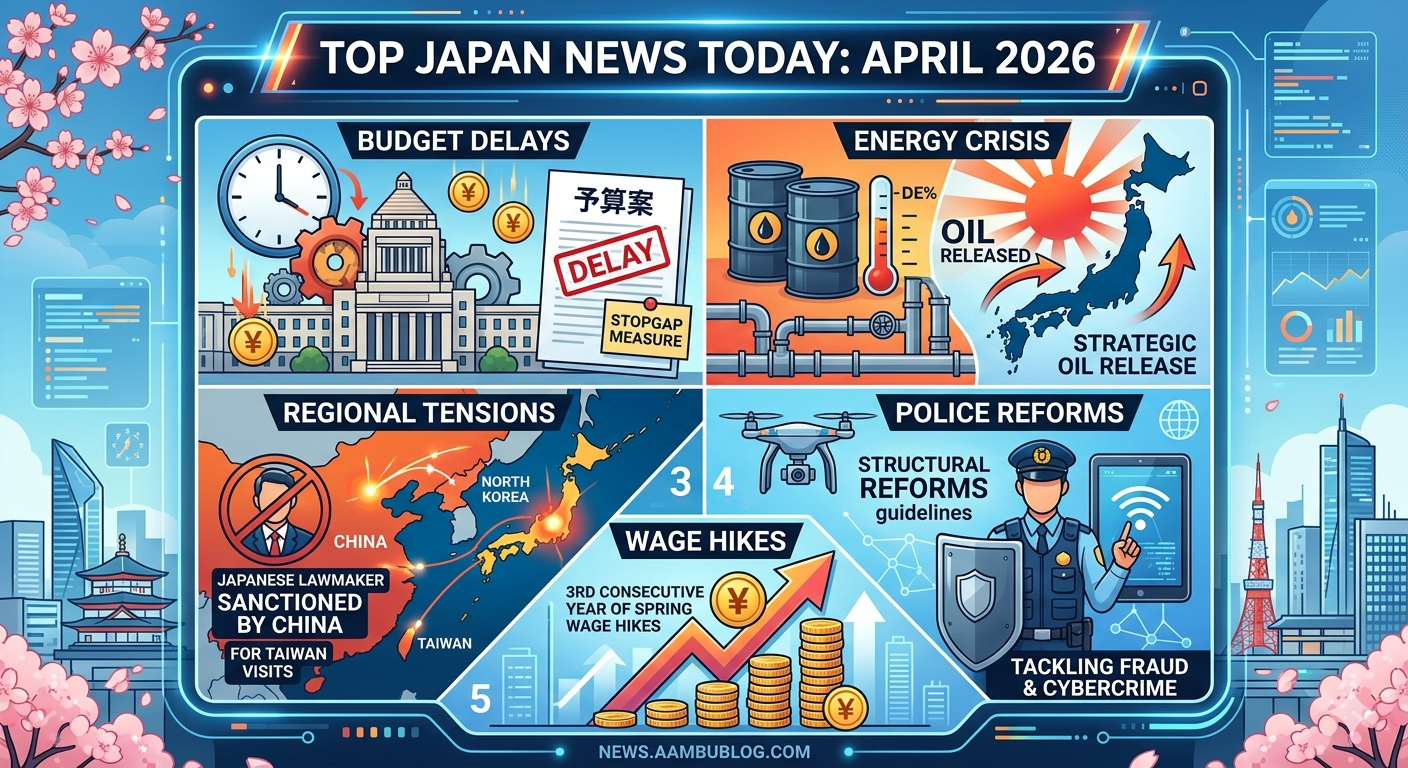
1. Japan’s Fiscal 2026 Budget Delayed
In a significant political development, Japan’s ruling Liberal Democratic Party (LDP) has abandoned its plan to enact the full fiscal 2026 budget before the start of the new financial year on April 1.
- The Solution: To prevent a government shutdown, the Diet (Japan’s parliament) passed an 8.56 trillion yen ($54 billion) stopgap measure at the last minute.
- The Context: The delay is largely due to intense parliamentary debates and demands from opposition parties for more intensive deliberation sessions with top leadership.
2. Historic Release of Strategic Oil Reserves
To combat rising global fuel costs and stabilize domestic supply chains, the Japanese government has initiated a massive release of its state-held oil reserves.
- The Scope: The government is releasing an amount equivalent to 30 days of domestic demand (around 8.5 million kiloliters).
- The Cause: This move comes as a direct response to the ongoing geopolitical conflicts in the Middle East, which have severely impacted international crude oil prices.
3. National Police Agency Announces Major Reforms
Japan’s National Police Agency (NPA) has issued new structural reform guidelines to modernize its force.
- Tackling Modern Crime: The reforms are designed to address the increasing specialization of special fraud and cybercrime.
- Resource Optimization: Due to Japan’s declining population, prefectural police departments will now share advanced forensic equipment, drones, and expert personnel rather than operating in silos.
4. Third Consecutive Year of Spring Wage Hikes
There is good news for the Japanese workforce. Following the annual spring wage negotiations, large companies across Japan have agreed to substantial wage hikes for the third successive year.
- Economic Impact: While nominal wages are rising at a historic pace, these increases are crucial for households dealing with persistent inflation and the rising cost of living, moving the country further away from its decades-long deflationary period.
5. Geopolitical Tensions: China Sanctions Japanese Lawmaker
Diplomatic relations between Tokyo and Beijing have hit another rough patch after China announced sanctions against Japanese lawmaker Keiji Furuya.
- The Trigger: The sanctions were imposed following Furuya’s recent visits to Taiwan.
- Broader Implications: This move highlights the deepening geopolitical friction in East Asia, as Japan continues to express concerns over regional security and stability in the Taiwan Strait.
Frequently Asked Questions (FAQs)
Q1: Why did Japan need to pass a stopgap budget?
Ans: A stopgap budget was necessary because the ruling and opposition parties could not agree on the full fiscal 2026 budget before the April 1 deadline. This temporary measure ensures that essential government functions continue without interruption while debates continue.
Q2: Will the release of Japan’s oil reserves lower global gas prices?
Ans: While it is primarily aimed at stabilizing domestic supplies in Japan, coordinated releases of strategic reserves by major economies (like the G7) can help cool down spiking international crude oil prices to some extent.
Q3: Why is the Japanese police force restructuring?
Ans: The restructuring is a response to two main factors: a shrinking national population that makes it harder to recruit new officers, and a sharp rise in high-tech crimes like cyber-attacks and international fraud that require highly specialized task forces.
Q4: Are the wage hikes in Japan keeping up with inflation?
Ans: The substantial wage hikes over the last three years are helping bridge the gap, but the Bank of Japan is closely monitoring the situation to ensure household purchasing power isn’t entirely eroded by the rising costs of food, energy, and essentials.