
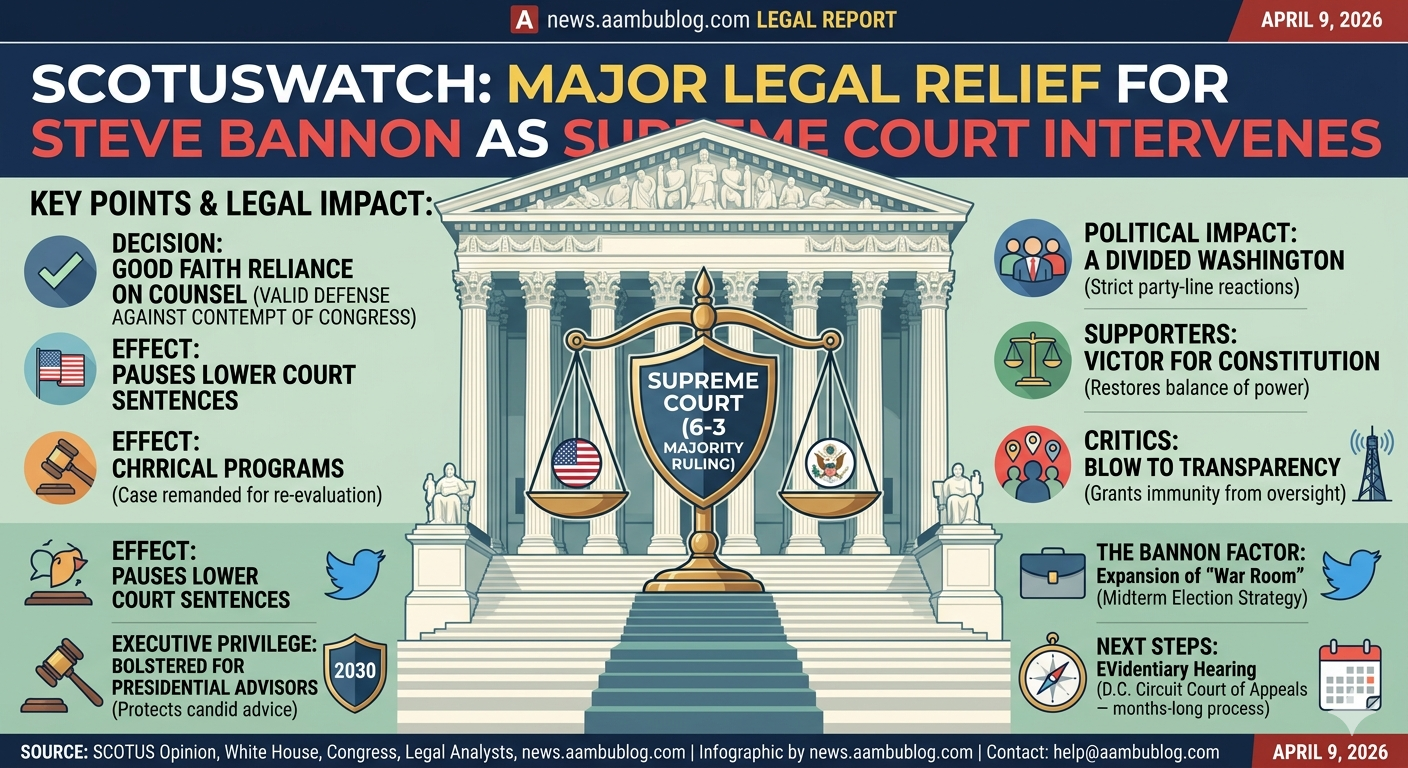
In a significant legal victory for the conservative movement, the United States Supreme Court (SCOTUS) issued a ruling today, April 9, 2026, that provides substantial relief to former White House Chief Strategist Steve Bannon. The decision marks a pivotal moment in the ongoing legal battles surrounding executive privilege and congressional authority.
1. The Core of the Ruling
The Supreme Court addressed the long-standing dispute regarding Bannon’s refusal to comply with congressional subpoenas.
- The Decision: By a 6-3 majority, the Court ruled that “good faith reliance” on legal counsel regarding executive privilege can be used as a valid defense against charges of Contempt of Congress.
- The Impact: This effectively pauses the enforcement of previous lower court sentences against Bannon, pending a re-evaluation of his case under these new legal guidelines.
2. Why This Matters for the Trump Administration
The ruling is seen as a “protective shield” for current and former advisors within the Trump circle.
- Executive Privilege Bolstered: The Court’s conservative majority argued that advisors must be able to provide candid advice to a President without the immediate fear of criminal prosecution by a politically opposed Congress.
- Precedent Setting: This decision limits the power of future Congressional committees to bypass claims of privilege by simply labeling them as “contemptuous.”
3. Political Reaction: A Divided Washington
As expected, the reaction to the SCOTUS intervention has been split strictly along party lines:
- Supporters: Bannon’s legal team hailed the decision as a “victory for the Constitution,” claiming it restores the balance of power between the Legislative and Executive branches.
- Critics: House Democrats issued a joint statement calling the ruling a “dangerous blow to transparency,” arguing that it essentially grants top officials “immunity from oversight.”
4. The “Bannon Factor” in the 2026 Midterms
With Steve Bannon now largely free from the immediate threat of incarceration, his influence is expected to surge:
- War Room Returns: Bannon has already announced a “massive expansion” of his War Room broadcast, focusing heavily on the 2026 midterm election strategy.
- Campaign Influence: Analysts suggest Bannon will play a key role in vetting candidates for the upcoming elections, ensuring they align with the “America First” agenda.
5. What Happens Next?
The case now returns to the D.C. Circuit Court of Appeals.
- Evidentiary Hearing: A new hearing will be scheduled to determine if Bannon’s initial refusal to testify was indeed based on a “good faith” interpretation of privilege.
- Timeline: Legal experts expect the process to take several months, likely pushing any final resolution past the November 2026 election cycle.
Frequently Asked Questions (FAQ)
Q1. Does this mean Steve Bannon is completely cleared?
Not exactly. The Supreme Court did not “pardon” him; it changed the rules for his defense. His case must now be reheard in a lower court using these new rules.
Q2. What is “Executive Privilege”?
It is the power claimed by the President and other members of the executive branch to resist certain subpoenas and other interventions by the legislative and judicial branches of government to access confidential information.
Q3. Who were the dissenting judges?
Justices Sotomayor, Kagan, and Jackson dissented, arguing that the ruling makes it “nearly impossible” for Congress to perform its constitutional duty of oversight.
For more legal and political analysis: help@aambublog.com