By National Desk | April 20, 2026
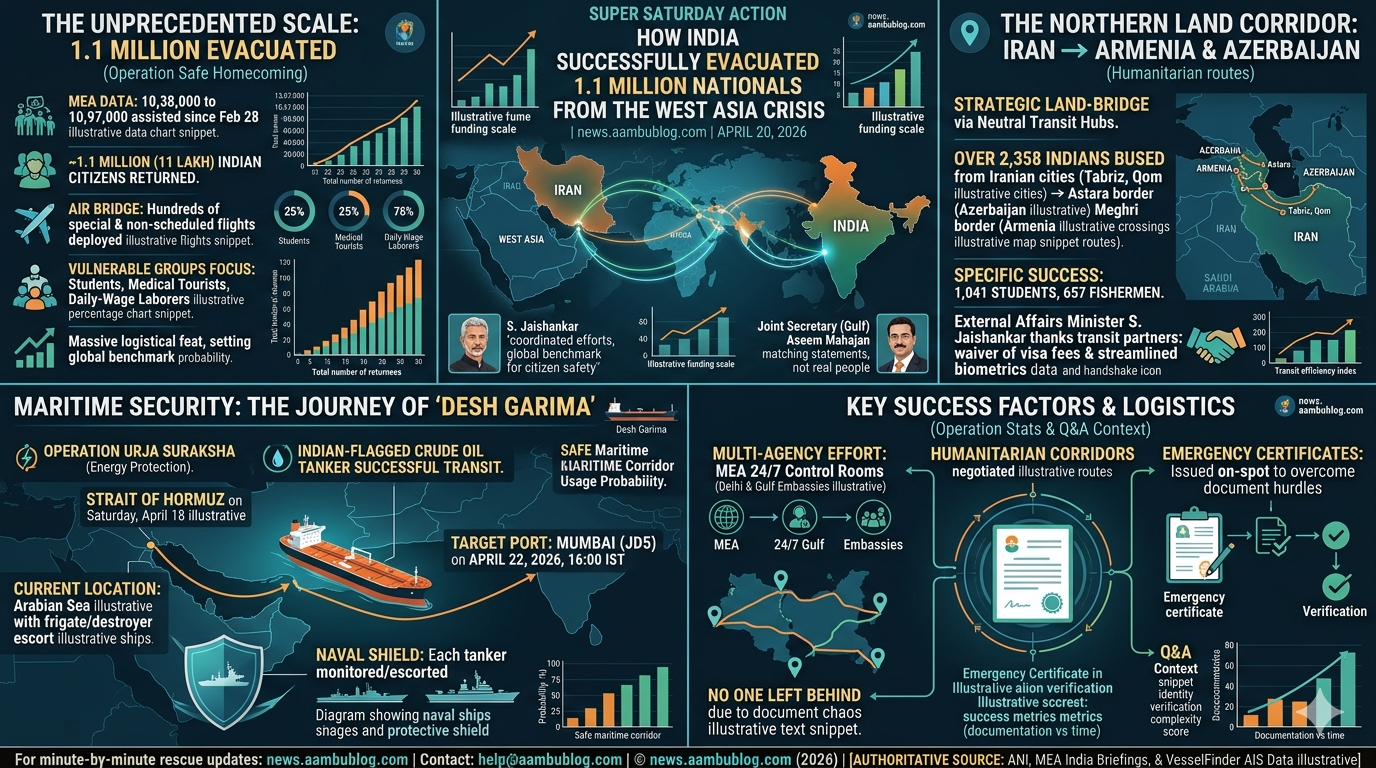
In what is being hailed as the largest non-combatant evacuation operation in modern history, India has successfully facilitated the return of nearly 1.1 million (11 lakh) of its citizens from conflict-hit West Asia. This massive logistical feat, involving coordinated efforts across air, land, and sea, has set a new global benchmark for disaster management and citizen safety.
1. The Unprecedented Scale: 10.97 Lakh and Counting
According to the latest data from the Ministry of External Affairs (MEA) and Joint Secretary (Gulf) Aseem Mahajan, the total number of Indians assisted since the start of the conflict on February 28 has reached 10,38,000 to 10,97,000.
- Air Bridge: Air India and other carriers deployed hundreds of special and non-scheduled flights to keep the India-Gulf corridor open, even as regional airspaces faced closures.
- Vulnerable Groups: Special focus was placed on students, medical tourists, and daily-wage laborers whose livelihoods were disrupted by the hostilities.
2. The Northern Corridor: Iran to Armenia and Azerbaijan
For Indians trapped in Iran, the traditional sea and air routes were high-risk. New Delhi negotiated a strategic “land-bridge” to bring its citizens home.
- The Route: Over 2,358 Indians were bused from Iranian cities like Tabriz and Qom to the Astara border crossing into Azerbaijan and the Meghri border into Armenia.
- Specific Success: This group included 1,041 students and 657 fishermen. External Affairs Minister S. Jaishankar specifically thanked the Armenian government for providing a safe transit hub for these nationals to fly back to Chennai and Ahmedabad.
3. Maritime Security: The Journey of ‘Desh Garima’
While people were being flown home, India’s energy security was handled by the Navy under Operation Urja Suraksha (Energy Protection).
- The Tanker: The Indian-flagged crude oil tanker ‘Desh Garima’ successfully transited the high-risk Strait of Hormuz on Saturday, April 18.
- Arrival: The vessel is currently in the Arabian Sea and is on track to dock at Mumbai (JD5) on April 22, 2026, at 16:00 IST.
- Naval Shield: Every Indian tanker in the region is being monitored or escorted by Indian Navy destroyers and frigates to prevent any “maritime piracy” or seizures.
Detailed Q&A: Operation Safe Homecoming 2026
Q1. How did India manage to evacuate 11 lakh people in such a short time?
It was a multi-agency effort. The MEA set up 24/7 control rooms in New Delhi and at every embassy in the Gulf. They combined scheduled commercial travel with “chartered” evacuation flights. For regions with no flights, they negotiated “Humanitarian Corridors” through neighboring countries like Armenia and Azerbaijan.
Q2. What were the biggest challenges faced during this operation?
The two biggest hurdles were airspace closures and identity documentation. Many Indians had their passports stuck with employers or lost during the initial chaos. The government issued “Emergency Certificates” on the spot to ensure no one was left behind due to paperwork.
Q3. What is the significance of the Armenia-Azerbaijan route?
Usually, Indians from Iran fly directly or come via the sea. But with the naval blockade and flight risks, these two countries provided a “neutral land route.” Azerbaijan even waived visa fees and streamlined biometrics at the border specifically for the Indian evacuation.
Q4. Is the evacuation now complete?
While over 1.1 million have returned, the MEA continues to monitor around 1.5 lakh Indians who have chosen to stay back in safer zones of the UAE and Saudi Arabia. Fresh advisories urge anyone in “active conflict zones” to exit immediately via the organized channels.