
By City News Desk | April 20, 2026
In a massive move to curb the toxic air pollution in the national capital, the Municipal Corporation of Delhi (MCD) has officially implemented a steep hike in the Environment Compensation Charge (ECC) for commercial vehicles entering Delhi. Following a landmark order by the Supreme Court of India, these new rates are designed to serve as a strong deterrent, forcing heavy transit vehicles to bypass the city.
1. The Supreme Court Mandate: 53% Hike in Green Tax
The hike comes after a bench led by Chief Justice Surya Kant approved the recommendations of the Commission for Air Quality Management (CAQM). While the order was passed on March 12, 2026, the MCD issued formal orders for its “immediate implementation in letter and spirit” on April 19.
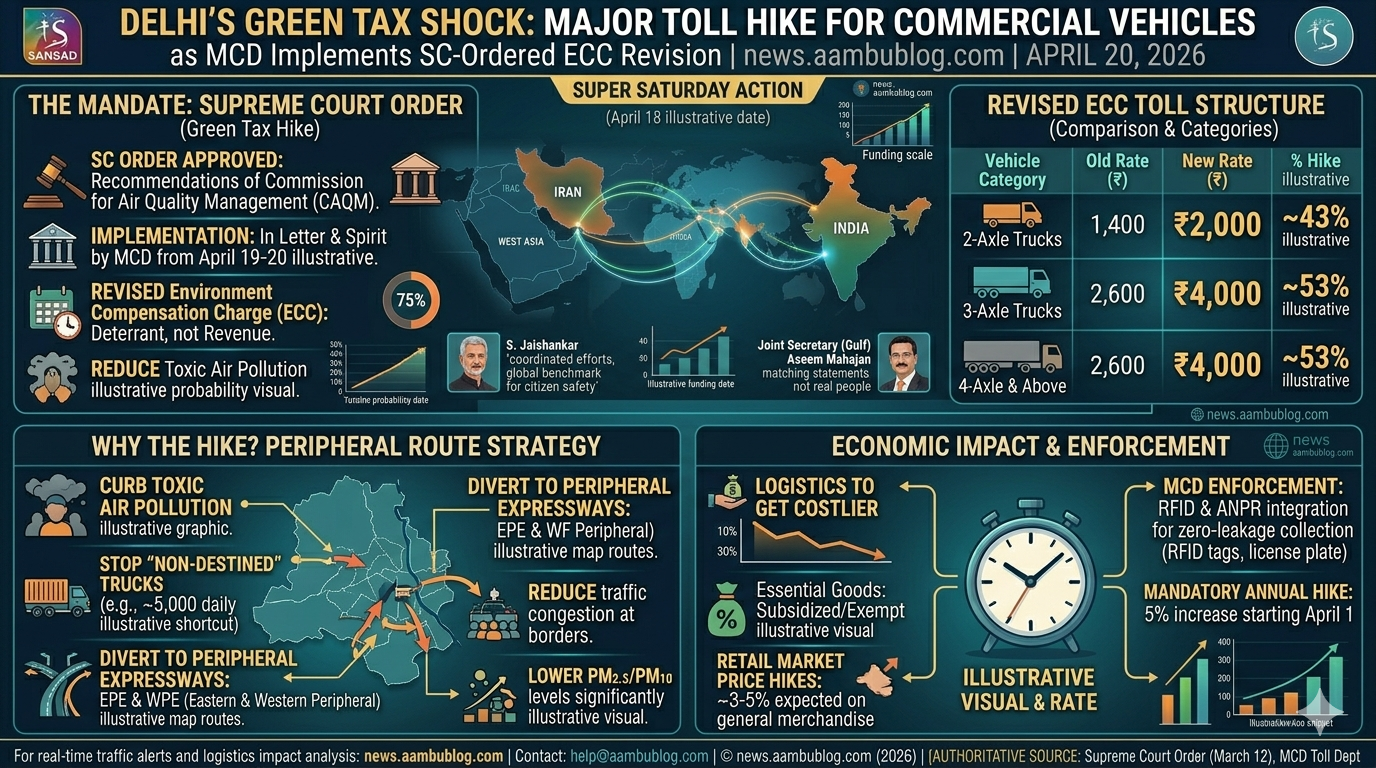
- Category 2 & 3 (Light-duty and 2-Axle Trucks): The ECC has been raised from ₹1,400 to ₹2,000.
- Category 4 & 5 (3-Axle, 4-Axle, and above): The charge has seen a massive jump from ₹2,600 to ₹4,000.
- The 5% Rule: In a first, the Court has also approved a 5% mandatory annual increase in ECC rates starting April 1 every year to keep up with inflation and maintain the deterrent effect.
2. Why the Hike? The Peripheral Expressway Strategy
The primary goal of this financial “shock” is not revenue generation but pollution control.
- The “Non-Destined” Problem: Data shows that nearly 5,000 heavy trucks enter Delhi daily just as a shortcut to reach other states.
- The Solution: By making entry costs as high as ₹4,000, the authorities are pushing these vehicles to use the Eastern and Western Peripheral Expressways (EPE & WPE), which bypass the city entirely.
- Heat Dome Context: This move is particularly urgent as Delhi-NCR is currently suffering from a “Heat Dome” effect, where stagnant hot air is trapping pollutants close to the ground, causing a spike in respiratory issues.
3. Economic Impact: Logistics to Get Costlier
The hike is expected to have a “domino effect” on the cost of goods in Delhi.
- Essential Goods: While vehicles carrying essential items like milk and vegetables are generally exempt or subsidized, the overall increase in logistics for construction materials and general merchandise will likely lead to a 3-5% price hike in retail markets.
- RFID Integration: The MCD is also speeding up the installation of RFID (Radio Frequency Identification) and Automatic Number Plate Recognition (ANPR) systems at all 126 entry points to ensure zero-leakage in tax collection.
Detailed Q&A: Delhi’s New Toll Rates
Q1. When do these new rates come into effect?
The rates are officially effective from April 1, 2026, but the MCD’s enforcement agencies (like Shahkar Global) have been directed to collect the enhanced rates with immediate effect starting April 19-20, following the formal notification.
Q2. Who is exempt from paying the Environment Compensation Charge?
Vehicles carrying essential commodities (milk, vegetables, fruits, salt), ambulances, and passenger buses are typically exempt from the ECC. However, private cars and two-wheelers do not pay ECC anyway—they only pay the standard toll if applicable.
Q3. Is this a permanent increase?
Yes. Not only is it permanent, but as per the Supreme Court’s direction, the rate will automatically increase by 5% every year on April 1. For example, a 4-axle truck paying ₹4,000 now will pay ₹4,200 in April 2027.
Q4. How will this help Delhi’s air quality?
By diverting approximately 5,000 heavy diesel vehicles daily to the peripheral expressways, the government aims to reduce Particulate Matter (PM2.5 and PM10) levels significantly. It also reduces traffic congestion at borders, which currently causes thousands of vehicles to “idle” and release more smoke while waiting in line.
Fact Sheet: New ECC Toll Structure (2026)
| Vehicle Category | Old Rate (₹) | New Rate (₹) | % Hike |
|---|---|---|---|
| LCV / 2-Axle Trucks | 1,400 | 2,000 | ~43% |
| 3-Axle Trucks | 2,600 | 4,000 | ~53% |
| 4-Axle & Above | 2,600 | 4,000 | ~53% |
| Annual Hike | N/A | 5% | Mandated |
For real-time traffic alerts and logistics impact analysis: news.aambublog.com
Contact: help@aambublog.com