
By Tech & Auto Desk, Tokyo | April 25, 2026
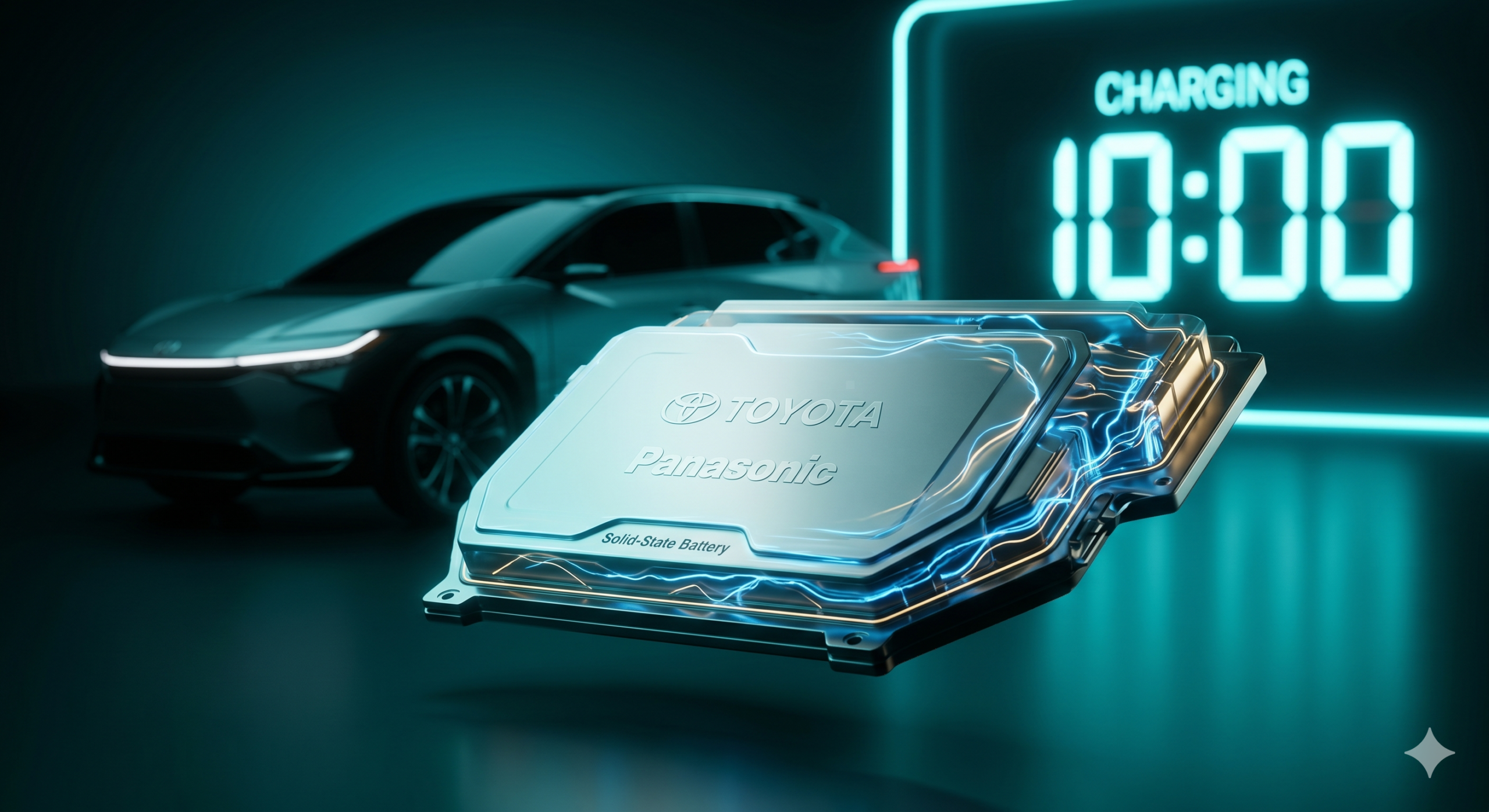
The global Electric Vehicle (EV) race just took a massive turn in favor of Japan. In a joint press conference held at Toyota City today, Toyota Motor Corporation and Panasonic Energy officially confirmed the commencement of mass production for their highly anticipated Solid-State Batteries (SSBs).
While Tesla and Chinese giants like BYD have dominated the lithium-ion era, Japan is betting its entire future on this “Holy Grail” of battery technology. The first commercial vehicle featuring this battery is set to hit the showrooms by December 2026.
1. The Game-Changing Specs
The data released by Toyota engineers today has sent shockwaves through the automotive industry. Compared to current EVs, the new Solid-State powered cars offer:
- Ultra-Fast Charging: A 10% to 80% charge in just 10 minutes. This is roughly the time it takes to grab a coffee at a petrol pump.
- Massive Range: A single full charge will provide a driving range of 1,200 km (750 miles). For context, you could drive from Delhi to Mumbai with just one stop.
- Enhanced Safety: Unlike liquid electrolytes in current batteries, solid-state batteries are non-flammable, virtually eliminating the risk of battery fires during accidents.
2. Moving Beyond ‘Prototypes’ to ‘Production’
For years, Solid-State technology was considered a “lab dream.” However, the Toyota-Panasonic partnership has successfully lowered the production cost by 40% through a new “stacking” manufacturing process.
- The Prime Planet Energy Venture: The mass production will happen under their joint venture, which has already started hiring 5,000 new engineers for its Himeji plant in Japan.
3. Market Impact: The End of ‘Range Anxiety’?
Industry analysts believe this could be the “iPhone moment” for the EV industry.
- Tesla’s Challenge: With this move, Japan aims to reclaim the crown from Elon Musk’s Tesla, which still relies on traditional lithium-ion and LFP (Lithium Iron Phosphate) technologies.
- Global Stock Market: Following the announcement, Toyota shares surged by 6.4% on the Nikkei, while Panasonic saw a 5.2% jump.
Detailed Q&A: Understanding Solid-State Tech
Q1. What is the difference between a normal EV battery and a Solid-State battery? Current EVs use “Liquid Electrolytes” to move energy. Solid-state batteries use a “Solid Electrolyte” (like ceramic or glass). This makes them smaller, lighter, and much more energy-dense, meaning you can fit more power into the same space.
Q2. Will these cars be very expensive? Initially, yes. The first models in December 2026 will likely be premium SUVs or luxury sedans. However, Toyota expects prices to stabilize and become comparable to petrol cars by 2028-29 as production scales up globally.
Q3. Does this technology have applications beyond cars? Absolutely. Because these batteries are safer and charge faster, they are the future of high-end smartphones, laptops, and even electric aviation (drones and small planes).
Q4. Can I use existing EV chargers for these new batteries? Yes, but to get the “10-minute charge” benefit, you will need High-Power DC Fast Chargers (above 350kW), which are currently being installed across major highways in India and Japan.
Copyright: © news.aambublog.com (2026)