By Global Strategic Desk | April 17, 2026
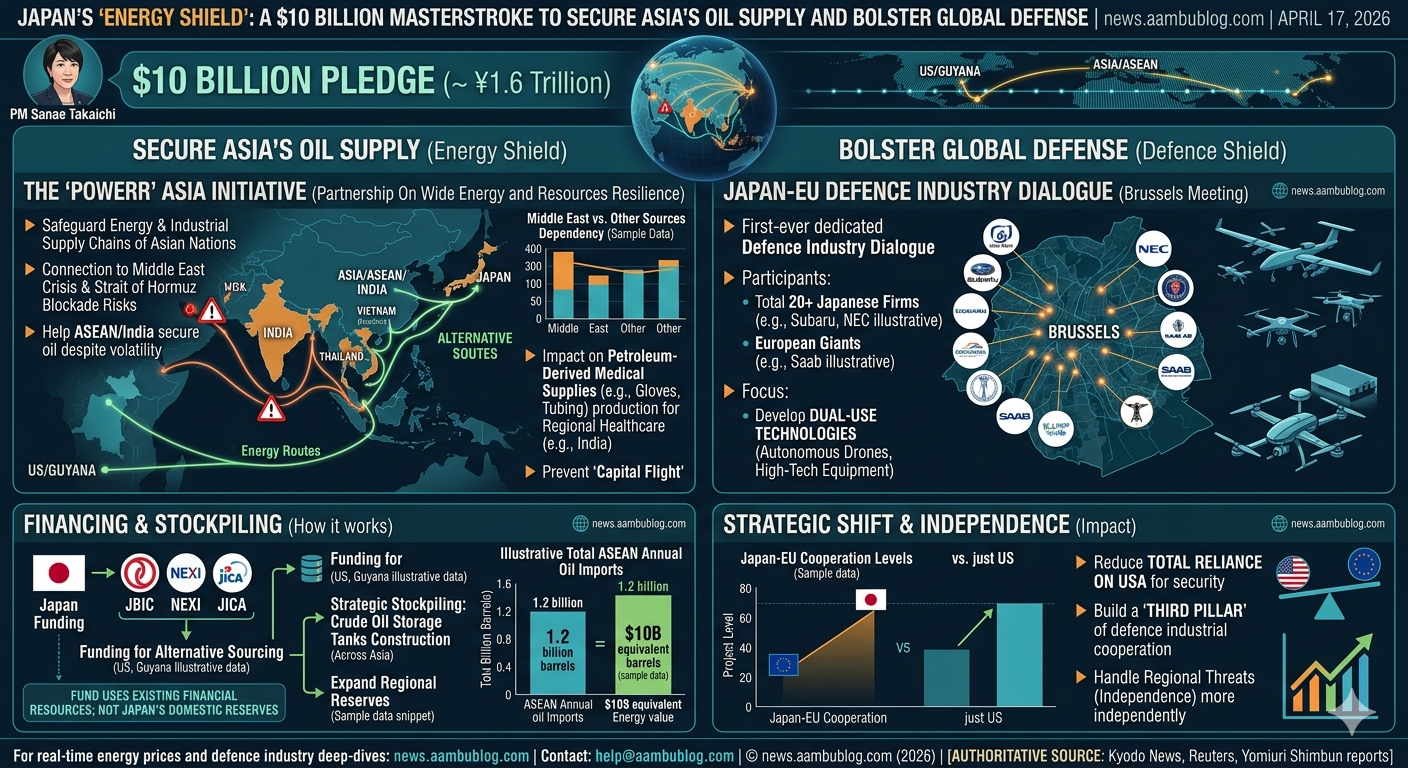
In an era of unprecedented geopolitical volatility, Japan has stepped up as a guardian of Asian economic stability. With the Middle East conflict threatening the world’s most critical energy corridors, Prime Minister Sanae Takaichi has unveiled a massive $10 billion (approx. ¥1.6 trillion) financial package to safeguard the energy and industrial supply chains of Asian nations.
1. The ‘POWERR’ Asia Initiative: A $10 Billion Safety Net
Unveiled following the Asia Zero-Emission Community (AZEC) Plus meeting, this initiative—often referred to as the Partnership On Wide Energy and Resources Resilience (POWERR)—is a direct response to the blockade risks in the Strait of Hormuz.
- The Goal: To help ASEAN nations and Asian partners secure crude oil and petroleum-derived products despite soaring prices and shipping disruptions.
- The Scale: The $10 billion fund is equivalent to roughly 1.2 billion barrels of oil, which matches the total annual crude oil imports of all ASEAN countries combined.
- Why now? Southeast Asian manufacturing hubs produce essential petroleum-derived medical supplies, including surgical gloves and dialysis tubing. A fuel shortage in Asia would directly paralyze Japan’s and India’s healthcare sectors.
2. Financing the Future: JBIC, NEXI, and JICA
Japan is not simply giving away cash; it is building a sophisticated financial infrastructure to support regional creditworthiness.
- Alternative Sourcing: The fund will help countries procure oil from non-Middle Eastern sources, such as the United States and Guyana.
- Strategic Stockpiling: A portion of the funds will be used to construct crude oil storage tanks and infrastructure across Asia to expand regional reserves.
- No Domestic Drain: PM Takaichi clarified that this fund uses existing financial resources and will not tap into Japan’s own domestic strategic reserves, ensuring Japan’s own 200-day safety net remains intact.
3. Japan-EU Defence Dialogue: A New Era of Security
While energy was the focus in Tokyo, defense took center stage in Brussels today. For the first time, Japan and the European Union held a dedicated Defence Industry Dialogue.
- The Participants: At least 20 major Japanese firms, including Subaru Corp. and NEC Corp., joined European giants like Saab AB.
- The Focus: Developing cutting-edge dual-use technologies, specifically focused on autonomous drones and high-tech defense equipment.
- The Significance: This move signals a shift away from a total reliance on the United States for security, with Japan and the EU building a “third pillar” of defense industrial cooperation to handle regional threats more independently.
4. Strategic Impact: A Win for India and ASEAN
For India and Southeast Asia, Japan’s move acts as a “buffer” against global inflation.
- Stable Prices: By providing loans and trade insurance, Japan is preventing a mass “capital flight” from Asian markets that often happens during oil shocks.
- Industrial Continuity: It ensures that factories in Vietnam, Thailand, and India continue to operate, protecting global trade from a secondary “supply chain heart attack.”
Quick FAQ: Japan’s Global Strategic Package
Q1. Is this package a loan or a gift?
It is primarily a financing framework consisting of low-interest loans, trade insurance (via NEXI), and infrastructure investments.
Q2. Which companies are leading the defense side?
On the Japanese side, Subaru (aviation/drones) and NEC (communications/cyber) are leading the charge in the Brussels dialogue.
Q3. Will this help India during the Middle East crisis?
Yes. By stabilizing the regional energy market, Japan is preventing a global “bidding war” for oil, which helps keep prices manageable for large importers like India.
For real-time energy prices and defense industry deep-dives: news.aambublog.com
Contact: help@aambublog.com