
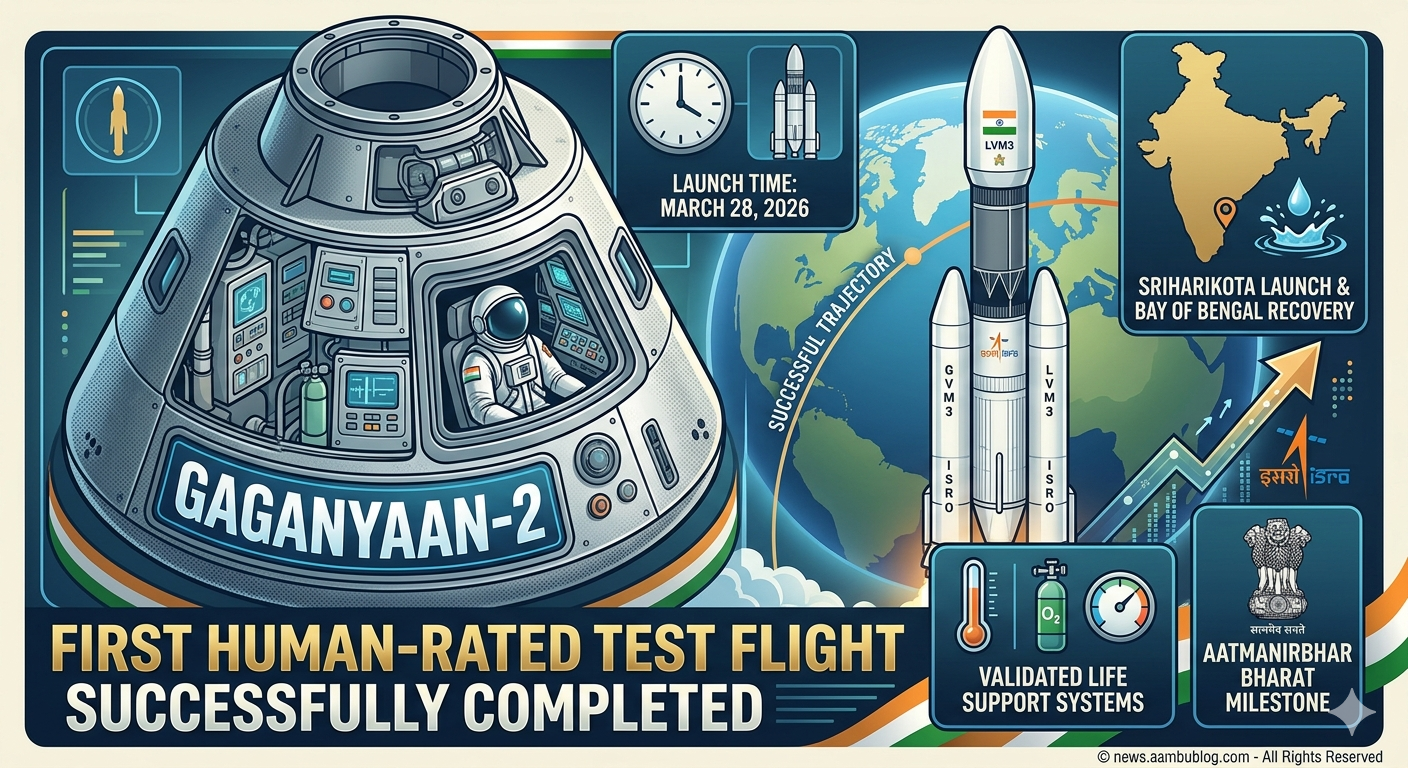
Bengaluru/Sriharikota (March 28, 2026): In a historical milestone for India’s space program, ISRO (Indian Space Research Organisation) has successfully completed the first human-rated test flight of the Gaganyaan-2 mission today. The test, conducted at the Satish Dhawan Space Centre in Sriharikota, marks a massive victory for the ‘Aatmanirbhar Bharat’ mission and moves India closer to launching its first fully indigenous manned spaceflight.
The ‘Human-Rated’ Test:
This was the first time an actual crew module, specially designed with life support systems and emergency protocols (human-rating), was launched using the LVM3 (Launch Vehicle Mark-3).
- Launch: The LVM3 rocket, a modified version of the trusted GSLV Mk III, lifted off flawlessly from the launch pad, carrying the dummy crew module into space.
- Separation: The module successfully separated and entered the defined low-Earth orbit, testing the launch escape system.
- Recovery: After a successful flight, the module safely splash-landed in the Bay of Bengal, where it was recovered by the Indian Navy.
Key Highlights of the Achievement:
- Life Support Systems: This test validated the crew safety, thermal protection, and life support systems required for astronauts.
- Aatmanirbhar Bharat: Every component, from the launch vehicle to the crew module, has been indigenous, pushing the limits of Indian engineering.
- Manned Mission: With this success, ISRO has announced it is now ready for the next phase, which will involve launched a fully operational unmanned test with a female-humanoid, followed by the actual manned mission (Gaganyaan-3).