
By Tech & Aerospace Desk | April 25, 2026
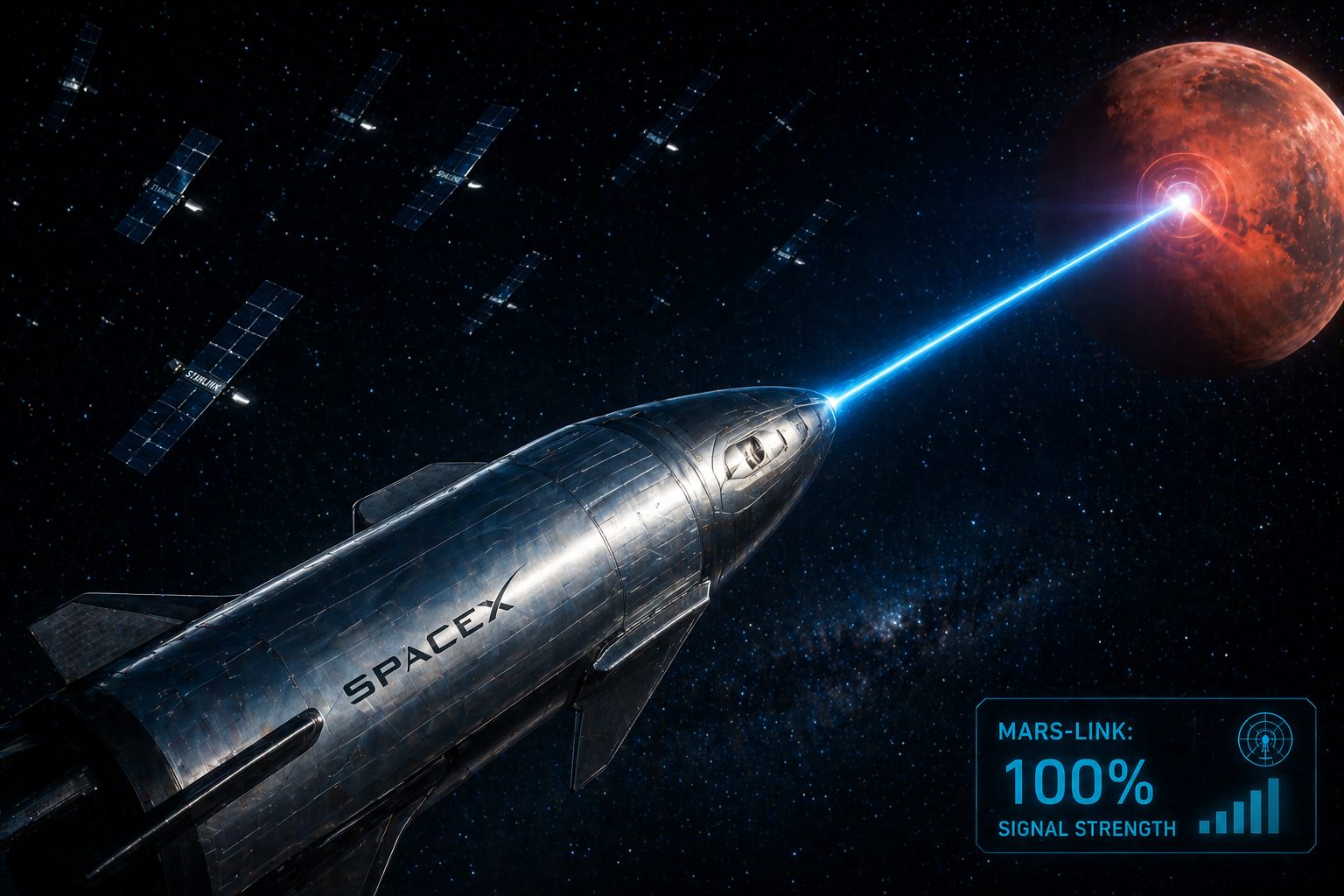
SpaceX has achieved a historic breakthrough in its quest to make humanity multi-planetary. During an orbital flight test early this morning from Starbase, Texas, the Starship spacecraft successfully demonstrated its new “Mars-Link” deep space communication system. This technology is designed to maintain high-speed data connectivity between Earth and Mars, overcoming the massive latency and distance barriers that have previously limited space exploration.
1. The ‘Laser-Link’ Breakthrough
The “Mars-Link” system utilizes advanced optical laser communication rather than traditional radio waves.
- Speed & Bandwidth: The test confirmed data transfer speeds of up to 10 Gbps over a simulated deep-space distance. This would allow for high-definition 4K video streaming from the surface of Mars to Earth.
- Reduced Latency: While the speed of light remains a physical limit, the efficiency of the laser-link ensures that the data packets are processed 80% faster than current NASA Deep Space Network protocols.
2. Reliability in Orbital Conditions
The Starship vehicle reached a peak altitude of 250 km, during which the Mars-Link hardware maintained a 100% stable connection with the Starlink satellite constellation.
- Autonomous Tracking: The onboard system used AI-driven mirrors to stay perfectly aligned with receiving satellites despite the high-speed vibrations of the spacecraft.
- Thermal Endurance: The communication array successfully operated through the intense heat of the spacecraft’s engine burns, proving its durability for long-term space travel.
3. Road to the 2029 Mars Mission
Elon Musk confirmed shortly after the test that this was the final major technical hurdle for the planned 2029 uncrewed Mars landing.
- Cargo First: The Mars-Link will be critical for the first wave of autonomous Starships that will carry life-support systems and fuel-generating factories to the Red Planet.
- Human-Ready: By the time the first humans arrive in the 2030s, Mars-Link is expected to provide a “Mars-wide” internet grid similar to Starlink on Earth.
Detailed Q&A: The Future of Space Communication
Q1. Why can’t we just use regular Wi-Fi or Radio in space? Radio waves “spread out” over vast distances, losing signal strength. At the distance of Mars (up to 400 million km), radio signals become extremely weak and slow. Laser-link communication uses a narrow, concentrated beam of light, which carries much more data and remains strong over millions of kilometers.
Q2. How long does it take for a message to reach Mars? Even with Mars-Link, physics dictates that light takes between 3 to 22 minutes to travel between Earth and Mars depending on their orbital positions. Mars-Link doesn’t make the signal faster than light, but it ensures that when the signal arrives, it contains massive amounts of data (like video) instead of just a few lines of text.
Q3. Does this have any use for people on Earth? Yes. The technology developed for Mars-Link will be integrated into the next generation of Starlink satellites, providing even faster internet speeds in remote areas of Earth and for transcontinental flights.
Q4. What is the next test for Starship? The next mission, scheduled for July 2026, will be a “Full Re-entry and Precision Landing” test, where SpaceX will attempt to land the Starship booster back on the launch tower using the “Mechazilla” arms.
Copyright: © news.aambublog.com (2026)