By News.AambuBlog.com | Global Markets | Updated: April 28, 2026
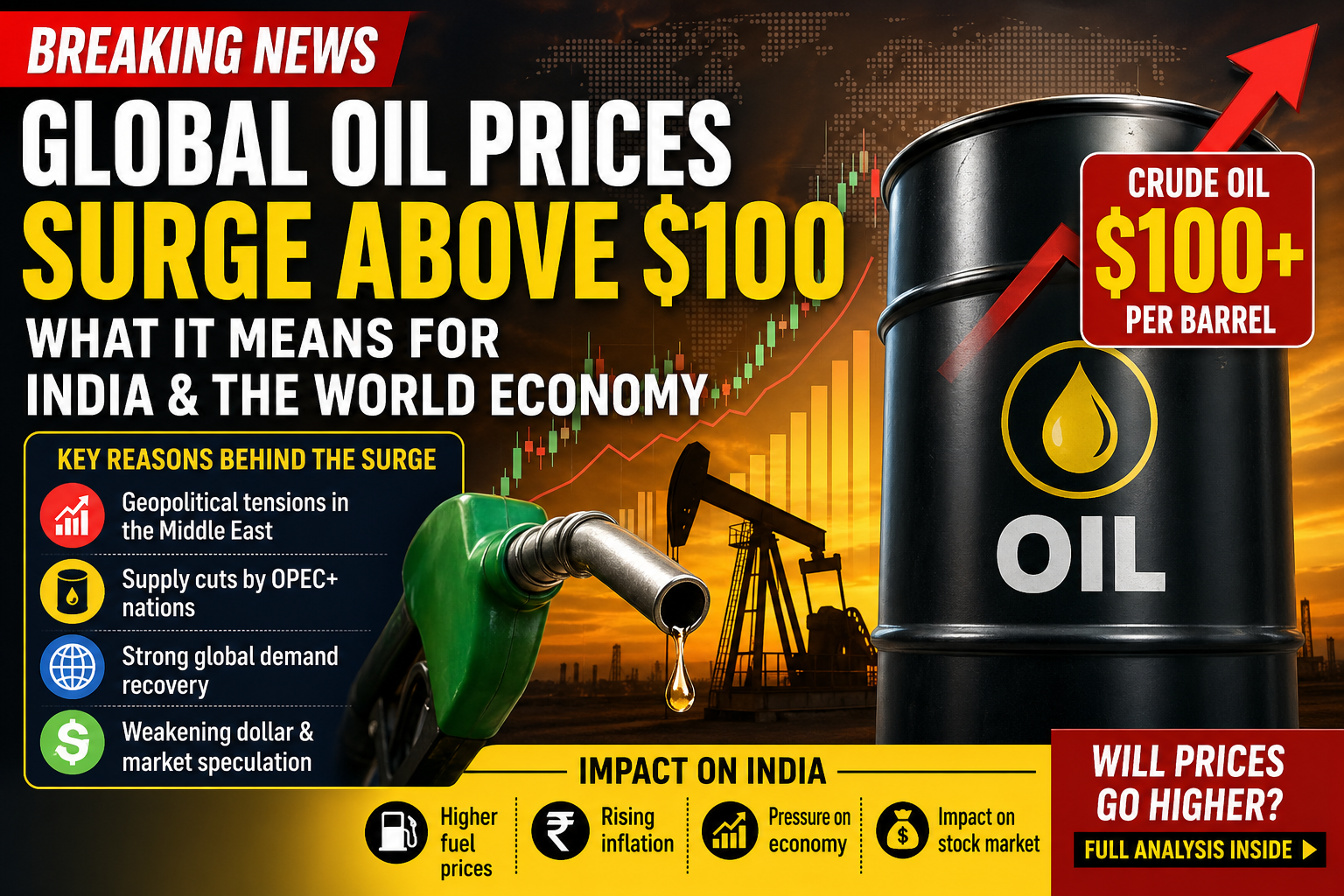
Global crude oil prices have surged past the critical $100 per barrel mark once again, sending shockwaves across international markets. The sudden spike is being driven by escalating geopolitical tensions in the Middle East, supply disruptions, and strong demand recovery from major economies.
Benchmark crude indices like Brent and WTI have witnessed sharp upward movement, raising concerns about inflation, fuel prices, and economic stability worldwide. For countries like India, which rely heavily on oil imports, the impact could be significant.
🌍 Why Are Oil Prices Rising?
The latest rally in oil prices is largely attributed to rising tensions in key oil-producing regions. Concerns over potential supply disruptions have triggered panic buying and speculative trading in global markets.
In addition, production cuts by major oil-exporting countries have tightened supply. The OPEC and its allies have maintained cautious output levels to stabilize prices, but recent developments have pushed prices higher.
Another key factor is the steady recovery in global demand, particularly from countries like China and India, where industrial and transportation activities have picked up.
🇮🇳 Impact on India: Rising Fuel Costs and Inflation
India imports more than 80% of its crude oil requirements, making it highly vulnerable to global price fluctuations. As prices rise, the cost of petrol, diesel, and LPG is expected to increase.
Higher fuel costs have a cascading effect on the economy:
- Transportation becomes expensive
- Prices of essential goods rise
- Inflationary pressure increases
This could affect household budgets and reduce consumer spending, slowing down economic growth.
📈 Stock Market Reaction
The surge in oil prices has already impacted stock markets. Energy stocks have gained, while sectors like aviation, logistics, and automobiles have come under pressure.
In India, companies heavily dependent on fuel costs are expected to face margin pressure. Meanwhile, oil exploration and production companies may benefit from higher prices.
Investors are closely monitoring the situation, as prolonged high oil prices could lead to increased volatility in global financial markets.
🏭 Industries Most Affected
Several industries are directly impacted by rising oil prices:
- Aviation: Fuel accounts for a major portion of operating costs
- Transport & Logistics: Increased freight charges
- Manufacturing: Higher input costs
- FMCG: Rising packaging and distribution expenses
Experts warn that if oil prices remain above $100 for an extended period, it could trigger a broader economic slowdown.
🌐 Global Economic Implications
The impact of rising oil prices is not limited to India. Countries around the world are facing similar challenges.
Higher energy costs can:
- Slow down economic growth
- Increase inflation globally
- Force central banks to maintain high interest rates
Developing economies are particularly vulnerable, as they have limited capacity to absorb such shocks.
🔄 Government Response and Policy Measures
Governments across the world are considering measures to manage the impact of rising oil prices.
In India, possible steps may include:
- Reducing fuel taxes
- Increasing subsidies
- Diversifying energy sources
The focus is also shifting towards renewable energy to reduce dependence on fossil fuels in the long term.
🔮 Future Outlook: Will Prices Go Higher?
Market analysts remain divided on the future trajectory of oil prices. Some believe that prices may stabilize if geopolitical tensions ease, while others warn of further increases if supply disruptions continue.
Factors to watch:
- Developments in the Middle East
- OPEC production decisions
- Global demand trends
- Currency fluctuations
🧾 Conclusion
The surge in global oil prices above $100 per barrel is a major development with far-reaching consequences. For India, it means higher fuel costs, rising inflation, and potential economic challenges.
As the situation evolves, governments, businesses, and consumers will need to adapt to changing market dynamics. The coming weeks will be crucial in determining whether this is a temporary spike or the beginning of a prolonged energy crisis.
❓ FAQs
1. Why have oil prices crossed $100 per barrel?
Due to geopolitical tensions, supply cuts by OPEC, and rising global demand.
2. How does this affect India?
India faces higher fuel costs, increased inflation, and economic pressure due to heavy oil imports.
3. Which sectors benefit from high oil prices?
Oil exploration and energy companies benefit, while aviation and transport sectors suffer.
4. Will oil prices continue to rise?
It depends on global events, especially geopolitical tensions and supply conditions.