In a significant move that signals a permanent shift in Europe’s security architecture, Germany’s leading defense contractor, Rheinmetall, has officially inaugurated its newest and largest munitions facility. This expansion is a direct response to the critical shortage of artillery shells across the continent and the changing geopolitical landscape in Eastern Europe.
1. The Unterluess Expansion: Scale and Capacity
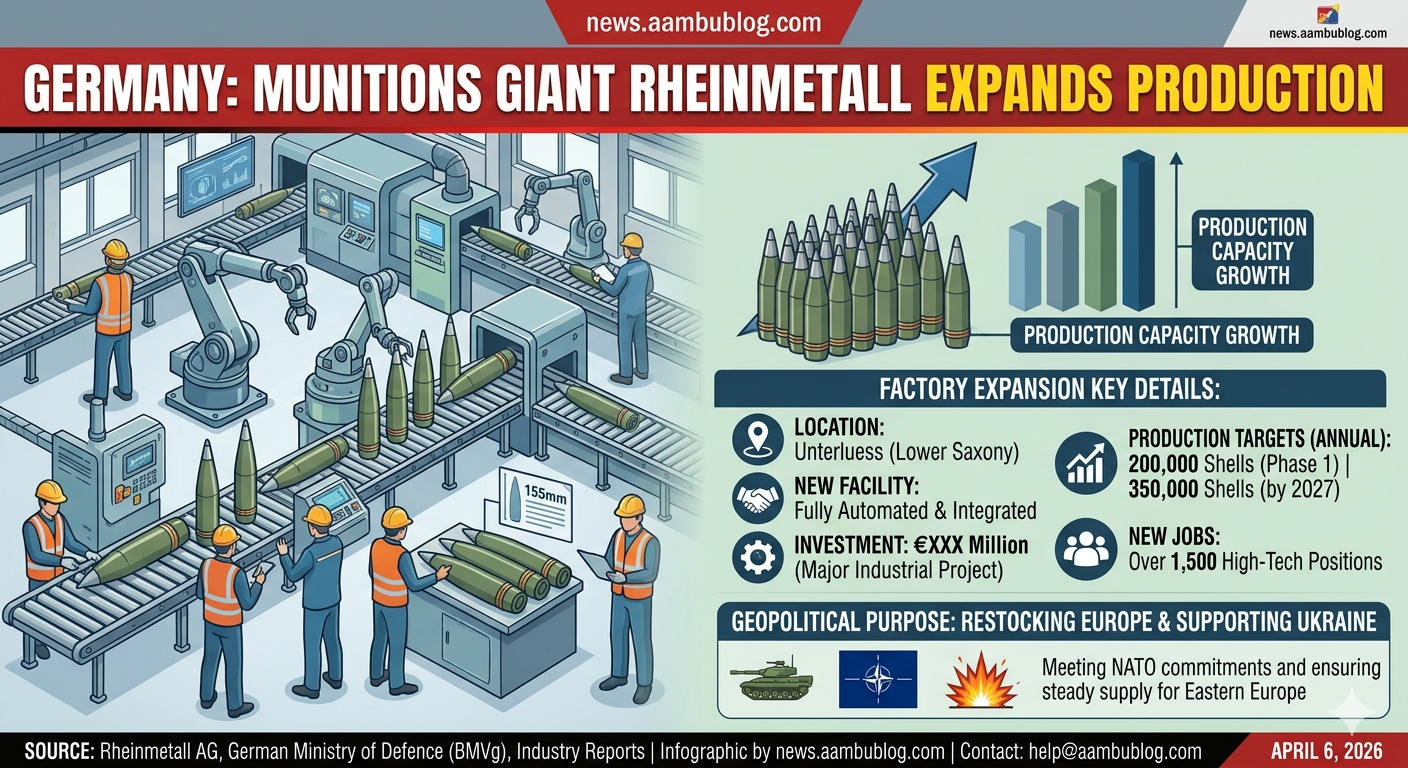
The new facility, located in the town of Unterluess, is set to become a cornerstone of European military production.
- Production Targets: The plant is designed to produce 200,000 artillery shells annually in its first phase, with a long-term goal of reaching 350,000 shells per year by 2027.
- Employment: The expansion is expected to create over 1,500 new high-tech jobs in the region, providing a significant boost to the local economy.
- Supply Chain: Rheinmetall is focusing on “Full-Cycle Production,” meaning the explosives, fuses, and metal casings will all be manufactured at a single site to avoid international supply delays.
2. From Automotive to Armaments: The German Industrial Shift
For decades, Germany’s economy was defined by its world-leading automotive industry. However, rising energy costs and global competition have forced a pivot.
- Factory Retooling: Several struggling automotive parts suppliers in the Ruhr and Saxony regions are now being retooled to produce military hardware and components for Rheinmetall and Krauss-Maffei Wegmann.
- Defense Budget: Germany’s “Zeitenwende” (Turning Point) policy has seen the defense budget rise to 2% of GDP, creating a massive domestic market for these companies.
3. Geopolitical Necessity: Restocking Europe
The move comes at a time when European stockpiles have reached “critically low” levels.
- Ukraine Support: A large portion of the new production is earmarked for long-term support to Ukraine, ensuring a steady supply of NATO-standard 155mm ammunition.
- NATO Readiness: The expansion allows Germany to meet its NATO commitments, which require members to maintain 30 days of ammunition supply for high-intensity conflict.
4. Economic Impact: The New “Military-Industrial Complex”
While the expansion is driven by security needs, the economic implications are profound.
- Stock Growth: Rheinmetall’s stock price has surged by over 400% since early 2024, making it one of the most valuable companies on the DAX.
- Export Potential: Germany is positioning itself as the primary “Arsenal of Democracy” for the European Union, with export orders already coming in from Poland, the Baltic States, and Scandinavia.
Frequently Asked Questions (FAQ)
Q1. What does Rheinmetall produce?
Rheinmetall is a German automotive and arms manufacturer. They are best known for producing the smoothbore gun of the Leopard 2 tank and various calibers of artillery and air defense systems.
Q2. Why is there a shortage of 155mm shells?
The conflict in Ukraine has seen a rate of artillery usage not seen since World War II. Current European production lines were built for peacetime and cannot keep up with the daily demand of thousands of rounds.
Q3. Is Germany becoming a military power again?
While Germany remains a democracy with strong civilian oversight, the current government has made it clear that “Hard Power” is once again a necessary tool for maintaining European peace and stability.