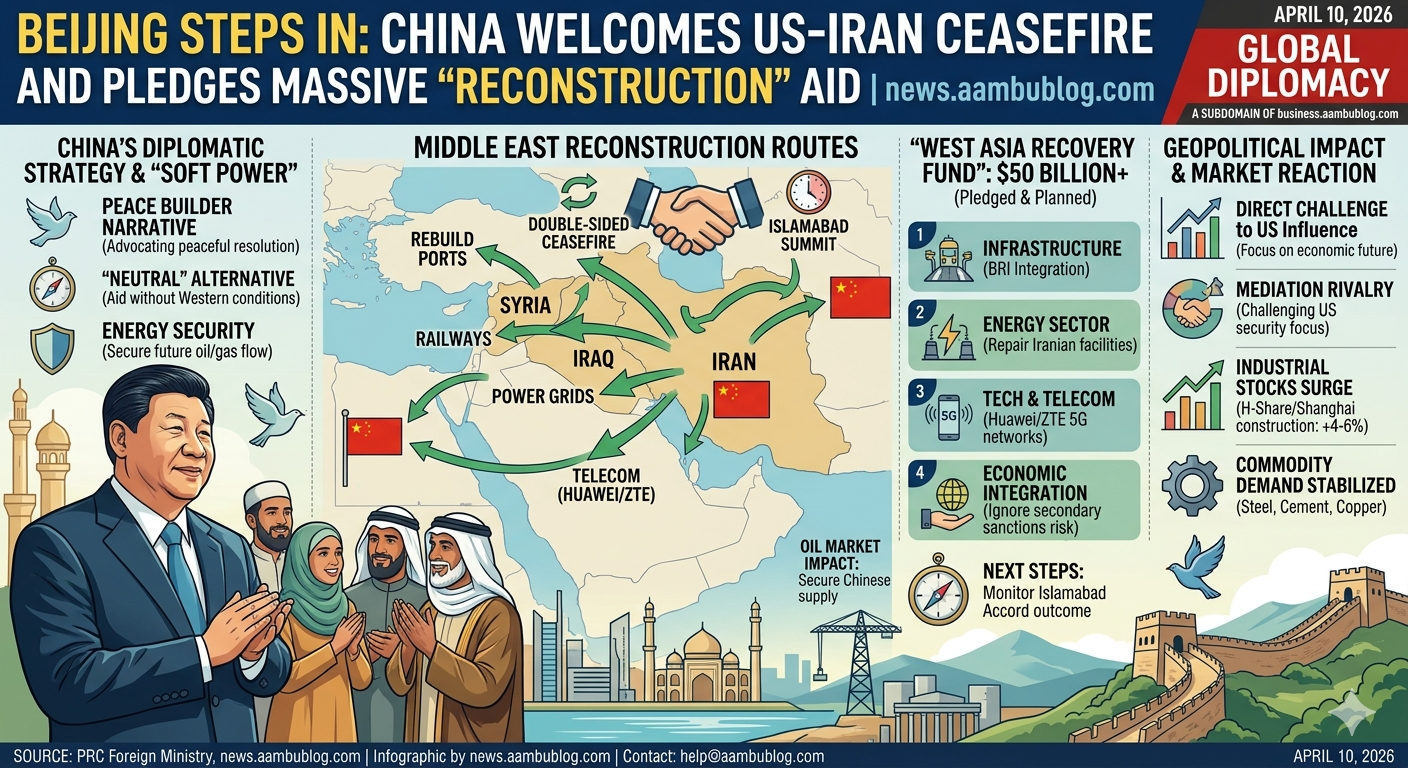
As the 14-day ceasefire between the United States and Iran takes hold, the People’s Republic of China (PRC) has made a major move to secure its influence in the region. Today, April 10, 2026, the Chinese Foreign Ministry officially welcomed the “strategic pause” and announced a comprehensive reconstruction aid package for war-torn areas in West Asia.
1. The “Peace Builder” Narrative
China’s Foreign Ministry spokesperson stated that Beijing has been “consistently advocating for a peaceful resolution” and hailed the Islamabad Summit as a victory for diplomacy.
- The Belt and Road Integration: Beijing has proposed integrating reconstruction efforts into its Belt and Road Initiative (BRI), offering to rebuild critical infrastructure such as ports, railways, and power grids that were damaged during the recent conflict.
- Diplomatic Strategy: By offering aid without the political conditions often attached by Western nations, China is positioning itself as a “neutral” alternative for Middle Eastern countries seeking to rebuild.
2. The Reconstruction Fund: Billions on the Table
While exact figures have not been released, sources in Beijing suggest the “West Asia Recovery Fund” could exceed $50 Billion.
- Energy Security: China’s primary interest remains the stability of its energy supply. Rebuilding Iranian and regional infrastructure ensures that oil and gas can flow smoothly toward Chinese markets.
- Tech and Telecom: The aid package is expected to include heavy involvement from Chinese tech giants like Huawei and ZTE to rebuild the digital infrastructure and 5G networks in the region.
3. The Geopolitical Chessboard
China’s offer is seen by many analysts as a direct challenge to US influence.
- The “Soft Power” Play: While the US focuses on the “security” aspect and sanctions relief in Islamabad, China is focusing on the “economic” future.
- Mediation Rivalry: After successfully brokering the Saudi-Iran deal in the past, Beijing wants to show that it remains the most reliable economic partner for Tehran, regardless of the outcome of US negotiations.
4. Impact on Global Markets
The announcement has already had a ripple effect:
- Industrial Stocks Surge: Shares of major Chinese construction and engineering firms listed in Hong Kong and Shanghai rose by 4-6% following the news.
- Commodity Demand: Anticipation of a massive reconstruction boom has stabilized global prices for steel, cement, and copper, which had previously dipped due to war-related uncertainty.
Frequently Asked Questions (FAQ)
Q1. Why is China offering aid to Iran?
China is Iran’s largest trading partner. A stable and rebuilt Iran is essential for China’s long-term energy security and the success of its Belt and Road trade routes.
Q2. Will this aid conflict with US Sanctions?
This is a major point of tension. If the US-Iran peace talks in Islamabad fail, any Chinese aid could be subject to “secondary sanctions” by the Trump administration. However, Beijing often ignores these sanctions in favor of its own strategic interests.
Q3. How does this affect India?
India is also a major player in Middle East reconstruction (specifically via the Chabahar Port). A massive Chinese entry could create competition for Indian infrastructure firms looking to secure contracts in the region.
For more on Global Power Shifts: help@aambublog.com