By Global Strategic Desk | April 20, 2026
In a monumental shift that is reshaping the security architecture of the Indo-Pacific, Japan has officially sealed its largest-ever defense export contract. Prime Minister Sanae Takaichi’s administration has finalized an agreement to sell state-of-the-art naval frigates to Australia, marking Japan’s most significant arms opening since the end of World War II.
This historic deal comes at a time when global alliances are being tested by geopolitical volatility and shifting power dynamics in Washington.
1. The Mega Deal: Breaking the Post-WWII Taboo
For decades, Japan operated under a strict pacifist constitution that heavily restricted the export of lethal military equipment. This new contract shatters that glass ceiling.
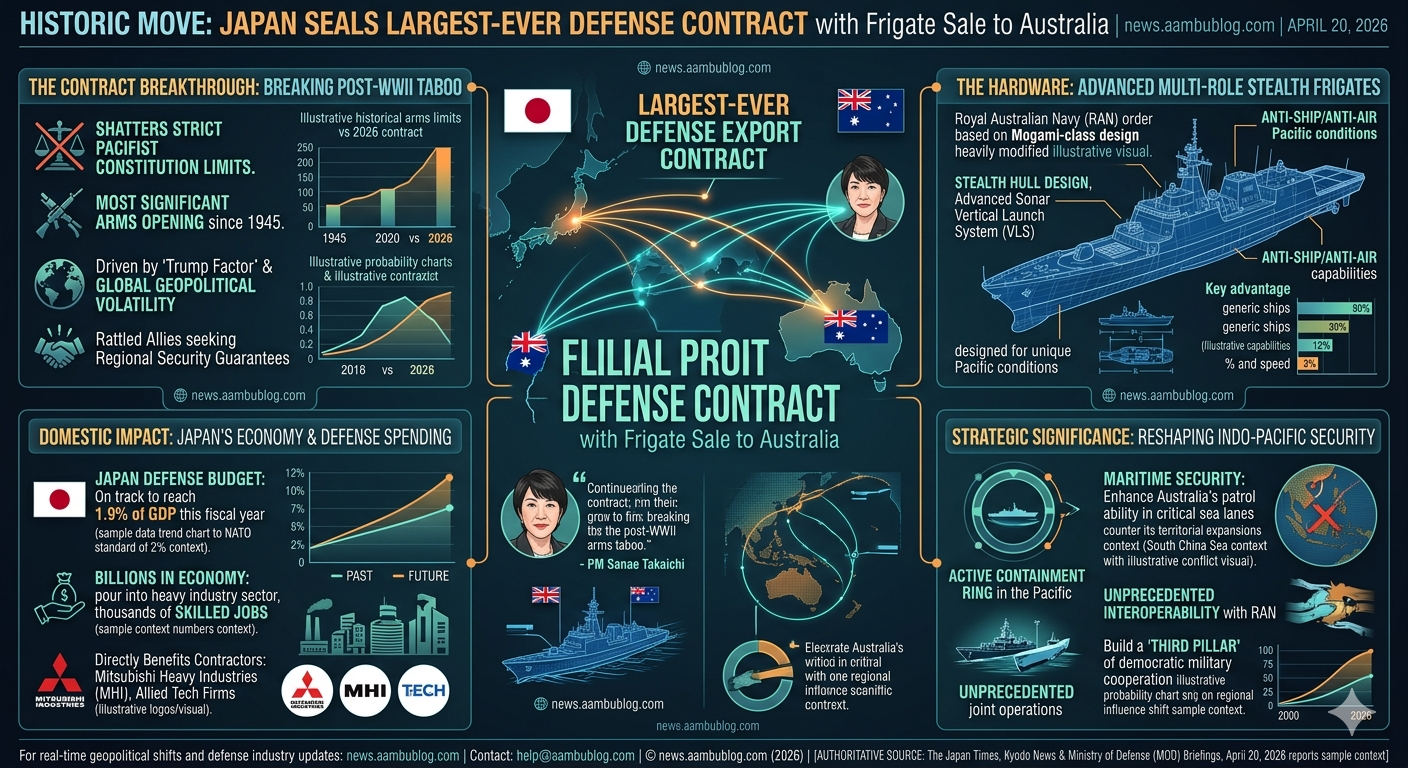
- The Hardware: Japan will supply the Royal Australian Navy with advanced, multi-role stealth frigates, heavily modified from the highly capable Mogami-class design currently used by the Japanese Maritime Self-Defense Force (JMSDF).
- The Scale: While the exact dollar figure remains classified, military analysts confirm it is the largest single defense export package in Japanese history, easily surpassing previous radar and non-lethal equipment sales to the Philippines and India.
2. Why Now? The “Trump Factor” and Global Uncertainty
This sudden acceleration in Japan’s defense posture isn’t happening in a vacuum. It is heavily driven by the current political climate in the United States.
- Rattled Allies: With U.S. President Donald Trump’s “unpredictability” and his focus on the ongoing U.S.-Iran conflict, traditional allies are looking for regional security guarantees.
- A New Defense Hub: Countries like Australia and the U.K. are increasingly viewing Japan as a reliable, high-tech alternative to American defense manufacturing, creating a “third pillar” of democratic military cooperation in the Indo-Pacific.
3. A Major Boost for Japan’s Economy and Spending
This export deal aligns perfectly with Japan’s internal military expansion goals.
- 1.9% of GDP: Reports confirmed today that Japan’s domestic defense spending is on track to reach an unprecedented 1.9% of its GDP this fiscal year, moving aggressively toward the NATO standard of 2%.
- Economic Ripple Effect: The frigate contract will pour billions into Japan’s heavy industry sector, directly benefiting major defense contractors like Mitsubishi Heavy Industries (MHI) and bringing thousands of highly skilled manufacturing jobs.
4. Strategic Impact on the Indo-Pacific
By arming Australia, Japan is actively helping to build a “containment ring” in the Pacific.
- Maritime Security: These advanced frigates will enhance Australia’s ability to patrol critical sea lanes and counter aggressive territorial expansions in the South China Sea and beyond.
- Interoperability: Because both the Australian and Japanese navies will be using similar underlying technology, their ability to conduct joint operations seamlessly will be significantly upgraded.
Detailed Q&A: Understanding Japan’s Arms Opening
Q1. Doesn’t Japan’s constitution ban the sale of weapons?
Historically, yes. However, over the past decade, Japan has been slowly easing its “Three Principles on Arms Exports.” The government recently revised these guidelines to allow the export of lethal equipment—like ships and jets—if they are co-developed with partners or if the export directly contributes to Japan’s national security.
Q2. Why did Australia choose Japanese ships over American or European ones?
Japan’s shipyards are known for delivering on time and on budget, a crucial factor as Western defense industries are currently backlogged supplying weapons to ongoing conflicts in Europe and West Asia. Additionally, the Japanese frigates are specifically designed for the Pacific theater’s unique maritime conditions.
Q3. How will this affect Japan’s relations with China and North Korea?
It will undoubtedly raise tensions. Beijing regularly criticizes Japan’s military normalization. Just yesterday, North Korea fired a flurry of ballistic missiles toward the Sea of Japan, which PM Takaichi confirmed fell outside Japan’s EEZ. Japan’s arms exports will likely be used by Pyongyang and Beijing to justify their own military buildups.
Fact Sheet: Japan’s Defense Shift (2026)
| Feature | Details |
|---|---|
| Milestone | Largest-ever defense export contract |
| Recipient | Royal Australian Navy |
| Equipment | Advanced Stealth Frigates (Mogami-class variants) |
| Japan Defense Budget | Reaching 1.9% of GDP this fiscal year |
| Primary Contractors | Mitsubishi Heavy Industries (MHI) & allied tech firms |
For real-time geopolitical shifts and defense industry updates: news.aambublog.com
Contact: help@aambublog.com