
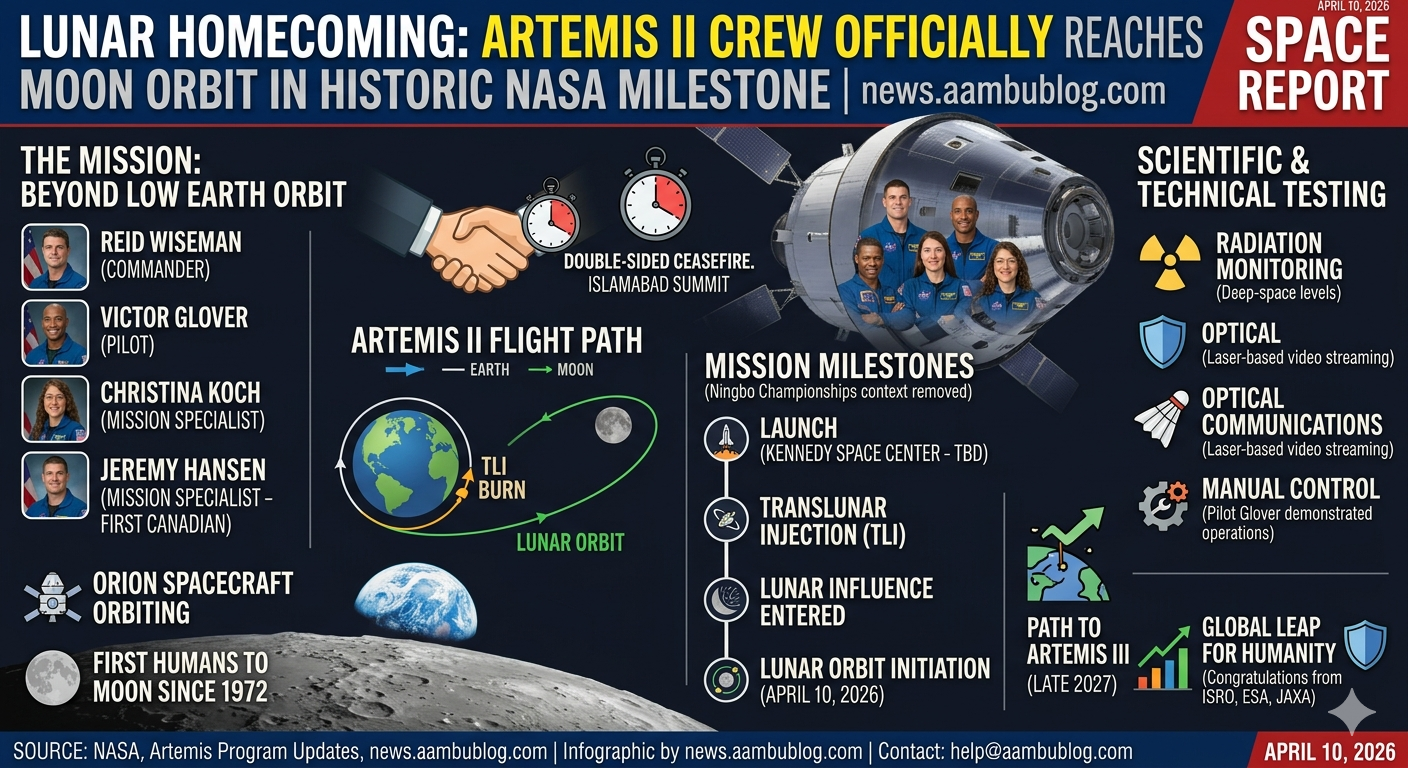
In a moment that has redefined the 21st-century space race, NASA’s Artemis II crew has officially reached lunar orbit today, April 10, 2026. This marks the first time humans have ventured to the Moon since the Apollo 17 mission in 1972. The four-member crew, aboard the Orion spacecraft, is currently performing critical system checks as they circle the lunar surface, preparing the way for future landings.
1. The Mission: Beyond Low Earth Orbit
The Artemis II mission is the first crewed test flight of the Space Launch System (SLS) rocket and the Orion spacecraft.
- The Crew: The mission is commanded by Reid Wiseman, with Victor Glover as pilot, and mission specialists Christina Koch and Jeremy Hansen (the first Canadian to reach the Moon).
- The Objective: Unlike Apollo missions that landed immediately, Artemis II is a “flyby” and orbital mission designed to test the life-support systems, communication arrays, and heat shields needed for deep-space travel.
2. Entering the Lunar Influence
Reaching the Moon’s gravity required a series of complex engine burns.
- The TLI Burn: After launching from Kennedy Space Center, the crew performed a Translunar Injection (TLI) burn, propelling them out of Earth’s orbit at speeds exceeding 24,500 mph.
- The Far Side: During their orbit, the crew will travel approximately 6,400 miles beyond the far side of the Moon. During this time, they will experience a temporary “blackout” in communication with Earth, a standard but tense part of lunar missions.
3. Scientific and Technical Testing
While the world watches for the photos, the crew is working around the clock:
- Radiation Monitoring: New sensors are measuring the deep-space radiation levels to protect future crews who will stay on the Moon for months at a time.
- Optical Communications: NASA is testing a new laser-based communication system that allows for high-definition video streaming from the Moon back to Earth.
- Manual Control: Pilot Victor Glover successfully performed manual proximity operations, demonstrating that humans can take control of the Orion capsule if automated systems fail.
4. Why This Matters: The Path to Artemis III
Artemis II is the final “rehearsal” before Artemis III, which is scheduled for late 2027.
- The Next Step: Artemis III will see the first woman and the next man actually step foot on the lunar South Pole.
- The Gateway: Data from today’s orbit will be used to finalize the positioning of the Lunar Gateway, a future space station that will serve as a hub for Moon and Mars missions.
5. Global Reaction: A Shared Human Achievement
The world has been captivated by the high-definition “Earthrise” photos sent back by the crew today. Leaders from India (ISRO), Europe (ESA), and Japan (JAXA) have sent congratulations, highlighting that while this is a NASA-led mission, it represents a global leap for humanity.
Frequently Asked Questions (FAQ)
Q1. Are the Artemis II astronauts landing on the Moon?
No. This is an orbital mission. They will circle the Moon and return to Earth to test all systems. The actual landing will happen during the Artemis III mission.
Q2. How long will the crew stay in lunar orbit?
The crew will spend approximately 24 to 48 hours in the lunar vicinity before performing the return burn to head back to Earth for a splashdown in the Pacific Ocean.
Q3. Can I see the Orion spacecraft from Earth?
While you cannot see the capsule with the naked eye, NASA’s “Artemis Real-time Orbit Retrogression” (AROW) website allows you to track its exact position in real-time.
For more Space & Science breakthroughs: help@aambublog.com