By Global Strategy Desk | April 16, 2026
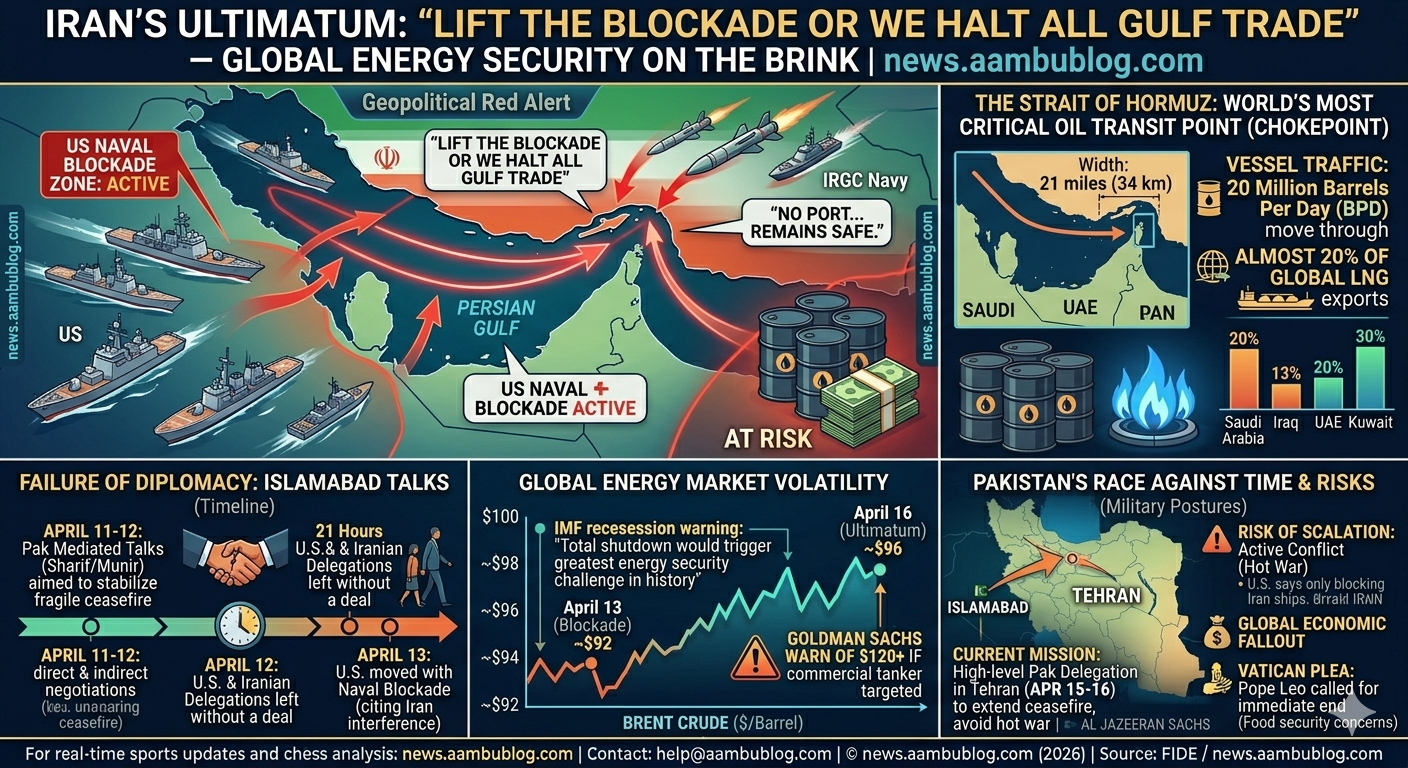
The geopolitical tension in West Asia has reached a point of no return. Following the U.S. Naval Blockade on Iranian ports that began on April 13, Tehran has issued its most severe ultimatum yet. Iran’s joint military command declared today that if the blockade is not lifted immediately, they will ensure that “no port in the Persian Gulf or the Arabian Sea remains safe,” effectively threatening to halt all global trade passing through the region.
1. The Ultimatum: A Direct Threat to Global Shipping
Iran’s statement comes as a direct response to President Donald Trump’s order to block all vessels entering or exiting Iranian waters.
- Tehran’s Stand: Iran has termed the U.S. blockade as “maritime piracy” and “illegal under international law.”
- The Threat: The Iranian Army stated that if their own oil exports are stopped, they will use their strategic position to block the Strait of Hormuz, through which nearly 20% of the world’s total oil consumption passes daily.
2. The Failure of the Islamabad Peace Talks
This escalation follows the collapse of the Islamabad Talks held on April 11-12.
- The Mediation: Brokered by Pakistan’s Prime Minister Shehbaz Sharif and Army Chief Asim Munir, the talks aimed to stabilize a fragile ceasefire.
- The Result: After 21 hours of intense direct and indirect negotiations, the U.S. and Iranian delegations left without a deal. The U.S. immediately moved forward with the blockade, citing Iran’s continued “interference” in regional shipping.
3. Strategic Impact: The Strait of Hormuz Chokepoint
The Strait of Hormuz is a narrow waterway separating the Arabian Peninsula from Iran. It is the only sea passage from the Persian Gulf to the open ocean.
- Oil & LNG at Risk: Roughly 20 million barrels of oil per day move through this 21-mile-wide passage. Additionally, almost 20% of global Liquefied Natural Gas (LNG) exports from Qatar and the UAE are now at risk of being stranded.
- Economic Fallout: Following Iran’s ultimatum, Brent Crude prices have seen extreme volatility, currently hovering around $95 – $96 per barrel, with analysts at Goldman Sachs warning it could cross $120 if a single commercial tanker is targeted.
4. Mediation Efforts: Pakistan’s Race Against Time
Pakistan remains the only bridge between the two nuclear-armed rivals.
- Current Mission: A high-level Pakistani delegation is currently in Tehran (as of April 15-16) to convince the Iranian leadership to extend the ceasefire and avoid a “hot war.”
- The Obstacle: The U.S. Central Command (CENTCOM) has clarified that while they will block ships to/from Iran, they will not impede other trade. However, Iran argues that any military presence near the Strait is a breach of their sovereignty.
5. Global Reaction: The Vatican and IMF Warn of Crisis
- IMF Warning: The International Monetary Fund has warned that a total shutdown of the Gulf trade would trigger the “greatest energy security challenge in history,” potentially leading to a global recession.
- The Vatican’s Plea: Pope Leo has called for an immediate end to the blockade, citing concerns over food security in developing nations that rely on stable energy prices.
Quick FAQ: The Gulf Blockade Crisis
Q1. What is a naval blockade?
A naval blockade is a military effort to cut off all maritime trade and supplies from reaching a specific country’s ports. The U.S. blockade currently targets only Iranian ports.
Q2. Why is the Strait of Hormuz so important?
It is the world’s most critical oil transit point. Most of the oil from Saudi Arabia, Iraq, Kuwait, and the UAE must pass through this narrow strait to reach global markets.
Q3. Will this lead to a world war?
While both sides are using extreme rhetoric, active mediation by Pakistan and pressure from the UN are currently the only factors preventing a full-scale military conflict.
For real-time geopolitical alerts and energy market data: news.aambublog.com
Contact: help@aambublog.com