Date: March 29, 2026
Category: Economy / Trade / India News
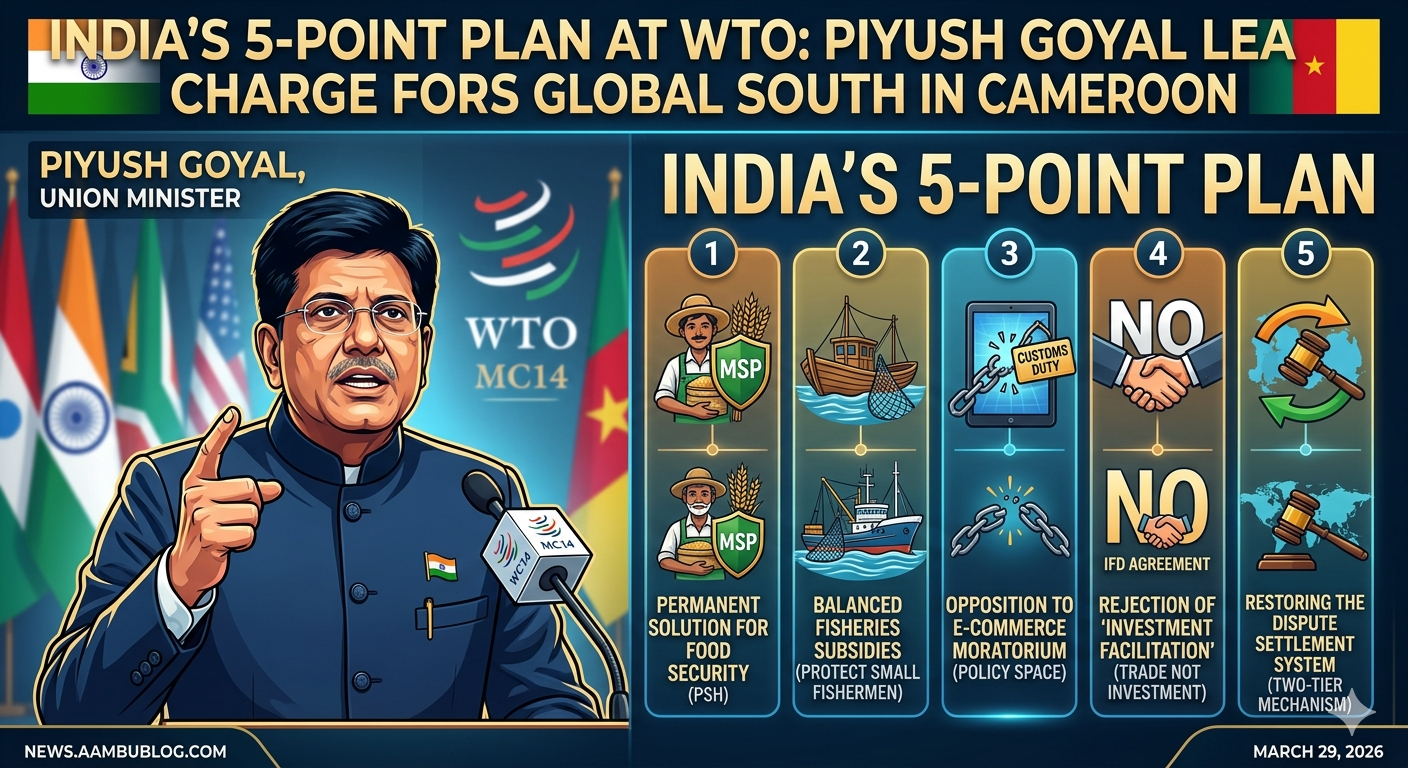
As the 14th Ministerial Conference (MC14) of the World Trade Organization (WTO) continues in Yaoundé, Cameroon, India has emerged as the strongest voice for developing nations. Union Minister Piyush Goyal presented a strategic “5-Point Plan” to ensure that global trade rules remain fair, inclusive, and protective of the common man’s interests.
1. Permanent Solution for Food Security (PSH)
India’s top priority is securing a permanent solution for Public Stockholding (PSH).
- The Issue: Current WTO rules limit agricultural subsidies to 10% of production value.
- India’s Stand: India demands that its Minimum Support Price (MSP) and food grain storage programs (which feed 80 crore people) should be protected from global legal challenges. Food security is a “non-negotiable” right for India.
2. Balanced Fisheries Subsidies
India is pushing for a “people-centric” approach to fisheries governance.
- The Demand: Large-scale industrial fishing nations (developed countries) should take more responsibility for overfishing.
- Protection: India wants to ensure that subsidies for its 9 million small-scale and traditional fishermen are not touched, as they depend on the sea for survival, not for commercial profit.
3. Opposition to E-Commerce Moratorium
Since 1998, there has been a ban on imposing customs duties on digital transmissions (e-books, software, streaming).
- The Conflict: Developed nations want to make this ban permanent.
- India’s View: India, along with South Africa and Indonesia, opposes this. Minister Goyal argued that developing countries need “policy space” and revenue from the digital economy to fund their own tech growth.
4. Rejection of ‘Investment Facilitation’ (IFD) as a WTO Rule
A China-led group is pushing to include an Investment Facilitation for Development (IFD) agreement into the WTO.
- India’s Move: India has blocked this, stating that the WTO is a Trade body, not an Investment body.
- The Logic: India believes such “plurilateral” deals (deals between some members) undermine the “multilateral” nature where every country has an equal vote.
5. Restoring the Dispute Settlement System
The WTO’s “Supreme Court” (Appellate Body) has been paralyzed for years because the US blocked the appointment of judges.
- The Goal: India is leading the call to restore a fully functional, two-tier dispute settlement mechanism by the end of 2026. Without this, trade rules cannot be enforced fairly.
📊 Editor’s Note: Why This Matters for You?
Trade War vs. Common Man: India’s stance at the WTO directly affects the price of the food you eat and the tech services you use. By fighting for the “Global South,” India is ensuring that big western corporations don’t monopolize the digital and agricultural markets. If India wins on the E-commerce front, we might see new taxes on global digital giants, but more support for “Make in India” startups.