
By Economy & Markets Desk | April 25, 2026
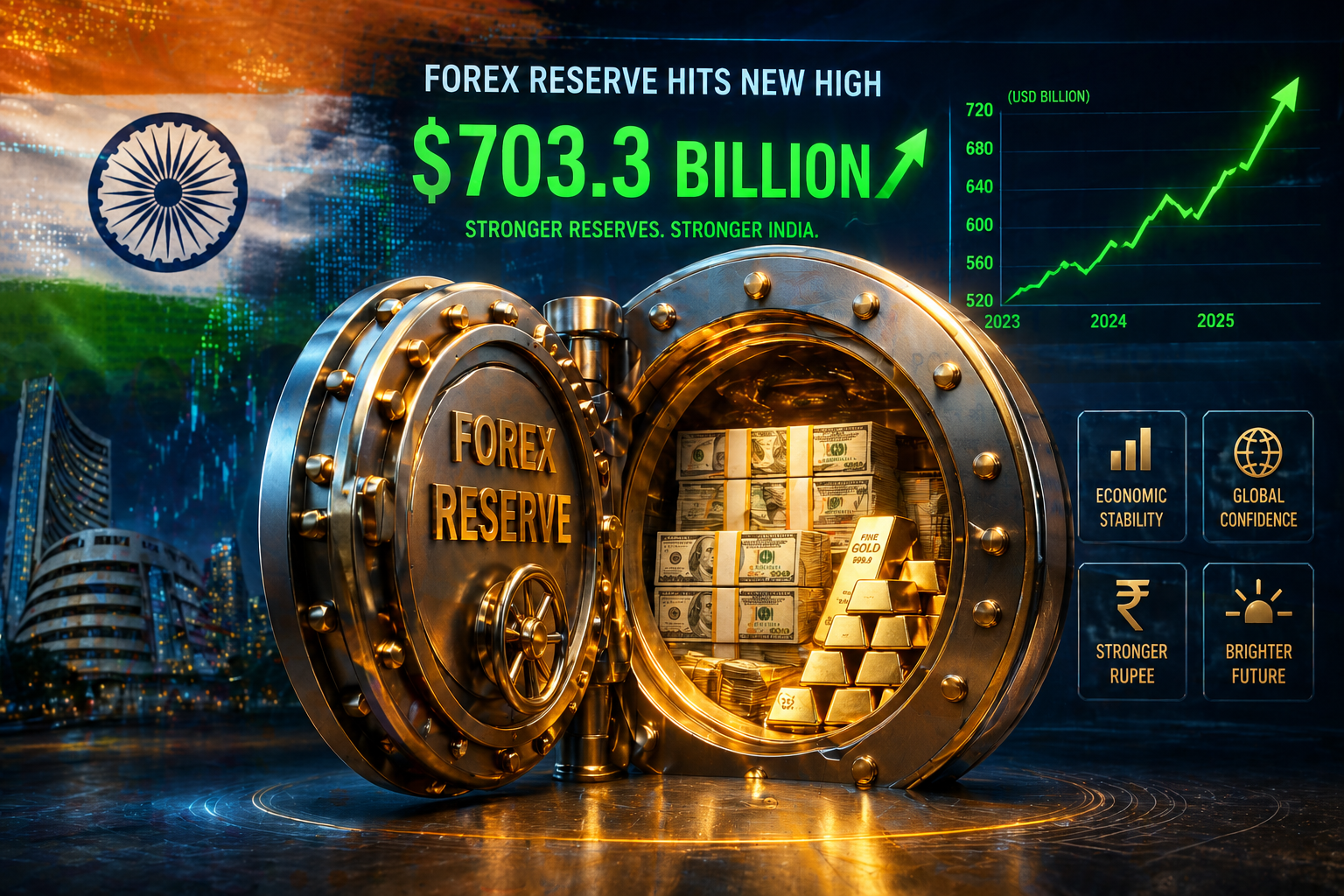
In a significant show of economic resilience, India’s foreign exchange (Forex) reserves have officially crossed the $703$ Billion mark. According to the latest weekly bulletin released by the Reserve Bank of India (RBI) on Friday evening, the reserves jumped by $2.362$ Billion to reach a total of $703.308$ Billion for the week ended April 17, 2026.
This marks the third consecutive week of growth, providing the RBI with massive “firepower” to defend the Indian Rupee against the ongoing geopolitical tensions in the Middle East.
1. What’s Driving the Surge?
The increase is largely attributed to a rise in Foreign Currency Assets (FCA), which are the largest component of the reserves.
- FCA Growth: The FCA increased by $1.481$ Billion, reaching $557.463$ Billion. These assets are influenced by the appreciation or depreciation of non-US units like the Euro, Pound, and Yen held in the reserves.
- Gold Reserves: As global uncertainty rises, gold has become a safe haven. India’s gold reserves also saw an uptick of $790$ Million, now standing at $122.133$ Billion.
2. Why $703$ Billion is a “Magic Number”
Crossing the $700$ Billion mark for the second time this year (after hitting an all-time high of $728$ Billion in February) is crucial for several reasons:
- Import Cover: India now has enough reserves to cover its entire import bill for nearly 12-14 months, ensuring that even if oil prices skyrocket due to the Hormuz crisis, the country can continue to function smoothly.
- Currency Stability: With such a huge “kitty,” the RBI can easily intervene in the market to stop the Rupee from falling too sharply against the Dollar, protecting Indian businesses from “imported inflation.”
3. RBI’s Strategic Intervention
Market experts believe the RBI has been a net buyer of Dollars in the spot market while also managing liquidity through forward contracts. This dual strategy helps keep the Rupee stable between the 85.50 and 86.20 range, despite the high-tension geopolitical atmosphere.
Detailed Q&A: India’s Forex Power
Q1. What exactly makes up India’s Forex Reserves?
India’s reserves consist of four main parts: Foreign Currency Assets (FCA), Gold, Special Drawing Rights (SDRs) with the IMF, and India’s Reserve Position with the IMF. FCA is the biggest part, making up about 80% of the total.
Q2. Does a higher Forex reserve mean the Rupee will get stronger?
Not necessarily, but it prevents the Rupee from getting weaker too fast. The RBI uses these dollars to “balance” the demand and supply in the market. A high reserve gives global investors confidence that India won’t run out of money to pay its debts.
Q3. How does this help the common man?
Indirectly, it keeps your life stable. High reserves mean the government doesn’t have to worry about an “economic crash” like Sri Lanka or Pakistan faced. It ensures that prices of essential imports (like crude oil and electronics) don’t spiral out of control due to a falling currency.
Q4. Is India the world leader in Forex reserves?
India currently ranks as the 4th or 5th largest holder of foreign exchange reserves globally, trailing only behind China, Japan, and Switzerland. This puts India in an elite league of financially secure nations.
Copyright: © news.aambublog.com (2026)