As the world’s second-largest economy enters the second quarter of 2026, China is navigating a delicate balance between cooling domestic demand and a massive surge in high-tech manufacturing. For India, the news is particularly striking as a decade-old border chill begins to melt through renewed trade.
1. The “Himalayan Thaw”: Border Trade Resumes
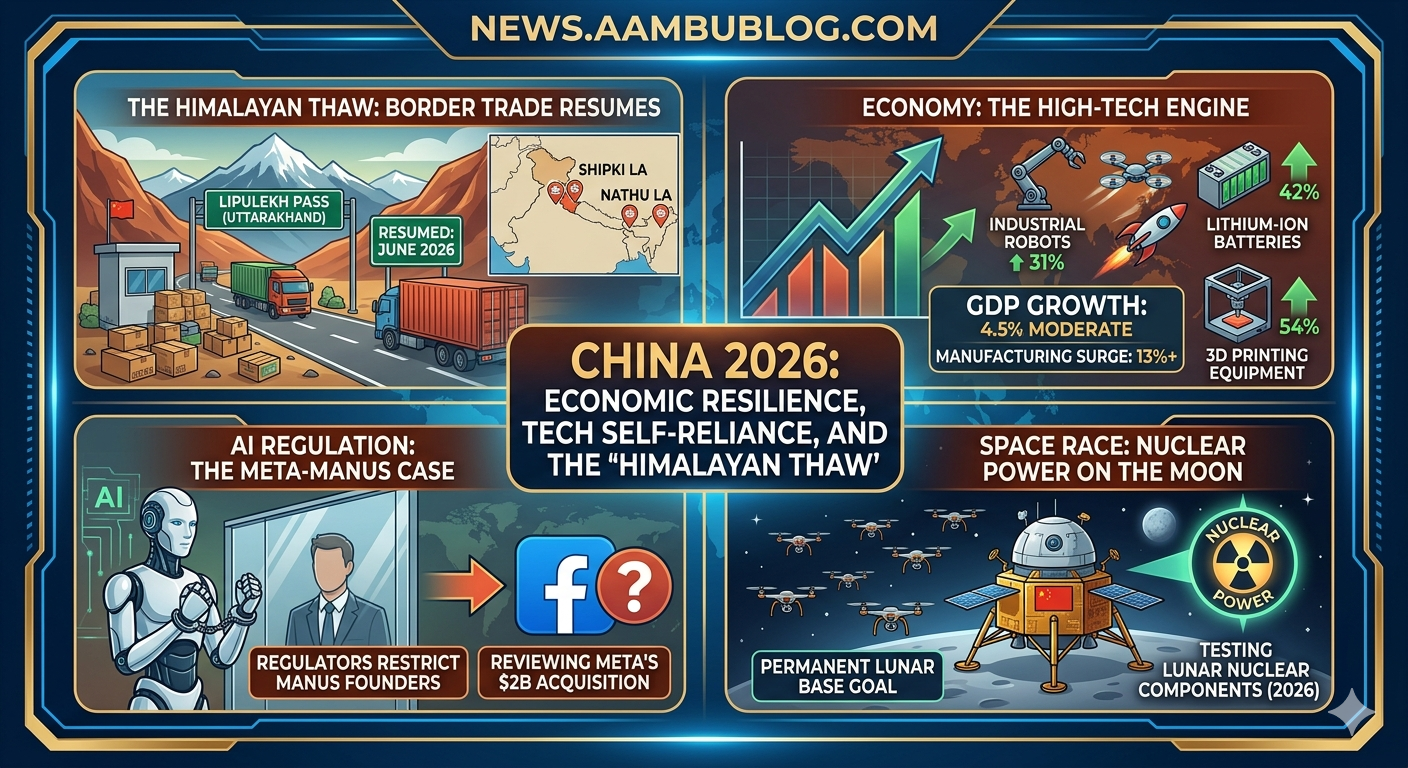
In a historic diplomatic breakthrough, India and China have officially agreed to resume border trade through the Lipulekh Pass in Uttarakhand, starting June 2026.
- The Context: Trade through this route was suspended in 2020 following the Galwan Valley tensions.
- New Infrastructure: Unlike the old days of mules and sheep, the 2026 trade season will benefit from new motorable roads, drastically cutting logistics costs for local traders in the Pithoragarh district.
- Broader Reach: This follows the 2025 agreement to also restore trade points at Shipki La (Himachal) and Nathu La (Sikkim).
2. Economy: The High-Tech Engine
While China’s overall GDP growth is projected to moderate to around 4.5% this year, its “New Three” industries are booming.
- Manufacturing Surge: High-tech manufacturing grew by over 13% in the first two months of 2026.
- The Leaders: Production of Industrial Robots (up 31%), Lithium-ion batteries (up 42%), and 3D printing equipment (up 54%) is driving exports even as local household spending remains sluggish.
- Self-Reliance: China’s new five-year plan (2026-2030) prioritizes “Tech Self-Sufficiency,” specifically in semiconductors and AI, to counter Western trade restrictions.
3. AI Regulation: The Meta-Manus Case
China continues to exert strong control over its domestic tech giants and foreign acquisitions.
- The News: Regulators have recently restricted the founders of the AI startup Manus from leaving the country.
- The Reason: Authorities are reviewing Meta’s (Facebook) $2 billion acquisition of the company to ensure it doesn’t violate national security or data export rules. This signals that while China wants tech growth, it will not allow its best AI talent or data to be easily transferred to US-based firms.
4. Space Race: Nuclear Power on the Moon
China has intensified its lunar program with the goal of establishing a permanent base.
- The Update: By 2030, China plans to send astronauts to the moon, but the 2026 roadmap focuses on deploying a “fleet of drones” and testing nuclear power components on the lunar surface to sustain a long-term base.
What This Means for India
The resumption of border trade and the stabilization of the Line of Actual Control (LAC) suggests that both nations are opting for “Economic Pragmatism.” While security concerns remain, the reopening of Himalayan routes is a massive win for local economies and signifies a shift from military standoff to managed competition.