
By: [Your News Desk] | Date: March 27, 2026 | Category: International / Politics
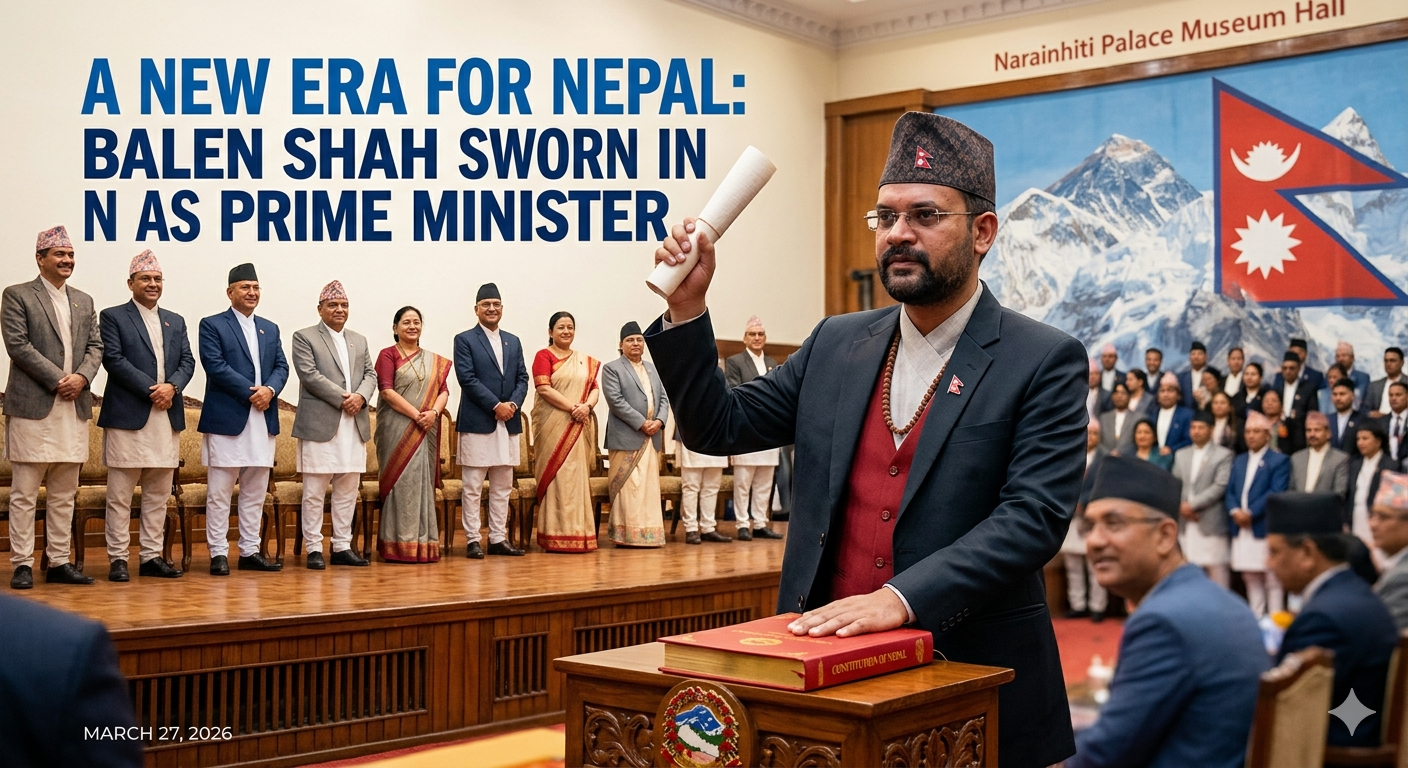
Today marks a historic turning point in Nepal’s political history. Balendra Shah, popularly known as Balen, has officially taken the oath as the 47th Prime Minister of Nepal. At just 35 years old, the former structural engineer and underground rap artist has become the youngest leader to head the Himalayan nation.
The Swearing-In: An Auspicious Start
The ceremony took place at the President’s Office, Sheetal Niwas, in Kathmandu. President Ram Chandra Paudel administered the oath of office to Balen Shah at exactly 12:34 PM.
Interestingly, this time was chosen by astrologers as the most “shubh” (auspicious) moment, coinciding with the festival of Ram Navami. The numerical pattern “1-2-3-4” is being seen by many in Nepal as a sign of a systematic and progressive future for the country.
The Rise of the ‘Walking Stick’
Balen’s journey from the music stage to the Prime Minister’s office is nothing short of a movie script:
- 2022: Won the Kathmandu Mayoral election as an independent candidate.
- 2025: Emerged as the face of the “Gen Z Protests” that demanded an end to corruption and old-school politics.
- 2026: Joined the Rastriya Swatantra Party (RSP) and led them to a landslide victory in the March 5 General Elections, winning 182 out of 275 seats.
In a symbolic victory, Balen defeated the veteran politician and four-time PM K.P. Sharma Oli in the Jhapa-5 constituency by a massive margin.
What This Means for India-Nepal Relations
Indian Prime Minister Narendra Modi was among the first global leaders to congratulate Balen Shah. In a message on ‘X’, PM Modi expressed his desire to take “India-Nepal friendship to even greater heights.”
While Balen has been a strong nationalist, experts believe his focus on infrastructure and technology (being an engineer himself) will open new doors for digital and energy cooperation between the two neighbors.
Challenges Ahead
Despite the massive mandate, the “Youngest PM” faces a tough road:
- Economic Recovery: Controlling inflation and boosting tourism.
- Systemic Change: Cleaning up the deep-rooted corruption that led to last year’s protests.
- Balancing Giants: Managing diplomatic relations between India and China.