In a landmark achievement for the global energy transition, Germany has officially announced that over 60% of its total electricity consumption was generated from renewable sources during the first quarter of 2026. This milestone cements Berlin’s position as a world leader in climate action and provides a successful blueprint for other industrial nations, including India.
1. Breaking Down the 60% Achievement
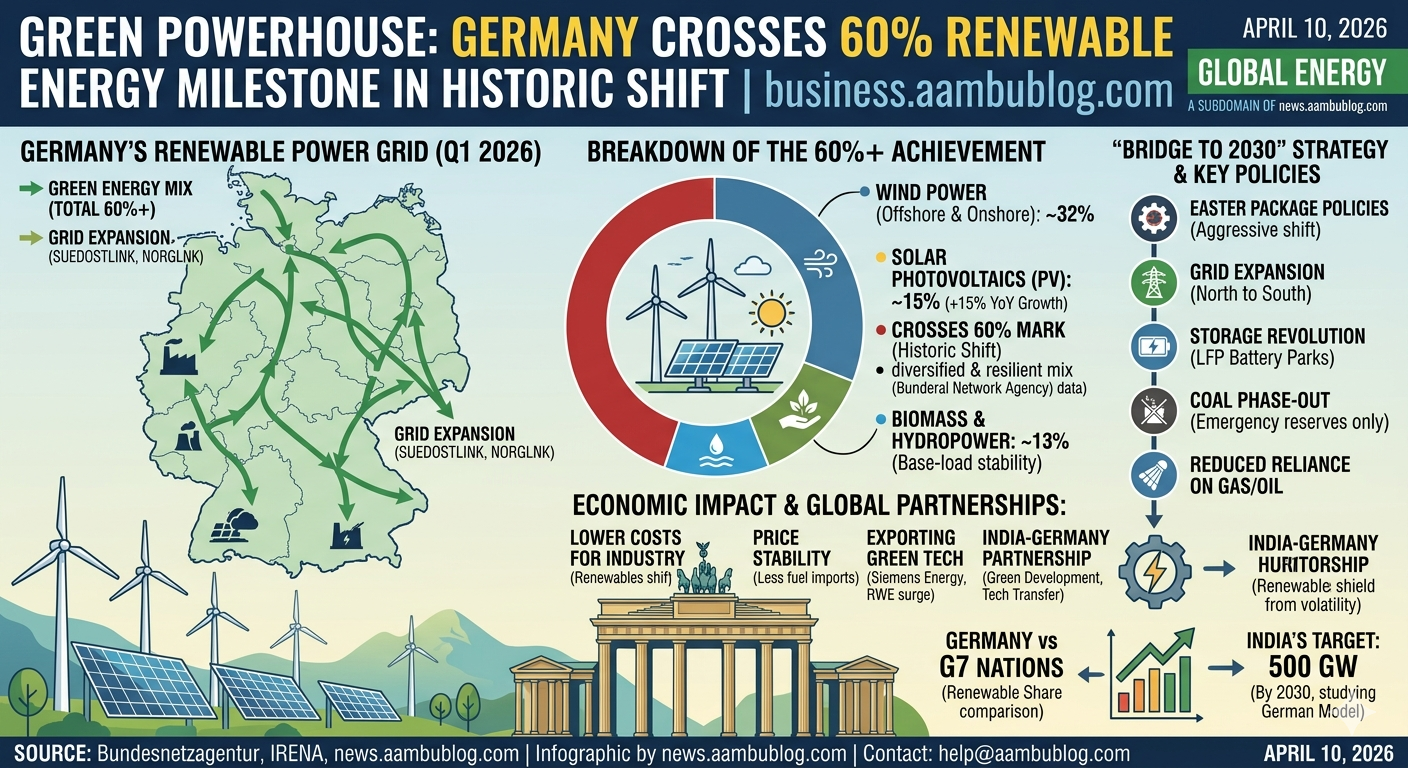
The data, released today by the Federal Network Agency (Bundesnetzagentur), shows a diversified and resilient green energy mix:
- Wind Power (Offshore & Onshore): Remained the largest contributor, accounting for nearly 32% of the total power generated.
- Solar Photovoltaics: Saw a massive 15% year-on-year growth, fueled by new regulations that made balcony solar units and community solar grids mandatory for new constructions.
- Biomass & Hydropower: Provided the essential “base-load” stability, making up the remaining 13% of the renewable share.
2. The “Bridge to 2030” Strategy
Germany’s success is not accidental. It is the result of the aggressive “Easter Package” policies implemented over the last few years:
- Grid Expansion: Germany has successfully completed several high-voltage “SuedOstLink” lines that transport wind energy from the breezy North to the industrial hubs in the South.
- Storage Revolution: The integration of massive Lithium-iron-phosphate (LFP) battery parks has allowed the grid to store excess solar energy during the day for use at night, reducing the need for natural gas.
- Phase-out Progress: This 60% mark has allowed Germany to further reduce its reliance on coal-fired plants, which are now largely used only as emergency reserves.
3. Economic Impact: Lower Costs for Industry
While the initial transition was expensive, the high share of renewables is now paying off for German businesses:
- Price Stability: Renewables have shielded German manufacturers from the extreme volatility seen in global gas and oil markets during the recent Middle East tensions.
- Exporting Green Tech: German firms like Siemens Energy and RWE are seeing a surge in global orders as they export the technology used to achieve this 60% mark.
4. The India-Germany Green Partnership
This news is particularly relevant for India, which currently ranks 4th globally in renewable energy capacity.
- Technology Transfer: Under the Green and Sustainable Development Partnership, Germany is sharing its grid-management software and battery storage expertise with India.
- Common Goals: As India aims for 500 GW of non-fossil capacity by 2030, the “German Model” of community-led solar power is being studied closely by Indian policymakers.
Frequently Asked Questions (FAQ)
Q1. Does Germany still use nuclear power?
No. Germany officially shut down its last remaining nuclear power plants in April 2023. The 60% milestone has been achieved entirely through wind, solar, biomass, and hydro.
Q2. What happens when the wind doesn’t blow and the sun doesn’t shine?
Germany uses a “Multi-layered Backup” system. This includes massive battery storage, green hydrogen-ready gas turbines, and interconnected power grids with neighboring European countries.
Q3. How does Germany’s 60% compare to India’s progress?
India currently generates about 40-43% of its capacity from non-fossil sources. Germany’s success shows that crossing the 50% “psychological barrier” is possible without crashing the industrial economy.