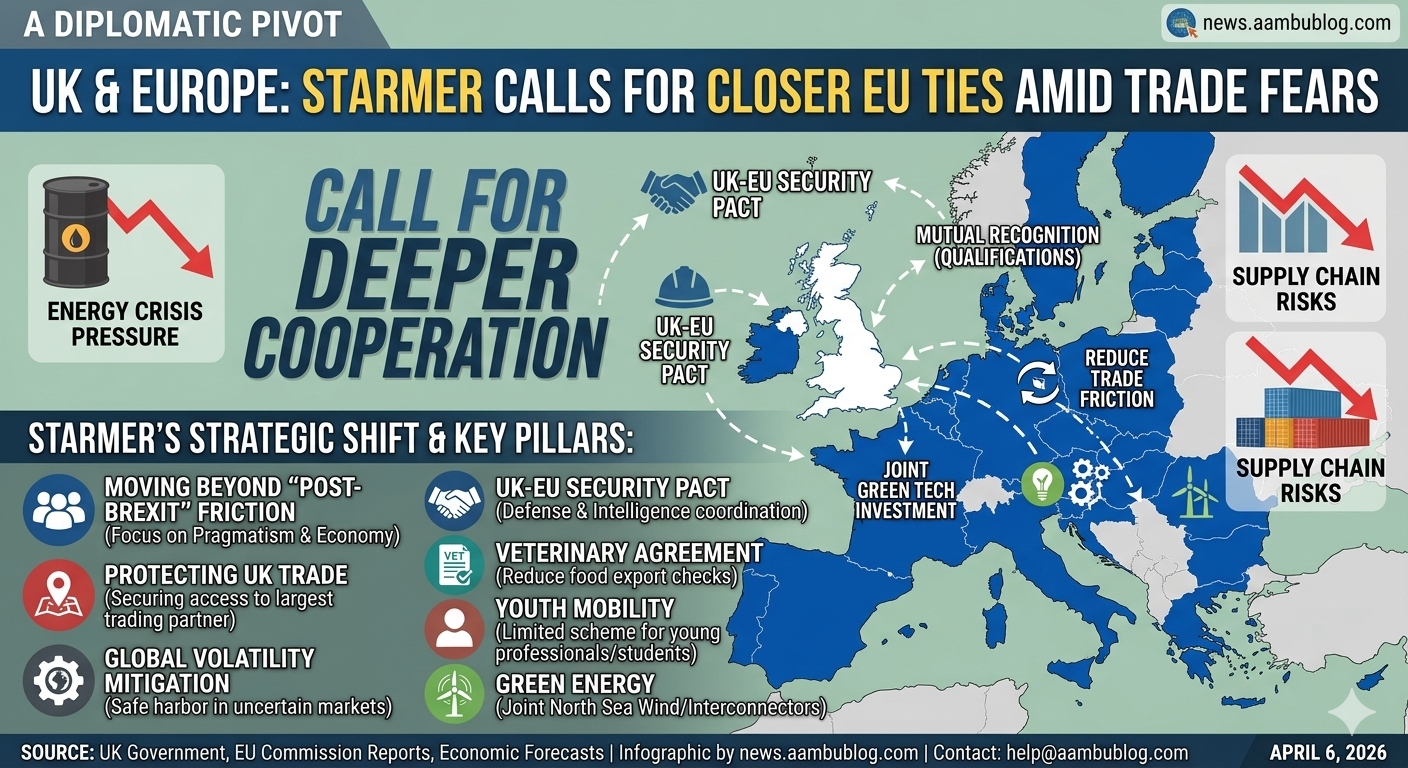
In a major strategic pivot, UK Prime Minister Keir Starmer has officially called for a deeper and more structured relationship with the European Union. Addressing business leaders and diplomats today, Starmer emphasized that the UK must move beyond the “friction of the past” to secure its economic future amidst rising global trade fears and regional instability.
1. The Pivot: Moving Beyond “Post-Brexit” Friction
While Starmer has repeatedly stated that the UK will not rejoin the Single Market or the Customs Union, his latest proposal marks the most significant outreach to Brussels since the 2016 referendum.
- The Goal: To reduce “red tape” and technical barriers that have hampered British exports to the EU, which remains the UK’s largest trading partner.
- Security & Defense: Starmer is pushing for a new UK-EU Security Pact to coordinate on defense manufacturing, intelligence sharing, and energy security.
- Economic Stability: The move is seen as a direct response to the global shift toward protectionism, with the UK seeking a “safe harbor” within the European economic sphere.
2. Why Now? The Pressure of Trade Fears
Several factors have accelerated this diplomatic “charm offensive”:
- Energy Crisis: Continued volatility in global energy markets has made UK-EU cooperation on North Sea wind power and electricity interconnectors a top priority.
- Supply Chain Risks: The ongoing “semi-blockade” of the Strait of Hormuz and tensions in West Asia have highlighted the need for regional supply chain resilience.
- Regulatory Alignment: British businesses, particularly in the automotive and chemical sectors, are demanding closer alignment with EU standards to remain competitive.
3. Key Areas of Cooperation
The Starmer government has outlined four “pillars” for this new relationship:
- Professional Qualifications: Mutual recognition of qualifications to help service sectors (law, architecture, engineering) operate across borders.
- Veterinary Agreement: A new deal to slash checks on food and agricultural exports.
- Youth Mobility: A limited scheme to allow young professionals and students to move more freely for work and study.
- Green Tech: Joint investment in carbon capture and hydrogen technology.
4. The Political Challenge
The proposal faces hurdles both at home and abroad:
- In the UK: Opposition parties have accused Starmer of “reversing Brexit by stealth,” while some business groups argue the moves don’t go far enough to solve border delays.
- In the EU: Brussels remains cautious, insisting that the UK cannot “cherry-pick” the benefits of the Single Market without accepting its rules, such as the free movement of people.
Frequently Asked Questions (FAQ)
Q1. Is the UK rejoining the European Union?
No. Prime Minister Starmer has made it clear that rejoining the EU, the Single Market, or the Customs Union is not on the table. The focus is on a “bespoke” deal to improve current trade terms.
Q2. How will this affect UK-India trade talks?
The UK government insists that closer ties with Europe will not come at the expense of its “Indo-Pacific tilt.” The India-UK Free Trade Agreement (FTA) remains a separate and high-priority objective.
Q3. Will this reduce the cost of living in the UK?
By reducing trade barriers and stabilizing energy cooperation, the government hopes to lower the cost of imported goods and energy bills over the long term.
Follow our UK & EU Bureau for live updates: help@aambublog.com
Copyright: © aambublog.com
Does this capture the tone you wanted for your news portal? I can generate the professional infographic image for this topic next.