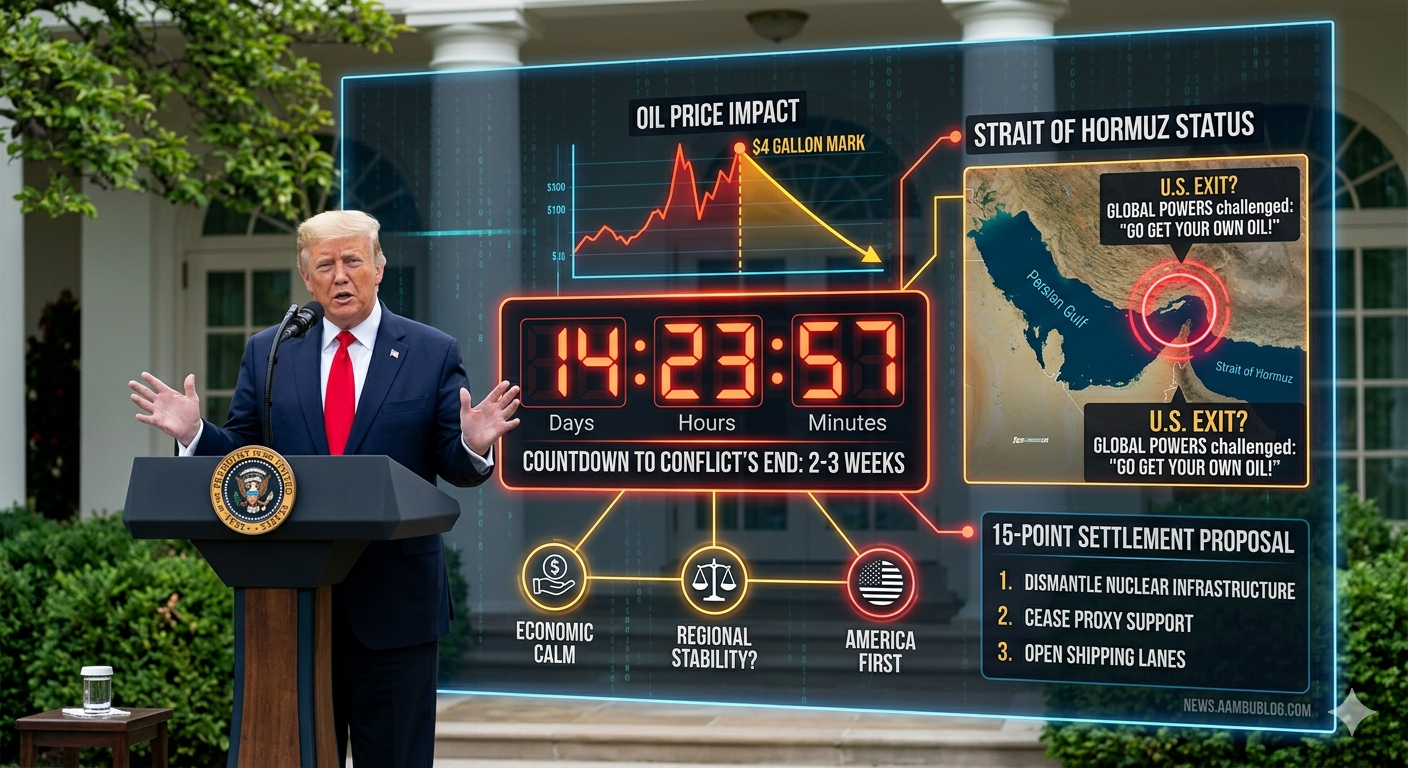
The world is currently witnessing one of the most volatile periods in modern history. In a move that has stunned both allies and adversaries, U.S. President Donald Trump has announced a definitive timeline for the conclusion of the military operations against Iran. Speaking during a high-stakes event at the White House, the President claimed that the “job is nearly done” and that U.S. forces could be winding down their offensive in as little as two to three weeks.
A Conflict at a Turning Point
As the war enters its fifth week, the rhetoric from Washington has shifted from pure military aggression to a mix of “final warnings” and diplomatic openings. President Trump’s latest statement comes amid a period of intense aerial campaigns and naval standoffs in the Persian Gulf.
”We’re finishing the job, and I think within maybe two weeks, maybe a couple of days longer, to do the job. We’ll be leaving very soon.” — President Donald Trump
Despite the optimism, the President made it clear that the U.S. exit is not necessarily dependent on a signed deal. He suggested that the U.S. has already achieved its primary military objectives, describing Iran’s military capabilities as “decimated.”
The Strategy: “Go Get Your Own Oil”
In a controversial twist, the President also addressed the ongoing blockade of the Strait of Hormuz. While the waterway remains a critical chokepoint—handling over 20% of the world’s oil—Trump signaled a major shift in U.S. foreign policy. He stated that once the U.S. “finishes its job,” it will no longer be the primary guardian of the Strait.
He challenged other global powers, specifically naming China and European nations, to take responsibility for their own energy security.
- The Message: “The U.S.A. won’t be there to help you anymore… Go get your own oil!”
- The Goal: To force other nations that rely on Middle Eastern oil to either support U.S. military efforts or secure the shipping lanes themselves.
The 15-Point Settlement Plan
While the military campaign continues, behind-the-scenes diplomacy is reportedly active. Reports suggest that Washington has sent a 15-point settlement proposal to Tehran through intermediaries. Key demands in the proposal include:
- Dismantling of Nuclear Infrastructure: A permanent end to Iran’s nuclear ambitions.
- Cessation of Proxy Support: Ending the funding and arming of regional militant groups.
- Reopening of the Strait: Immediate and unconditional access for international shipping.
Economic Impact: The $4 Gallon Mark
For the average citizen, the biggest concern remains the economy. In the U.S., gas prices have officially jumped past $4 a gallon for the first time since 2022. In India and Europe, the surge in crude oil prices is already trickling down into higher costs for groceries and transportation. The President’s “2-3 week” timeline is seen by many as an attempt to calm the global energy markets and lower fuel prices.
Frequently Asked Questions (FAQs)
1. Is the war really ending in 3 weeks?
While President Trump is optimistic, military experts warn that “finishing the job” depends on Iran’s reaction to the current U.S. pressure. The next few days, described by the Pentagon as “decisive,” will tell the true story.
2. What happens if no deal is reached?
The President indicated that the U.S. might leave regardless of a deal, having sufficiently degraded Iran’s military infrastructure. However, this could leave a power vacuum in the region.
3. Why is the U.S. asking other countries to “get their own oil”?
This is part of the “America First” policy, where the administration argues that the U.S. should not bear the entire financial and military burden of protecting trade routes that primarily benefit other nations.
Editor’s Note: With a prime-time presidential address scheduled for this evening, the world waits to see if this is a genuine peace plan or a strategic maneuver. Stay tuned to news.aambublog.com for live updates.