By Political Desk | April 16, 2026
The Indian Parliament has commenced a crucial three-day special session today, April 16, 2026. The atmosphere in the National Capital is charged as the government moves to introduce two landmark pieces of legislation: the Women’s Reservation (Implementation) Bill and the Delimitation (Constitutional Amendment) Bill.
These bills are expected to fundamentally alter the electoral map of India and the representation of women in the highest legislative bodies.
1. The Women’s Reservation Bill: From Paper to Power
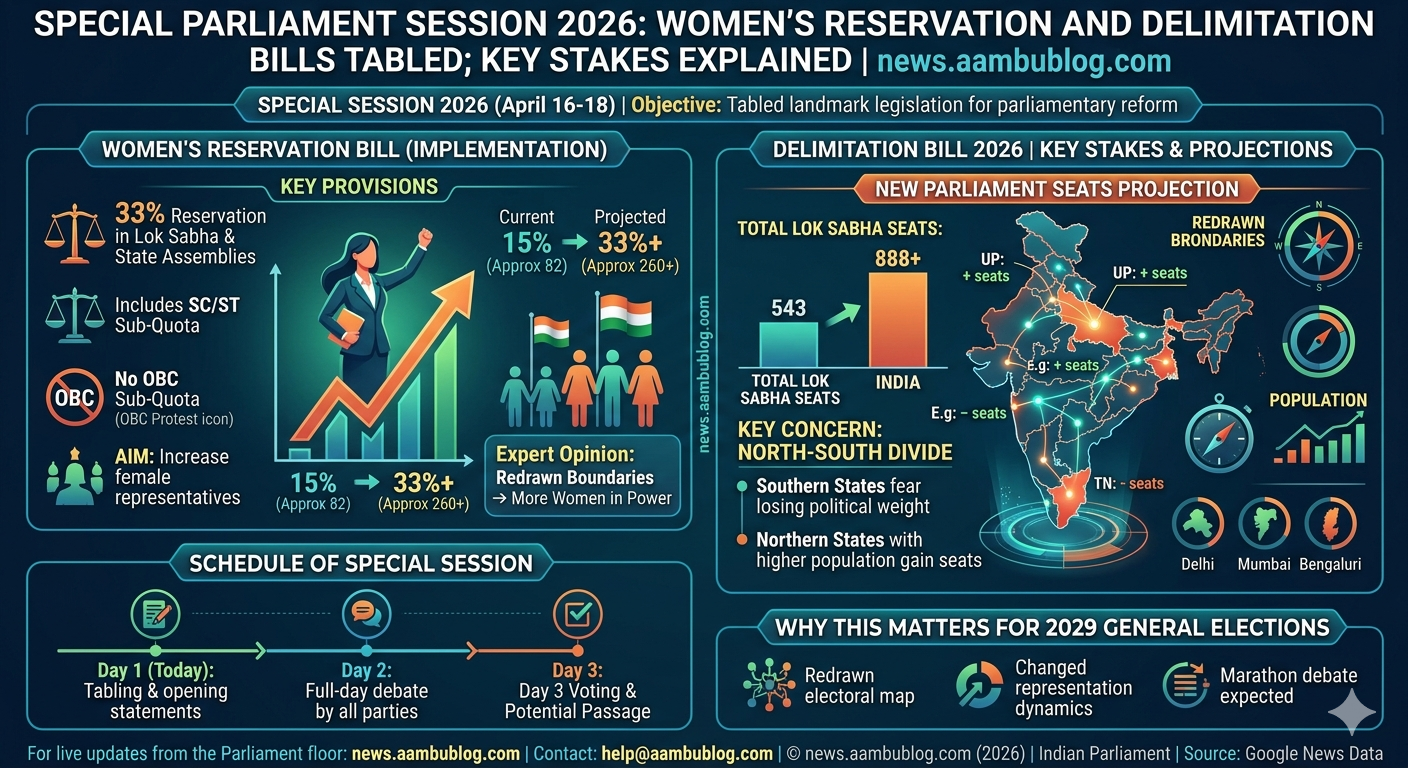
While the principle of 33% reservation for women in the Lok Sabha and State Assemblies was passed earlier, this new Bill focuses on the immediate implementation timeline.
- The Goal: To ensure that the 33% quota is active before the next major electoral cycle.
- Key Provision: The bill includes a sub-quota for women belonging to Scheduled Castes (SC) and Scheduled Tribes (ST) within the overall 33% reservation.
- Political Conflict: Opposition parties are demanding an additional “Quota within Quota” for Other Backward Classes (OBC) women, which remains a major point of contention in the house today.
2. The Delimitation Bill 2026: Redrawing India’s Map
The second and perhaps more controversial move is the introduction of the Delimitation Bill. Delimitation is the process of redrawing the boundaries of Lok Sabha and State Assembly constituencies based on the latest population data.
- Why Now? The freeze on the number of seats in Parliament (based on the 1971 census) is set to expire. The government aims to increase the total number of seats in the Lok Sabha to reflect India’s current population of over 1.4 billion.
- The New Parliament House: With the capacity of the new Lok Sabha chamber being 888 seats, this bill is the first legal step toward filling those benches.
- North-South Divide: Southern states (like Tamil Nadu and Kerala) have expressed deep concerns. They argue that states that successfully controlled population growth might lose political weight, while Northern states with higher populations will gain more seats.
3. Schedule of the Special Session
The government has cleared the deck for a marathon debate over the next 72 hours:
- Day 1 (Today): Tabling of both Bills and opening statements by the Law Minister.
- Day 2: Full-day debate with speakers from all major national and regional parties.
- Day 3: Voting and potential passage in the Lok Sabha before moving to the Rajya Sabha.
4. Expert Opinion: Why This Matters for 2029
Political analysts suggest that if these bills pass this week, the 2029 General Elections will look entirely different. We could see a Lok Sabha with over 800 members, where at least 260+ members will be women.
Quick FAQ: Special Session April 2026
Q1. Will the number of seats in Lok Sabha increase immediately?
No. The Bill sets the legal framework. The actual redrawing of boundaries will happen after a formal Delimitation Commission completes its report, likely by 2027-28.
Q2. Is there an OBC quota in the Women’s Bill?
As of the current draft tabled today, there is no separate OBC sub-quota, which is the primary reason for the protest by several opposition parties.
Q3. How long is this special session?
It is a 3-day session, starting today, April 16, and scheduled to conclude on the evening of April 18, 2026.
For live updates from the Parliament floor: news.aambublog.com
Contact: help@aambublog.com