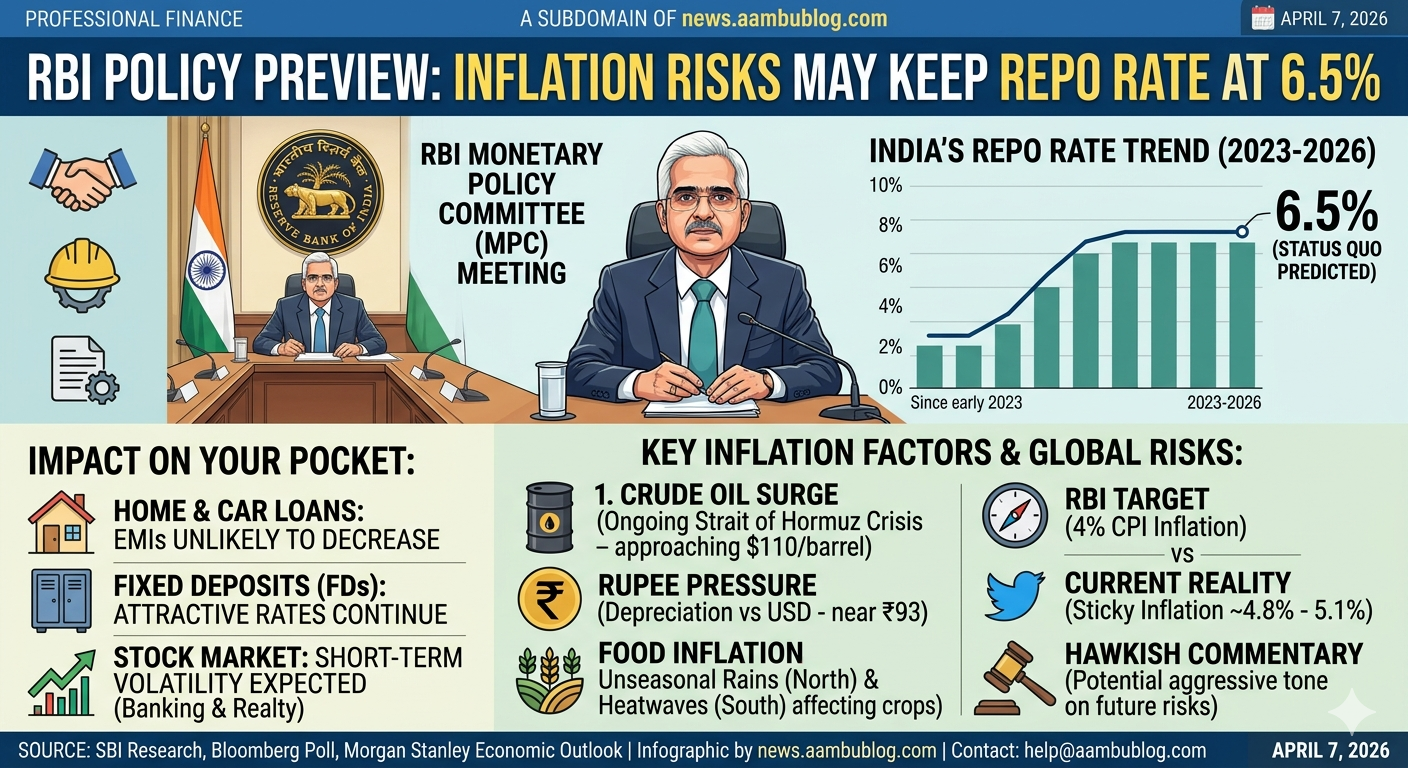
The Reserve Bank of India’s (RBI) Monetary Policy Committee (MPC) is set to conclude its first meeting of the 2026-27 fiscal year this week. With global economic tensions rising and domestic inflation remaining “sticky,” all eyes are on Governor Shaktikanta Das. Most financial analysts and economists predict that the RBI will maintain a “Status Quo,” keeping the Repo Rate unchanged at 6.5%.
1. The Current Economic Context
Since early 2023, the RBI has kept the repo rate at 6.5%. While there were hopes for a rate cut in mid-2026, new global challenges have emerged:
- Crude Oil Surge: The ongoing “semi-blockade” of the Strait of Hormuz has pushed global crude prices toward $110 per barrel. For a country like India, which imports over 80% of its oil, this is a direct threat to price stability.
- Currency Pressure: The Indian Rupee is facing depreciation pressure against the US Dollar, currently trading near the ₹93 mark. A rate cut now could further weaken the Rupee.
2. Why the Repo Rate Matters to You
The Repo Rate is the rate at which the RBI lends money to commercial banks. Any change here has a “domino effect” on your pocket:
- Home & Car Loans: If the rate remains at 6.5%, EMIs on floating-rate home loans and car loans are unlikely to decrease.
- Fixed Deposits (FDs): Steady repo rates mean that banks will continue to offer attractive interest rates on FDs, which is good news for senior citizens and conservative savers.
- Stock Market Impact: The market has already “priced in” a status quo. However, any aggressive commentary (hawkish tone) from the Governor regarding future inflation could lead to short-term volatility in banking and realty stocks.
3. The Inflation “Elephant” in the Room
RBI Governor Shaktikanta Das has famously described inflation as the “elephant in the room.”
- Target vs. Reality: The RBI’s target is 4%, but retail inflation (CPI) has been hovering around 4.8% to 5.1% due to rising food prices and supply chain disruptions.
- Food Inflation: Unseasonal rains in North India and heatwaves in the South have impacted crop yields, keeping vegetable and cereal prices high.
4. Expert Predictions: What to Expect?
| Expert/Agency | Prediction | Reasoning |
|---|---|---|
| SBI Research | Status Quo (6.5%) | Focus on stabilizing the Rupee. |
| Morgan Stanley | Status Quo (6.5%) | Global oil price volatility. |
| Bloomberg Poll | 90% chance of No Change | Inflation |
5. When will the official announcement happen?
The official statement from the RBI Governor is expected on April 9, 2026, at 10:00 A.M. IST.
Frequently Asked Questions (FAQ)
Q1. What is the Repo Rate?
The Repo Rate is the interest rate at which the Reserve Bank of India lends money to commercial banks. It is a key tool used by the RBI to control inflation.
Q2. When can we expect a rate cut?
Most economists believe a rate cut might only be possible in the third quarter (Q3) of 2026, provided inflation falls below 4.5% and global oil prices stabilize.
Q3. How does a high repo rate affect the common man?
A high repo rate makes borrowing expensive (higher EMIs) but makes saving more profitable (higher FD interest rates). It is used to reduce the flow of money in the economy to bring down high prices.