By National Security & Energy Desk | April 22, 2026
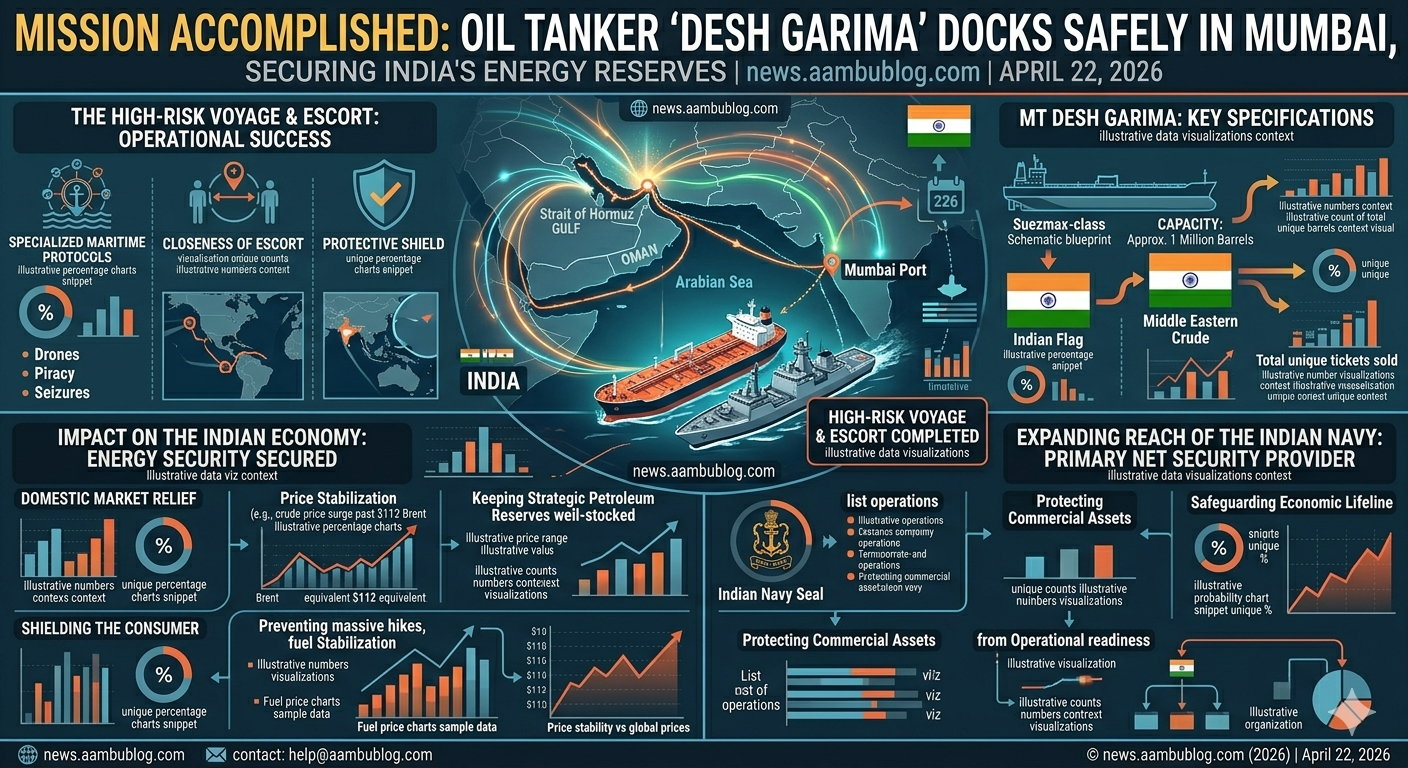
Amidst the escalating geopolitical crisis and the expiration of the US-Iran ceasefire in the Persian Gulf, India has successfully executed a critical maritime operation. Early this morning, the Indian-flagged crude oil tanker MT Desh Garima safely docked at the Mumbai Port Trust, carrying over a million barrels of essential Middle Eastern crude oil.
The vessel completed its high-risk transit through the volatile Strait of Hormuz and the Arabian Sea under the heavily armed escort of the Indian Navy, marking a massive victory for India’s energy security protocols.
1. The High-Risk Voyage and Navy Escort
As global shipping conglomerates suspended operations in the Gulf due to skyrocketing war-risk insurance and threats of blockades, the Indian government activated specialized maritime security protocols.
- The Escort: The MT Desh Garima was closely escorted by the guided-missile destroyer INS Visakhapatnam. The warship provided a protective shield against potential drone strikes, piracy, and arbitrary seizures that have recently plagued the region.
- Strategic Route: The convoy navigated through the critical chokepoint of the Strait of Hormuz, maintaining a heightened state of alert before crossing into the safer waters of the eastern Arabian Sea.
2. Why This Matters for the Indian Economy
India imports more than 80% of its crude oil requirements, making it highly vulnerable to Middle Eastern supply chain disruptions. The safe arrival of this cargo is a major relief for the domestic market.
- Price Stabilization: With global Brent Crude prices surging past the $112 mark this morning due to the Gulf standoff, this secured shipment ensures that Indian strategic petroleum reserves remain well-stocked.
- Shielding the Consumer: By maintaining a steady physical supply of crude, state-run oil marketing companies (OMCs) can better absorb the shock of global price volatility, temporarily preventing massive price hikes for petrol and diesel at local fuel pumps.
3. The Expanding Reach of the Indian Navy
This successful escort mission underscores a major shift in India’s strategic defense posture. The Indian Navy is no longer just a coastal defense force; it is actively operating as the primary net security provider in the Indian Ocean Region (IOR). By protecting commercial assets in international waters, the Navy is directly safeguarding the nation’s economic lifeline.
Detailed Q&A: India’s Maritime Energy Security
Q1. Will domestic petrol and diesel prices drop now?
A price drop is unlikely. Global crude prices are still dangerously high. However, the safe arrival of MT Desh Garima prevents an immediate shortage, which means prices are more likely to remain stable rather than spiking uncontrollably in the coming weeks.
Q2. Does the Indian Navy escort all commercial ships?
No. Escorts are reserved for high-value, Indian-flagged strategic assets (like massive crude carriers or natural gas ships) passing through designated “high-risk areas.” This is part of ongoing maritime security operations similar to Operation Sankalp.
Q3. How much oil does the MT Desh Garima hold?
A Suezmax-class tanker like the MT Desh Garima can carry roughly 1 million barrels of crude oil. To put that into perspective, that is enough crude to meet a significant portion of India’s daily national consumption demand.
Fact Sheet: MT Desh Garima Escort Mission
| Operational Metric | Details |
|---|---|
| Vessel Name | MT Desh Garima |
| Cargo | Approx. 1 Million Barrels of Crude Oil |
| Naval Escort | INS Visakhapatnam (Guided-Missile Destroyer) |
| Route Negotiated | Strait of Hormuz to Mumbai Port |
| Strategic Impact | Bolsters National Petroleum Reserves |
For real-time defense updates and national energy market analysis: news.aambublog.com
Contact: help@aambublog.com