
By Tech Desk | April 11, 2026
The Indian Space Research Organisation (ISRO) has achieved another critical milestone in its quest to send humans into space. Today, ISRO successfully conducted the 2nd Integrated Air Drop Test (IADT-02) at the Satish Dhawan Space Centre (SDSC-SHAR), Sriharikota. This test is a vital step toward ensuring the safety of Indian astronauts (Gagan-Yatris) during their return to Earth.
1. What was the IADT-02 Test?
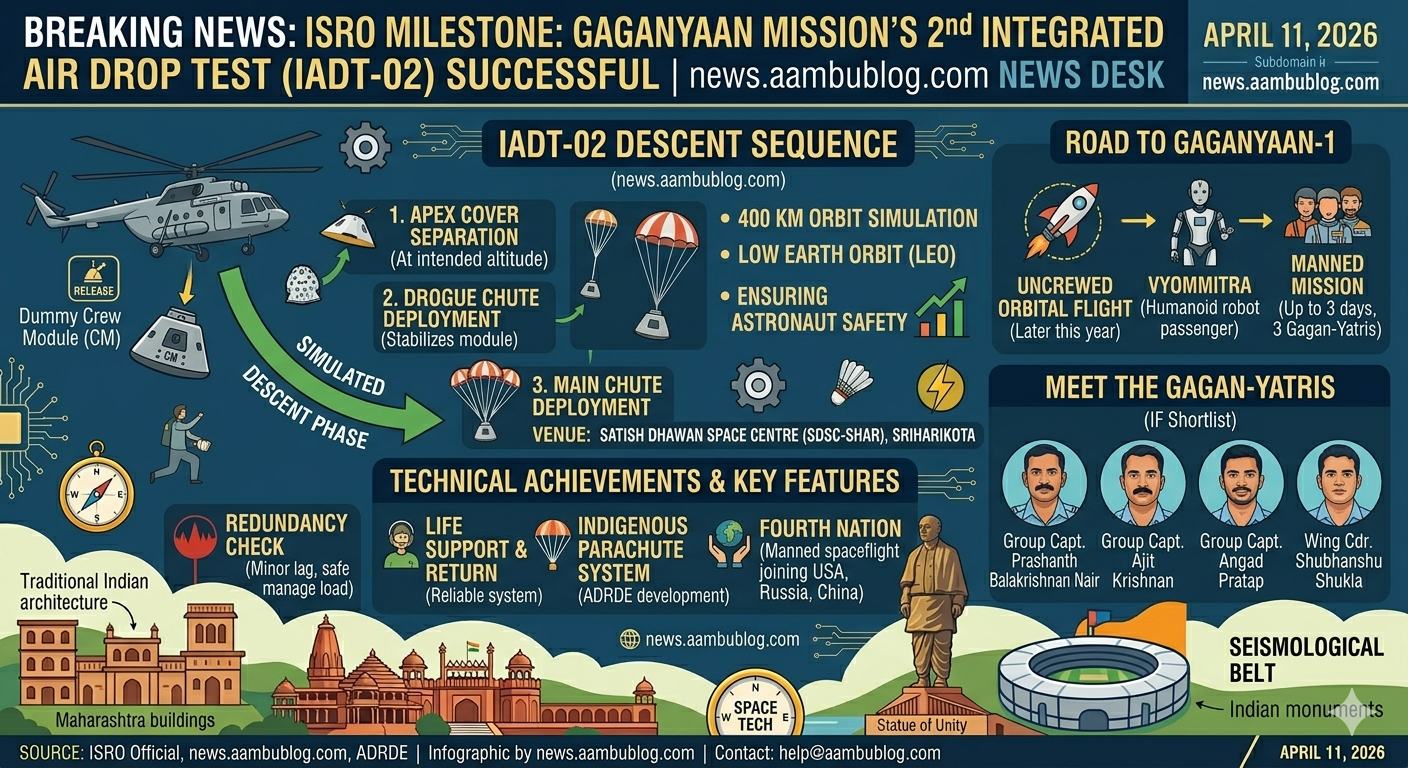
The Integrated Air Drop Test focuses on the Parachute Deployment System. Since the Gaganyaan crew module will be traveling at immense speeds when it re-enters Earth’s atmosphere, it needs a flawless parachute system to slow down and land safely in the ocean.
- The Drop: A dummy Crew Module (CM) was lifted to a specific altitude by an Indian Air Force (IAF) heavy-lift helicopter.
- The Release: The module was released to simulate the final descent phase of a real space mission.
- The Deployment: All three main chutes deployed sequentially, bringing the module to a gentle “splashdown” in the pre-designated zone.
2. Key Technical Achievements
ISRO officials confirmed that the test met all mission objectives:
- Apex Cover Separation: The protective cover for the parachutes separated perfectly at the intended altitude.
- Drogue Parachute Performance: The smaller drogue chutes successfully stabilized the module before the main chutes opened.
- Redundancy Check: The system proved that even if one parachute has a minor lag, the others can safely manage the load.
3. The Road to “Gaganyaan-1”
This successful air drop test clears the way for the first uncrewed orbital flight, Gaganyaan-1, expected later this year.
- Vyommitra: The humanoid robot “Vyommitra” will be the sole passenger in the first uncrewed mission to monitor the cabin environment.
- Manned Mission: The success of IADT-02 gives scientists the confidence needed for the eventual manned mission, where three Indian astronauts will spend up to 3 days in a 400 km orbit.
4. Why This Matters for India
With the Gaganyaan mission, India aims to become the fourth nation in the world to launch a manned spaceflight mission, joining the ranks of the USA, Russia, and China. This success highlights India’s self-reliance in high-end space technology and the robustness of the indigenous parachute systems developed by the Aerial Delivery Research and Development Establishment (ADRDE).
Frequently Asked Questions (FAQ)
Q1. What is the Gaganyaan mission?
Gaganyaan is India’s first human spaceflight program designed to demonstrate indigenous capability to undertake human space flight missions to Low Earth Orbit (LEO).
Q2. Why is the Air Drop Test important?
It tests the “Life Support” and “Return” aspects of the mission. If the parachutes fail, the astronauts cannot return to Earth safely. Today’s test proves the return system is reliable.
Q3. Who are the astronauts for the mission?
ISRO has already shortlisted four IAF pilots—Group Captain Prashanth Balakrishnan Nair, Group Captain Ajit Krishnan, Group Captain Angad Pratap, and Wing Commander Shubhanshu Shukla—for the final mission.
For more Space & Tech breakthroughs: news.aambublog.com
Contact: help@aambublog.com