By Tech & Business Desk | April 22, 2026
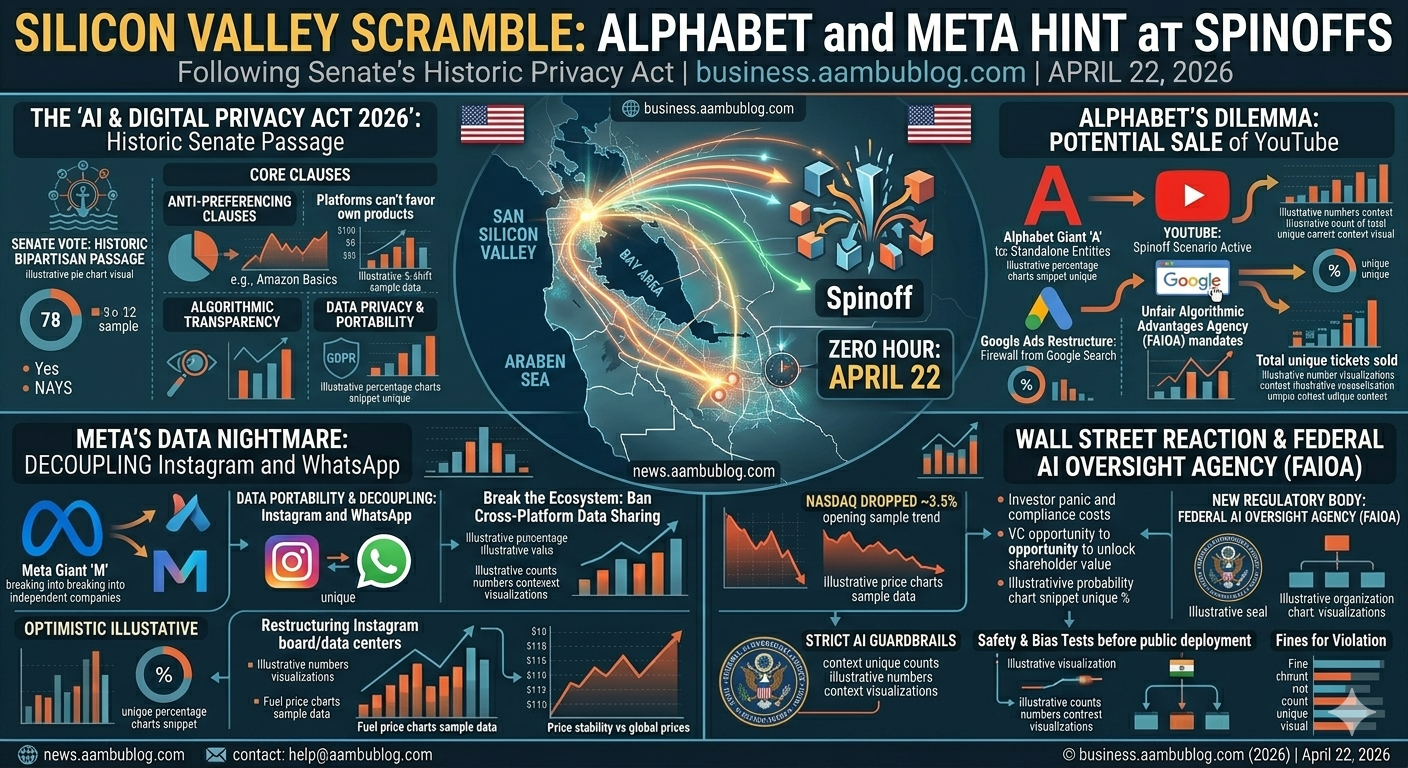
The aftershocks of the United States Senate passing the ‘AI & Digital Privacy Act of 2026’ are already tearing through Silicon Valley. Facing the reality of strict “anti-preferencing” laws and draconian federal oversight, the world’s biggest tech monopolies are officially hitting the panic button.
Early this morning, insider reports from Wall Street revealed that giants like Alphabet (Google’s parent company) and Meta have initiated emergency boardroom discussions. The agenda? Historic corporate spinoffs and restructuring to avoid daily federal fines that could cripple their global revenue.
1. Alphabet’s Dilemma: The Potential Sale of YouTube
Alphabet is currently in the crosshairs of the new legislation’s anti-monopoly clauses. The Act strictly prohibits a single corporation from owning the dominant search engine, the primary ad network, and the largest video platform simultaneously, as it creates an “unfair algorithmic advantage.”
- The Spinoff Strategy: Financial analysts at Morgan Stanley suggest that Alphabet is actively modeling a scenario to spin off YouTube into a separate, publicly traded entity.
- The Google Ads Restructure: Alphabet may also be forced to erect a permanent “firewall” between its Google Search algorithms and its Google Ads business to comply with the new Federal AI Oversight Agency (FAIOA) mandates.
2. Meta’s Data Nightmare: Decoupling WhatsApp and Instagram
For Mark Zuckerberg’s Meta, the challenge isn’t just about ads; it’s about the new, ultra-strict data portability rules. The 2026 Act essentially bans the cross-platform sharing of user data without explicit, renewed consent every 30 days.
- Breaking the Ecosystem: Meta’s current business model relies on feeding Instagram and WhatsApp user data into its central Facebook ad engine. If this becomes illegal, the financial incentive to keep these platforms under one roof disappears.
- Corporate Restructuring: Reports indicate Meta is consulting with top-tier legal firms to potentially separate Instagram’s executive board and data centers entirely from Facebook headquarters.
3. Wall Street’s Reaction: Volatility and Opportunity
The tech-heavy NASDAQ composite experienced wild swings in early trading today as investors digested the news of potential breakups.
- Short-Term Panic: Shares of Alphabet (GOOGL) and Meta (META) dipped an additional 2% this morning as shareholders fear the immense legal and operational costs of restructuring.
- Long-Term Value: Conversely, venture capitalists are thrilled. Spun-off companies historically unlock massive shareholder value. An independent YouTube, free from Alphabet’s corporate umbrella, could theoretically become the most valuable standalone media company on earth.
Professional Tip for Tech Investors
Do not panic-sell top-tier tech stocks just yet. While the headline of “breaking up Big Tech” sounds terrifying for the market, historical precedents (like the breakup of Standard Oil or AT&T) show that the individual “baby” companies often end up being worth significantly more combined than the original monopoly. Watch the legal restructuring closely over the next 18 months.
Detailed Q&A: The Silicon Valley Breakup
Q1. Will Google actually sell YouTube?
It is highly unlikely they will sell it to a competitor. Instead, a “spinoff” means Alphabet would create a new company for YouTube and give current Alphabet shareholders stock in the new company. Alphabet executives would step down from YouTube’s board to ensure it operates independently under the new law.
Q2. When will these changes actually happen?
The ‘AI & Digital Privacy Act 2026’ gives tech companies an 18-month grace period to comply once the President signs it. This means the actual spinoffs or major structural changes would likely hit the market in late 2027.
Q3. How will this affect small businesses running digital ads?
In the short term, it might cause chaos as ad platforms restructure their targeting algorithms to comply with privacy laws. However, the legislation’s goal is to create more competition, which should theoretically lower advertising costs for small businesses over the long term.
Fact Sheet: Big Tech’s Restructuring Outlook
| Company | Primary Threat from New Law | Potential Action Plan |
|---|---|---|
| Alphabet (Google) | Anti-Preferencing (Search + Ads + Video) | Spinoff YouTube; Firewall Google Ads |
| Meta | Cross-Platform Data Sharing Bans | Decouple Instagram & WhatsApp data |
| Amazon | Retail Marketplace vs. Own Products | Spin off ‘Amazon Basics’ division |
| Apple | App Store Monopoly & App Preferencing | Allow aggressive third-party app stores |