By Global Economy & Energy Desk | April 18, 2026
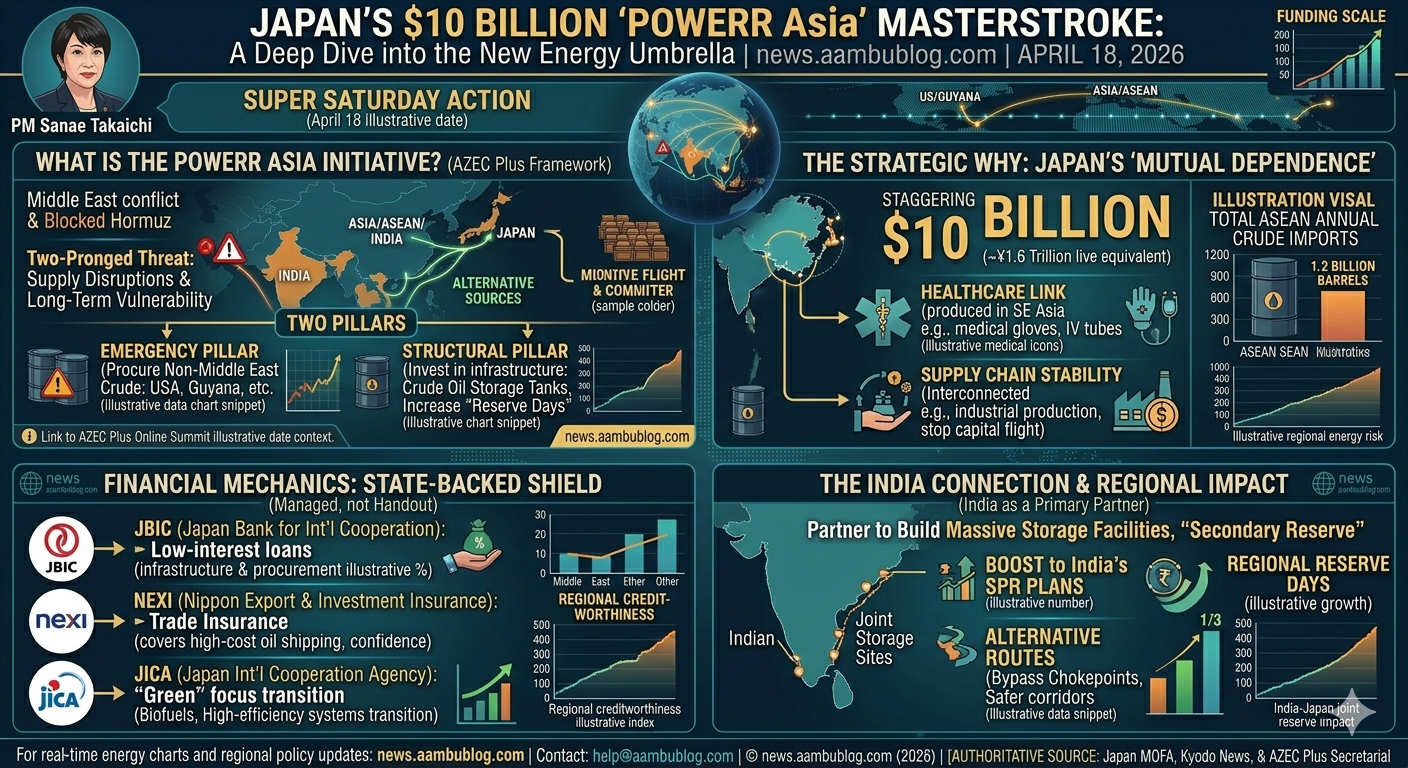
As the shadow of the Middle East conflict looms over the global economy, Japan has launched a pre-emptive strike to protect the Asian markets. Prime Minister Sanae Takaichi recently unveiled the Partnership On Wide Energy and Resources Resilience (POWERR Asia), a massive $10 billion (approx. ¥1.6 trillion) framework designed to serve as a financial and structural “Energy Shield” for the continent.
1. What is the POWERR Asia Initiative?
Launched during the Asia Zero-Emission Community (AZEC) Plus Online Summit, POWERR Asia is a regional cooperation framework. It is designed to tackle the two-pronged threat of immediate energy supply disruptions and long-term resource vulnerability.
- Emergency Pillar: Providing instant liquidity and credit for Asian nations to procure crude oil and petroleum products from alternative sources (like the US and Guyana) if the Strait of Hormuz remains blocked.
- Structural Pillar: Investing in the physical infrastructure of energy—specifically crude oil storage tanks—to increase the number of “reserve days” across ASEAN and South Asia.
2. The Strategic Why: Why is Japan Funding Asia?
Many analysts wonder why Japan is pledging such a staggering amount—equivalent to roughly 1.2 billion barrels of oil—to other nations. The answer lies in Mutual Dependence.
- The Healthcare Link: Much of Japan’s (and India’s) medical equipment—from surgical gloves to IV tubes—is produced in Southeast Asian factories. These factories run on petroleum-derived energy. If Thailand or Malaysia runs out of fuel, Japan’s hospitals stop functioning.
- Supply Chain Stability: Japan and ASEAN are “interconnected through supply chains.” By stabilizing the energy costs of its neighbors, Japan is effectively protecting its own industrial production and stopping global “capital flight” from Asian markets.
3. The Financial Mechanics: JBIC and NEXI in Action
The $10 billion isn’t a simple handout; it’s a sophisticated financial safety net managed through state-backed institutions:
- JBIC (Japan Bank for International Cooperation): Will provide low-interest loans for energy infrastructure and emergency procurement.
- **NEXI (Nippon Export and Investment Insurance): Will offer trade insurance to cover the risks of high-cost oil shipping, giving Asian companies the confidence to buy oil even during a crisis.
- JICA (Japan International Cooperation Agency): Will focus on the “Green” side, helping nations transition to biofuels and high-efficiency energy systems.
4. The India Connection: Building Regional Reserves
For India, the POWERR Asia initiative provides a massive boost to its Strategic Petroleum Reserve (SPR) plans.
- Joint Infrastructure: Japan is looking to partner with India to build massive storage facilities along the coastline, creating a “secondary reserve” that both nations can lean on during a global shock.
- Alternative Routes: The fund will support the development of logistics that bypass traditional chokepoints, focusing on safer maritime corridors.
POWERR Asia at a Glance: Key Features
| Feature | Details |
|---|---|
| Total Fund | $10 Billion (USD) |
| Scale | Equivalent to ~1 year of ASEAN oil imports |
| Emergency Focus | Funding for non-Middle East crude (USA, Guyana, etc.) |
| Structural Focus | Building Storage Tanks & Stockpiling systems |
| Participating Nations | India, ASEAN-10, South Korea, Bangladesh |
Quick FAQ: The POWERR Asia Deep Dive
Q1. Does this mean Japan is giving away its own oil?
No. PM Takaichi clarified that Japan’s 200-day national reserves will not be tapped. This is a financial framework to help other nations buy and store their own oil.
Q2. How does this impact the local petrol price?
By preventing a global “bidding war” for limited oil, Japan’s funding helps keep international oil prices stabilized, which indirectly keeps petrol and diesel prices manageable in India and ASEAN.
Q3. Is this related to Decarbonization?
Yes. While it handles the oil crisis now, it is part of the AZEC Plus vision, which includes long-term shifts to Hydrogen, Ammonia, and Biofuels.
For real-time energy charts and regional policy updates: news.aambublog.com
Contact: help@aambublog.com