By National Desk | April 18, 2026
In a dramatic turn of events that has stunned the nation, the 131st Constitutional Amendment Bill (Women’s Reservation) and the accompanying Delimitation Bill 2026 failed to clear the Lok Sabha late last night, April 17. Despite intense debates and high expectations, the government could not secure the mandatory “special majority” required for a constitutional change.
1. The Numbers: A Narrow Miss for the Government
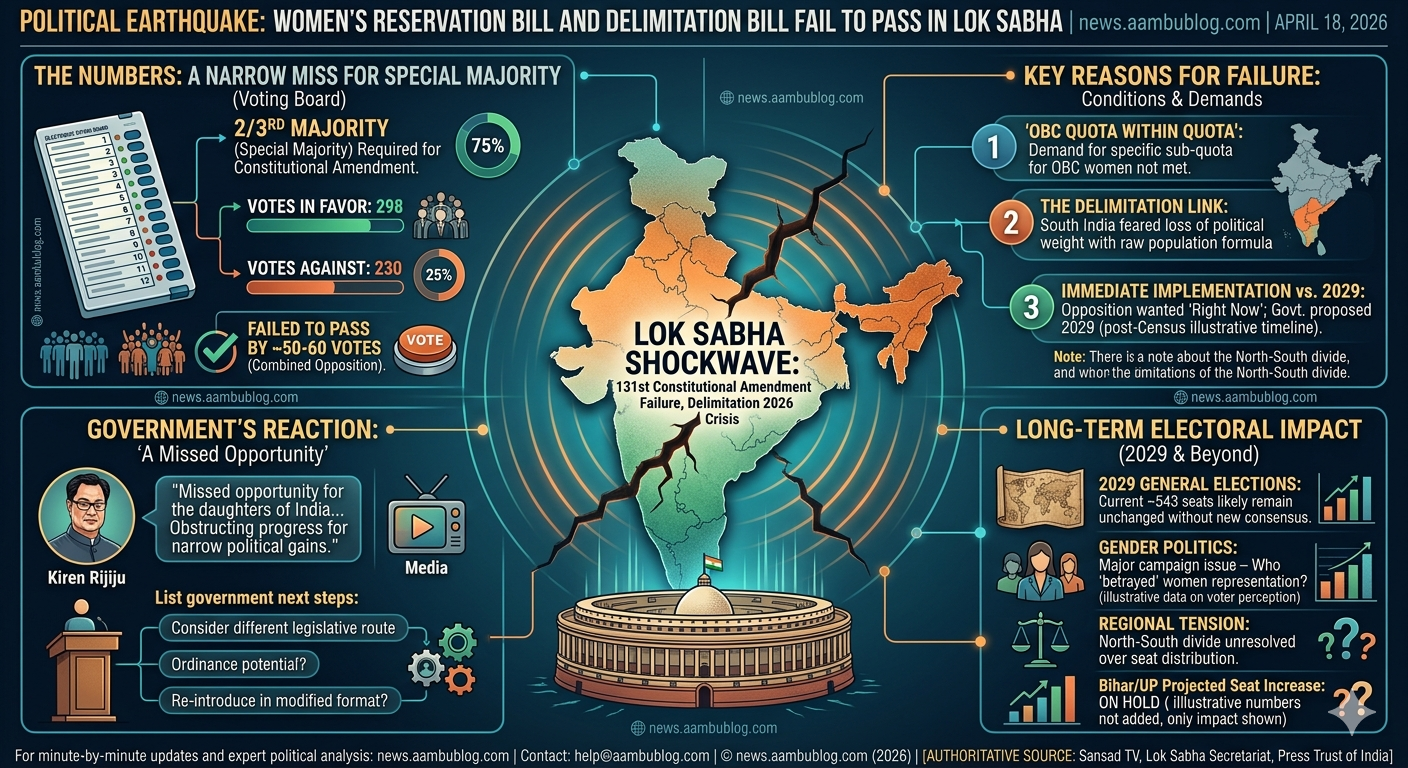
To pass a Constitutional Amendment, the government needs a two-thirds majority of the members present and voting.
- Votes in Favor: 298
- Votes Against: 230
- The Gap: The government fell short of the required mark by approximately 50-60 votes, as the combined opposition stood its ground.
2. Why Did the Bill Fail?
The failure wasn’t due to a lack of support for women’s representation itself, but rather the “conditions” attached to it.
- The Delimitation Link: The government insisted on linking Women’s Reservation to the Delimitation process (redrawing of seats). Southern states and the opposition feared this would reduce the political weight of South India.
- “OBC Quota within Quota”: Several parties, including the SP, RJD, and sections of the INDIA bloc, demanded a specific sub-quota for OBC women, which the current bill did not provide.
- Immediate Implementation: The opposition demanded that the 33% reservation be implemented for the upcoming state elections, whereas the government’s plan was to wait until 2029.
3. Government’s Reaction: “A Missed Opportunity”
Union Minister for Parliamentary Affairs, Kiren Rijiju, expressed deep disappointment immediately after the voting.
- Official Statement: Rijiju called the failure a “missed opportunity for the daughters of India” and blamed the opposition for “obstructing progress for narrow political gains.”
- Strategy: Sources suggest the government might now consider a different legislative route or re-introduce the bill in a modified format in the next session.
4. Impact on the 2029 General Elections
The failure of these bills creates a massive ripple effect:
- Electoral Map: Without the Delimitation Bill, the current 543-seat structure will likely remain for the 2029 elections unless a new consensus is reached.
- Gender Politics: This will likely become a major campaign issue. The ruling party will blame the opposition for the “betrayal” of women, while the opposition will highlight the “flaws” in the government’s draft.
- Regional Tension: The North-South divide over seat distribution remains unresolved, leaving a cloud of uncertainty over how future Parliaments will be formed.
Quick Comparison: What the Bill Proposed vs. Why it Failed
| Feature | Proposal | Reason for Rejection |
|---|---|---|
| Quota Percentage | 33% Seats for Women | Agreement on %, disagreement on “Who” (OBC sub-quota). |
| Delimitation | Required before implementation | South India feared loss of Lok Sabha seats. |
| Timeline | Post-2026 Census | Opposition wanted implementation “Right Now.” |
Quick FAQ: The 2026 Parliament Shock
Q1. Does this mean there will be no Women’s Reservation in 2029?
As of now, yes. Unless the government brings a new bill or an ordinance, the 2029 elections will proceed under the old system.
Q2. Can the government bring the same bill again?
Yes, but they would need to either build a consensus with the opposition or wait for a change in the House’s arithmetic.
Q3. What happened to the Bihar Delimitation impact?
Since the main Delimitation Bill failed, the projected increase in seats for states like Bihar and UP is now on hold.
For minute-by-minute updates and expert political analysis: news.aambublog.com
Contact: help@aambublog.com