
By Technology & Science Desk | April 16, 2026
Japan’s premier national research institute, RIKEN, has officially announced a massive leap in its computational capabilities. In a strategic move to dominate the future of high-performance computing (HPC), RIKEN has upgraded its “Reimei-Fugaku” hybrid platform by procuring the state-of-the-art Quantinuum System Model H2 quantum computer.
This development marks a new era where classical supercomputers and quantum processors work in perfect harmony to solve humanity’s most complex challenges.
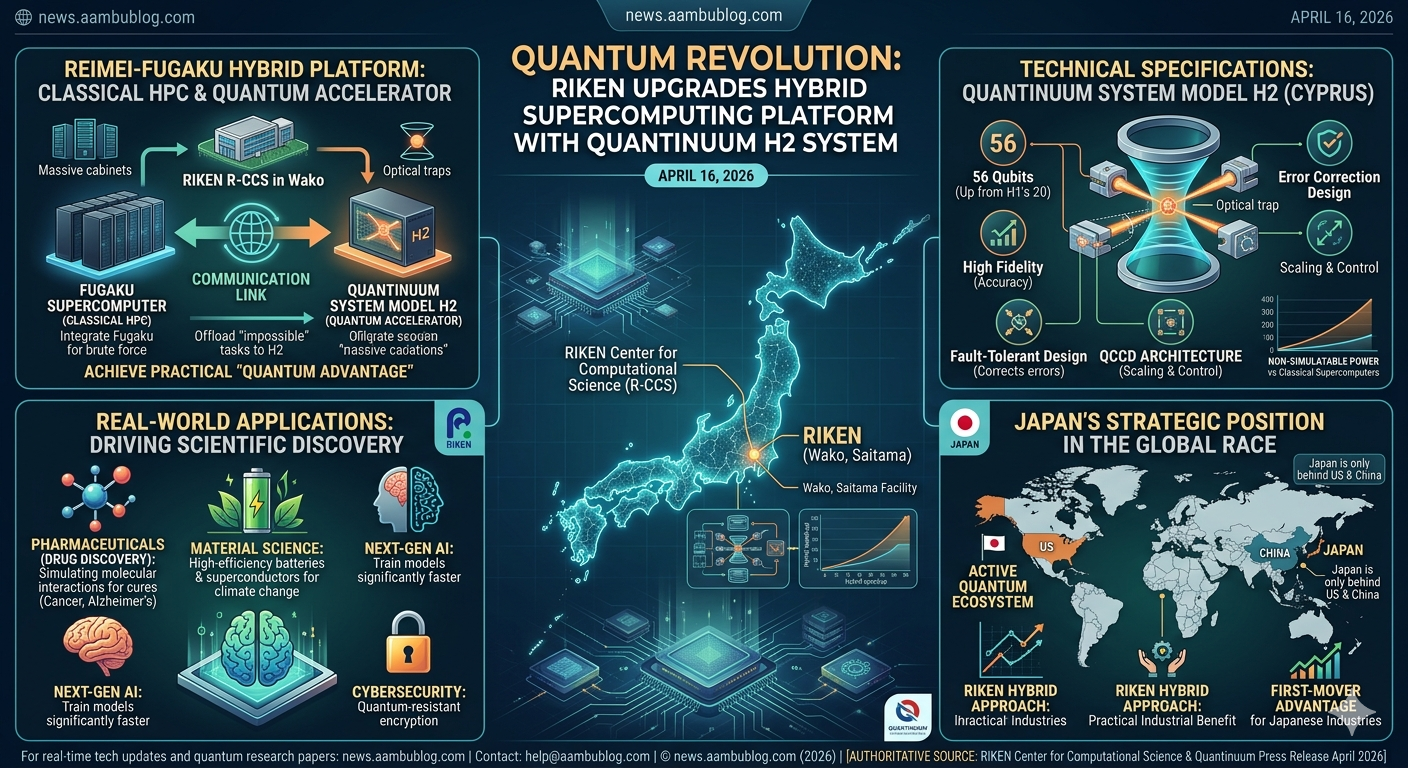
1. Reimei-Fugaku: The World’s Most Powerful Hybrid Platform
The Reimei-Fugaku project is a visionary initiative that combines the brute force of Japan’s flagship supercomputer, Fugaku, with the precision of quantum circuits.
- The Integration: By connecting Fugaku with Quantinuum’s hardware at RIKEN’s facility in Wako, Saitama, researchers can now offload specific, “impossible” mathematical tasks from the classical supercomputer to the quantum processor.
- The Goal: To achieve a “Quantum Advantage” in practical applications, moving beyond theoretical experiments into real-world industrial usage.
2. Technical Edge: The Jump to 56 Qubits
The upgrade from the previous H1 system to the Quantinuum H2 is a significant technical milestone.
- Higher Capacity: The H2 system features 56 qubits, making it one of the most powerful gate-based quantum computers available today.
- Fidelity and Error Correction: Unlike many other systems, the H2 uses trapped-ion technology, which is known for its high “fidelity” (accuracy). It is designed to support Fault-Tolerant Quantum Computing, meaning it can correct its own errors during complex calculations.
- Non-Simulatable Power: At 56 qubits, the H2 has reached a point where its operations can no longer be accurately simulated by even the largest classical supercomputers, effectively entering a territory of pure quantum discovery.
3. Real-World Applications: From Drugs to Materials
RIKEN plans to deploy this upgraded power across several critical domains:
- Pharmaceuticals (Drug Discovery): Simulating molecular interactions at the quantum level to find cures for diseases like cancer and Alzheimer’s.
- Material Science: Developing new, high-efficiency materials for batteries and superconductors to fight climate change.
- Next-Gen AI: Using quantum algorithms to train AI models significantly faster and with more complex data sets than currently possible.
- Cybersecurity: Developing quantum-resistant encryption to protect national data against future threats.
4. Japan’s Strategic Position in the Global Race
With this upgrade, Japan has solidified its position alongside the US and China in the “Quantum Race.” While other nations are focusing on pure quantum research, RIKEN’s Hybrid Approach is considered more practical for immediate industrial benefit. By using the H2 to “assist” Fugaku, Japan is ensuring its industries have the first-mover advantage in the next business cycle.
Quick FAQ: RIKEN’s Quantum Upgrade 2026
Q1. What is a “Hybrid” platform?
A hybrid platform uses a traditional supercomputer (like Fugaku) for most tasks but sends extremely complex parts of a problem to a quantum computer (like H2) to be solved faster.
Q2. Why is the H2 better than the H1?
The H2 has more qubits (56 vs 20 in H1) and uses an advanced QCCD (Quantum Charge-Coupled Device) architecture, which allows for better scaling and higher accuracy in long computations.
Q3. Will this replace the Fugaku supercomputer?
No. Quantum computers are not meant to replace supercomputers but to act as “accelerators” for specific types of math that classical computers find difficult.
For real-time tech updates and quantum research papers: news.aambublog.com
Contact: help@aambublog.com