By Global Economy & Tech Desk | April 16, 2026
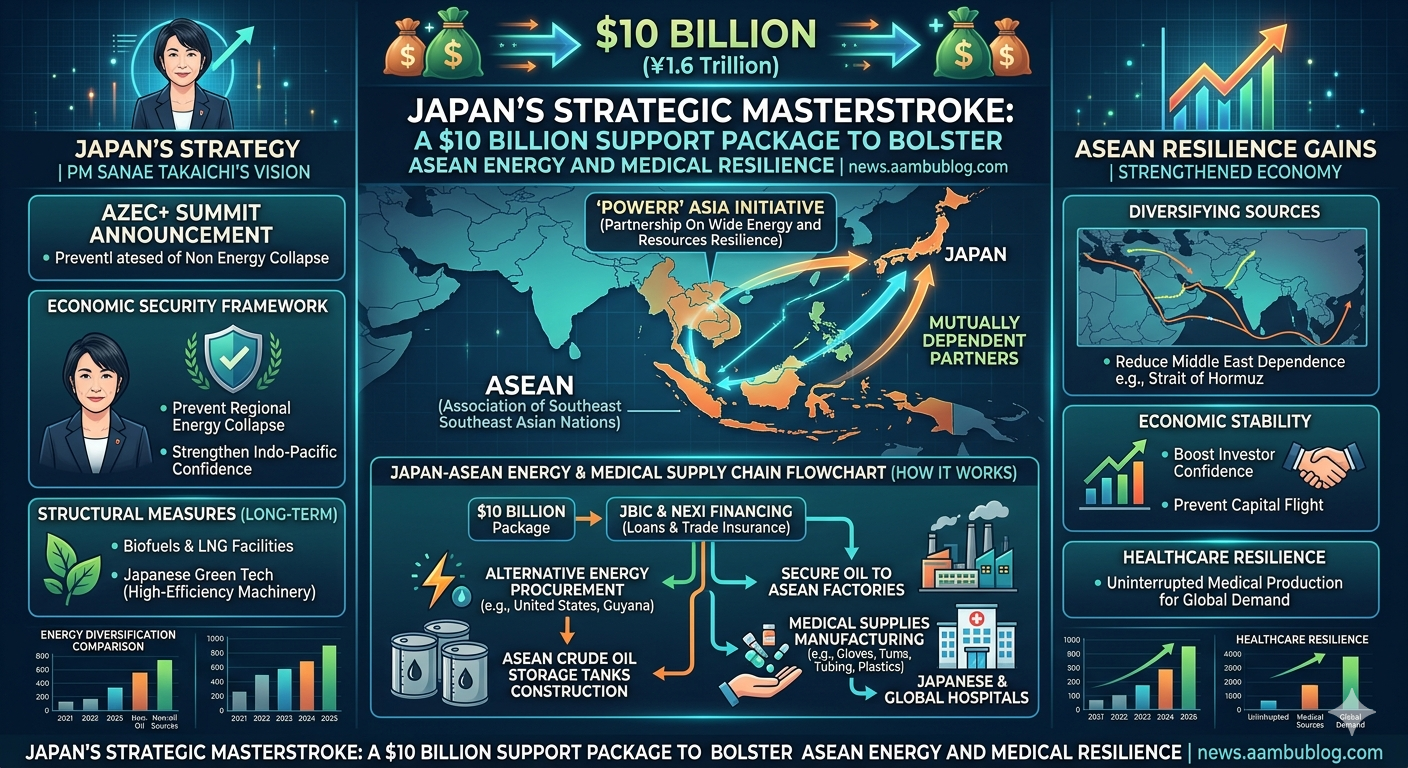
In a landmark move to stabilize the Asian economy amidst rising global tensions, Japan’s Prime Minister Sanae Takaichi announced a massive $10 billion (approx. ¥1.6 trillion) financial support framework for ASEAN nations today. This package, unveiled during the Asia Zero-Emission Community (AZEC) Plus online summit, is designed to ensure that Southeast Asia remains resilient against the energy shocks and supply chain disruptions currently emanating from the Middle East.
1. The Vision: PM Sanae Takaichi’s ‘POWERR’ Asia Initiative
Prime Minister Takaichi introduced the “Partnership On Wide Energy and Resources Resilience” (POWERR) Asia framework. This initiative acknowledges that Japan and ASEAN are “mutually dependent” partners whose economies are deeply interconnected through intricate supply chains.
- Strategic Goal: To prevent a regional energy collapse that could trigger a secondary economic crisis in Japan.
- The Scale: The $10 billion fund is equivalent to roughly 1.2 billion barrels of oil, which matches the total annual crude oil imports of all ASEAN countries combined.
2. Addressing the Energy Crisis: Beyond the Middle East
With the Strait of Hormuz facing potential closure, Japan is helping its neighbors diversify their energy sources.
- Alternative Procurement: The fund will provide loans through the Japan Bank for International Cooperation (JBIC) and Nippon Export and Investment Insurance (NEXI) to help ASEAN companies buy crude oil from alternative sources, such as the United States and Guyana.
- Stockpiling Support: A significant portion of the fund will be used to build structural infrastructure, including the construction of massive crude oil storage tanks across Southeast Asian nations that currently have limited reserves.
3. Securing Medical Supply Chains: The ‘Petroleum-to-Health’ Link
One of the most innovative aspects of this masterstroke is its focus on the medical sector.
- The Crisis: Most essential medical supplies—such as surgical gloves, dialysis tubing, and plastic containers—are petroleum-derived products manufactured in Southeast Asia.
- The Ripple Effect: Oil shortages in Malaysia or Thailand lead to manufacturing halts, which in turn causes critical shortages in Japanese and global hospitals.
- The Solution: By ensuring a steady flow of oil to ASEAN factories, Japan is effectively securing its own national healthcare system.
4. Structural Reforms for Future Resilience
Japan isn’t just providing a short-term band-aid; the package includes long-term structural measures:
- Energy Diversification: Promoting the adoption of biofuels and Liquefied Natural Gas (LNG) power facilities to reduce the region’s total dependence on crude oil.
- Energy Efficiency: Sharing Japanese “Green Tech” to help ASEAN industries lower their energy consumption through high-efficiency machinery.
5. Economic Impact: A Win-Win for the Indo-Pacific
Financial analysts suggest that this package will prevent a mass exodus of capital from Asian markets. By providing a $10 billion “credit safety net,” Japan is boosting investor confidence in ASEAN, ensuring that the region remains the world’s primary manufacturing hub despite the global energy emergency.
Quick FAQ: Japan’s $10 Billion ASEAN Package
Q1. Which countries are eligible for this support?
Key partners include Malaysia, Vietnam, Thailand, Singapore, and the Philippines, along with other members of the Association of Southeast Asian Nations (ASEAN).
Q2. Does this affect Japan’s own oil reserves?
No. PM Takaichi clarified that this is a financial framework and does not involve releasing Japan’s domestic crude oil reserves to other nations. Japan will maintain its own 200-day strategic reserve.
Q3. How will the funds be disbursed?
The funds will be channeled through state-backed financial institutions like JBIC and NEXI in the form of low-interest loans and trade insurance for energy procurement.
For real-time updates on Asian markets and diplomatic strategy: news.aambublog.com
Contact: help@aambublog.com