By Global Finance Desk | April 16, 2026
The International Monetary Fund (IMF) issued a harrowing “Red Alert” today, warning that the world is standing on the precipice of an unprecedented energy crisis. Speaking from Washington D.C., the IMF Managing Director highlighted that the confluence of the U.S.-Iran naval blockade and the widening conflict in the Middle East has created a “perfect storm” that could derail global recovery and trigger a deep recession.
1. The Catalyst: A Chokepoint Under Siege
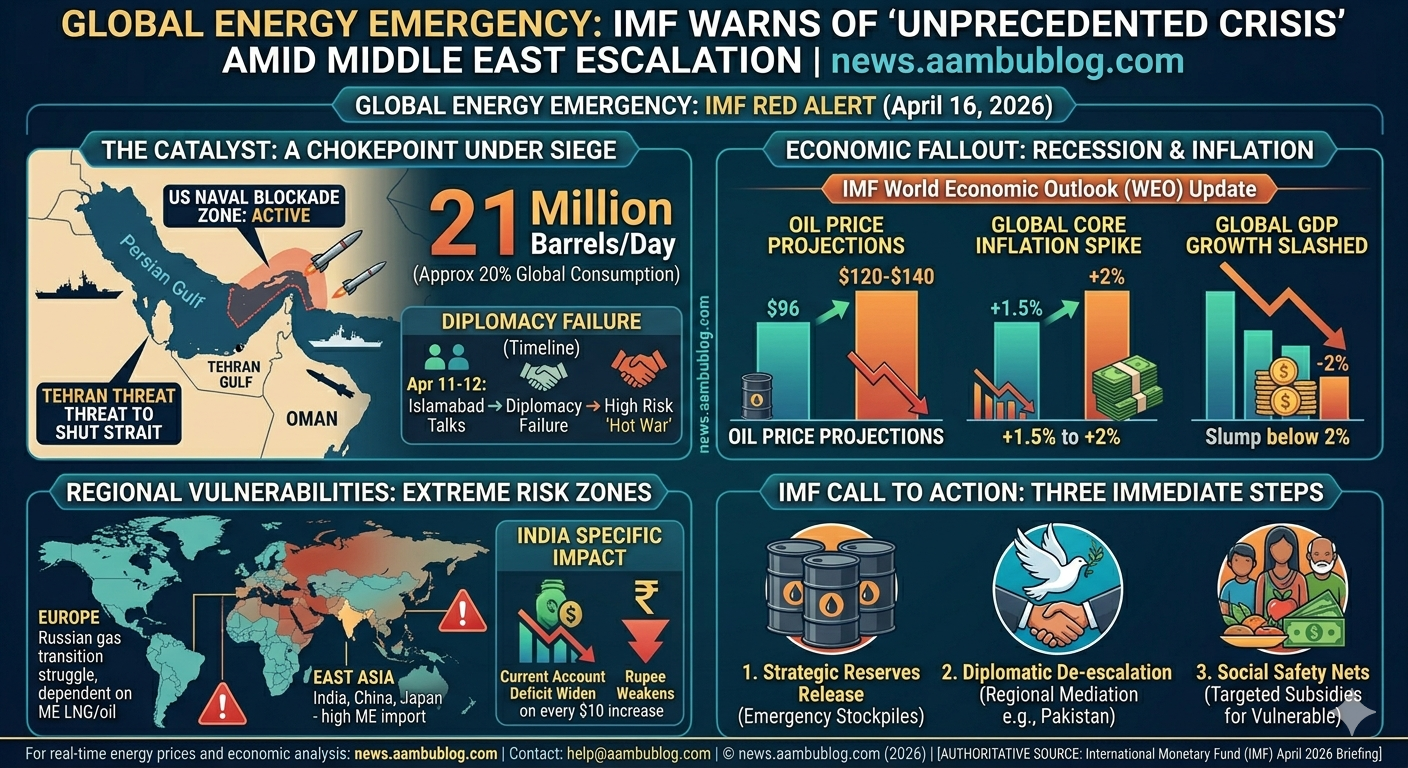
The primary driver of this alert is the active U.S. naval blockade of Iranian ports and the subsequent threat by Tehran to shut down the Strait of Hormuz.
- The Chokepoint: The Strait of Hormuz is the world’s most important oil artery. Nearly 21 million barrels of oil per day—roughly 20% of global consumption—pass through this narrow passage.
- The Disruption: With diplomacy failing in the recent Islamabad Talks, the risk of a “Hot War” has skyrocketed. The IMF warns that even a partial closure of the Gulf trade routes would lead to an immediate global supply deficit.
2. Economic Fallout: Recession and Skyrocketing Inflation
The IMF’s updated World Economic Outlook (WEO) paints a grim picture for the remainder of 2026.
- Oil Price Projections: While Brent Crude is currently trading around $96/barrel, the IMF projections suggest it could breach the $120–$140 range if the blockade persists through the next quarter.
- Inflation Targets at Risk: Most central banks (including the RBI and the Federal Reserve) were aiming for a “soft landing.” However, the energy spike is expected to push global core inflation up by an additional 1.5% to 2%.
- Growth Slowdown: Global GDP growth for 2026, previously estimated at 2.9%, could be slashed to below 2%, technically entering “slump” territory.
3. Regional Vulnerabilities: Who Hits Hardest?
The crisis is not distributed equally. The IMF identified two regions as “Extreme Risk” zones:
- Europe: Already struggling with the transition away from Russian gas, European nations are highly dependent on Middle Eastern LNG and oil.
- East Asia: Economies like India, China, and Japan import a massive percentage of their energy needs from the Persian Gulf. For India, every $10 increase in oil prices traditionally widens the current account deficit and weakens the Rupee.
4. The IMF’s Call to Action
The IMF has urged world leaders to take three immediate steps:
- Strategic Reserves: Release emergency oil stockpiles to stabilize short-term price volatility.
- Diplomatic De-escalation: Support the mediation efforts led by regional players (like Pakistan) to end the naval blockade.
- Social Safety Nets: Governments must prepare targeted subsidies for the most vulnerable populations to offset rising heating and transport costs.
Quick FAQ: The 2026 Energy Crisis
Q1. Why is the IMF calling this “unprecedented”?
Unlike previous crises, this involves a direct naval blockade of a major producer (Iran) coupled with a trade war between the US and the UK, and active conflict in Lebanon.
Q2. How will this affect my daily expenses?
If oil prices hit $120/barrel, expect a significant rise in petrol/diesel prices, airline fares, and the cost of essential goods due to increased logistics expenses.
Q3. Is there any hope for a quick resolution?
Hope rests on the high-level talks currently being brokered. If the US and Iran agree to a maritime corridor for commercial shipping, the market could stabilize rapidly.
For real-time energy prices and economic analysis: news.aambublog.com
Contact: help@aambublog.com