
1. News Introduction (The Lead)
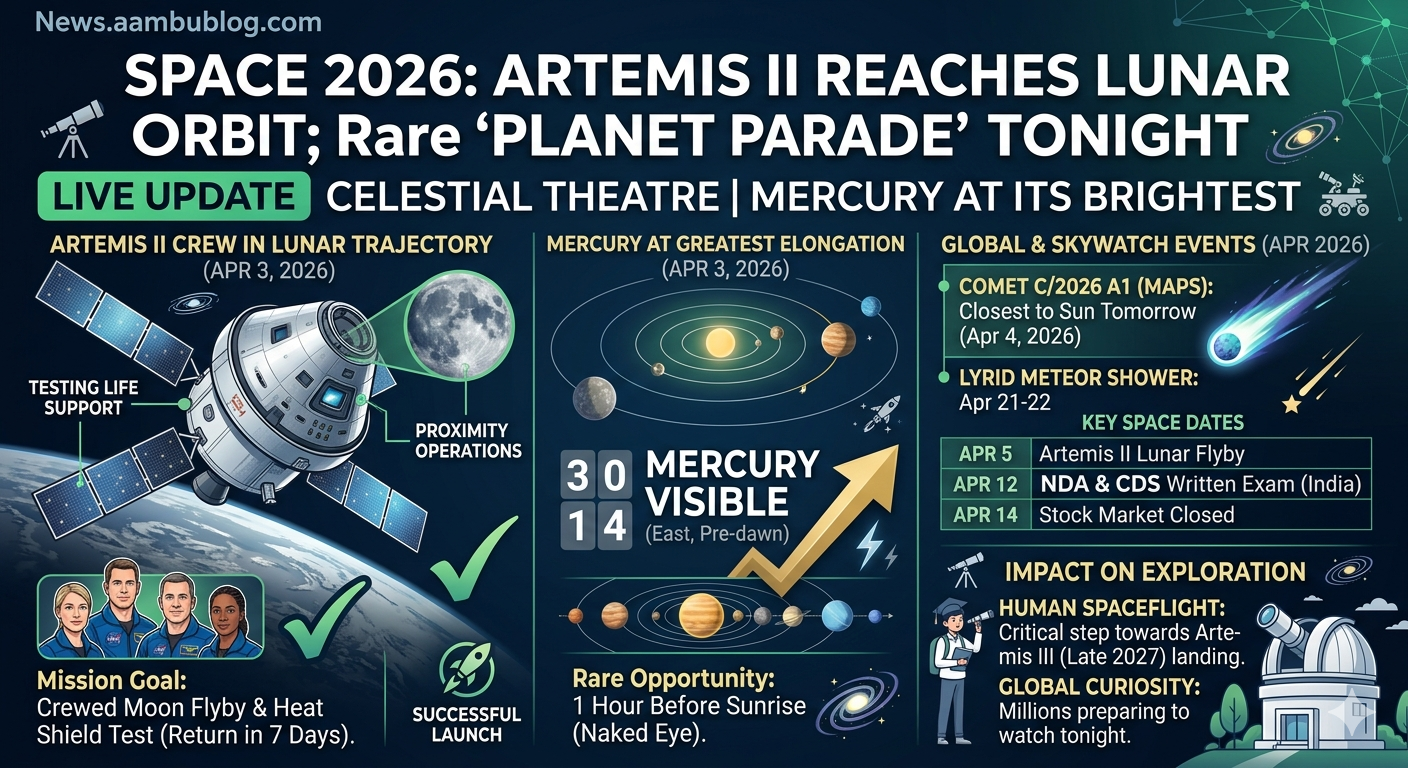
The eyes of the world are turned toward the stars today, April 3, 2026. Following a successful launch on April 1, NASA’s Artemis II mission—carrying the first human crew to the Moon in over 50 years—has officially entered lunar trajectory. Back on Earth, skywatchers are preparing for a rare astronomical event tonight as Mercury reaches its greatest western elongation, appearing as a bright “morning star” alongside a stunning Planet Parade of five major planets.
2. Key Highlights (Fast Facts)
- Artemis II Update: Commander Reid Wiseman and his crew are currently 380,000 km from Earth.
- Tonight’s Event: Mercury is at its furthest distance from the Sun, making it visible to the naked eye.
- Planet Parade: Mars, Saturn, Jupiter, Venus, and Mercury will align in the pre-dawn sky.
- Comet Watch: Comet C/2026 A1 (MAPS) is brightening and will be closest to the Sun tomorrow, April 4.
- Mission Goal: Artemis II will spend 10 days testing life-support systems around the Moon before returning.
3. Detailed Coverage
H2: Artemis II: Humanity’s Return to the Moon
The Artemis II mission is the first crewed flight under NASA’s program to establish a long-term presence on the Moon. The crew, including Pilot Victor Glover and Mission Specialists Christina Koch and Jeremy Hansen, are currently performing “proximity operations”—testing how the Orion spacecraft maneuvers in deep space.
This mission is a critical stepping stone for the Artemis III landing, currently scheduled for late 2027.
H2: Skywatching Guide: How to see Mercury Tonight
Because Mercury is usually lost in the Sun’s glare, tonight is a rare opportunity. Look toward the Eastern horizon about 45-60 minutes before sunrise. Mercury will appear as a small, steady point of light low in the sky. If you have binoculars, you may also catch a glimpse of the Comet MAPS, which is expected to show a visible tail by tomorrow morning.
4. April 2026 Celestial Calendar (Table)
| Event | Date | Best Time to Watch |
|---|---|---|
| Mercury Elongation | April 3, 2026 | 1 Hour before Sunrise |
| Comet MAPS Perihelion | April 4, 2026 | Pre-dawn (East) |
| Artemis II Lunar Flyby | April 5, 2026 | NASA Live Stream |
| Lyrid Meteor Shower | April 21-22, 2026 | Midnight |
5. Frequently Asked Questions (FAQs)
- Q1: Are the Artemis II astronauts going to land on the Moon?
- Ans: No, Artemis II is a “flyby” mission. The crew will loop around the far side of the Moon and return to Earth to test the heat shield and splashdown procedures.
- Q2: Do I need a telescope to see the Planet Parade?
- Ans: Most of the planets (Venus, Jupiter, Mars, and Saturn) will be visible to the naked eye. However, a telescope is recommended to see the details of Mercury and the Comet.
- Q3: What makes Comet C/2026 A1 (MAPS) special?
- Ans: This is a long-period comet from the Oort Cloud. It hasn’t visited the inner solar system in thousands of years and may become bright enough to be seen from city suburbs.
6. Editor’s Conclusion & Future Outlook
From the success of Artemis II to the ancient light of a visiting comet, April 2026 is proving to be a landmark month for science. These events remind us that while Earth faces geopolitical challenges, our potential for exploration remains limitless. Stay tuned to News.aambublog.com for the first high-resolution photos of the Lunar far-side, expected in 48 hours.