By Technology & Innovation Desk | April 23, 2026
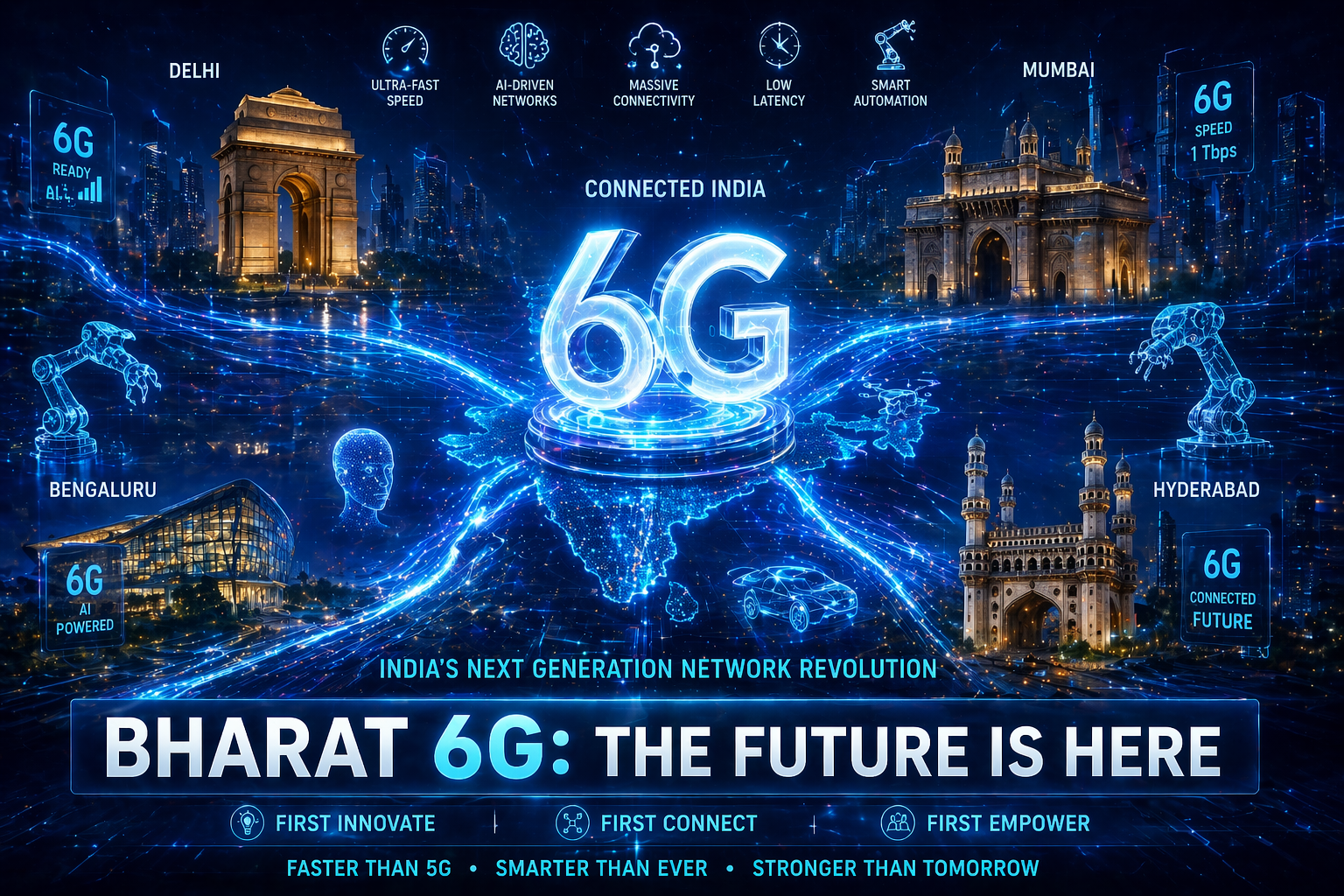
In a landmark move that cements India’s position as a global leader in telecommunications, the Department of Telecommunications (DoT) officially launched the nation’s first 6G spectrum trials today. The trials are being rolled out across four major strategic hubs: Delhi, Mumbai, Bengaluru, and Hyderabad, marking a massive leap from 5G to the next frontier of connectivity.
This initiative is part of the “Bharat 6G Vision” and is being executed through the Bharat 6G Alliance, focusing on 100% indigenous technology and hardware.
1. The TeraHertz Frontier: Unprecedented Speeds
Unlike 5G, which operates on lower frequency bands, India’s 6G trials are pushing into the TeraHertz (THz) frequency spectrum.
- Lightning Fast: The trials aim to achieve data download speeds that are up to 100 times faster than current 5G networks. This means downloading a 4K movie in less than a second will soon be a reality.
- Ultra-Low Latency: The primary goal is to reduce latency to “near-zero” levels, which is essential for futuristic applications like holographic communication, remote robotic surgeries, and fully autonomous transport systems in Indian cities.
2. The ‘Aatmanirbhar’ Advantage: Indigenous R&D
The most significant aspect of these trials is that they are being conducted using equipment and software developed entirely within India.
- Bharat 6G Alliance: A consortium of top Indian startups, research institutions (like IITs), and private telecom players are leading the charge. This reduces India’s historical dependence on foreign vendors like Nokia, Ericsson, or Huawei.
- Patents & IP: The government has confirmed that Indian researchers have already contributed to nearly 10% of the global 6G patents, ensuring that India is a “standard-setter” rather than just a “technology-follower” this time around.
3. Real-World Use Cases in the 4 Cities
The trials aren’t just about speed; they are about testing real-world solutions in dense urban environments.
- Delhi & Mumbai: Testing high-density connectivity for smart city infrastructure and traffic management.
- Bengaluru: Focusing on Industry 4.0 and AI-driven automation for the manufacturing sector.
- Hyderabad: Conducting specialized tests for satellite-terrestrial integrated networks to ensure seamless connectivity even in remote areas.
Detailed Q&A: India’s 6G Revolution
Q1. When will 6G be available for the general public? These are early-stage technical trials. While the foundation is being laid today, official commercial rollout for the general public is expected to begin between late 2028 and early 2030. The current trials are for testing infrastructure stability and frequency interference.
Q2. Do I need a new phone for 6G? Yes. Current 5G-enabled smartphones do not have the hardware (specifically the THz antennas and processors) required to handle 6G frequencies. New 6G-compatible devices will likely start entering the market around 2027-2028 as global standards are finalized.
Q3. Will 6G replace 5G entirely? No. 6G will work alongside 5G. While 5G will continue to provide the backbone for mobile broadband, 6G will be used for high-end applications like holographic calls, massive IoT (Internet of Things) clusters, and ultra-high-speed industrial automation.
Q4. Is 6G safe for health? Yes. All spectrum trials in India strictly follow the radiation safety guidelines set by the International Commission on Non-Ionizing Radiation Protection (ICNIRP). The DoT is continuously monitoring signal emissions to ensure they remain well within safe limits for human exposure.
Copyright: © news.aambublog.com (2026)