By Economy & Energy Desk | April 23, 2026
In a swift move to shield the domestic economy from the spiraling global oil prices, the Government of India has officially authorized the emergency release of 5 million barrels of crude oil from its Strategic Petroleum Reserves (SPR). The decision was finalized following an emergency cabinet meeting today, as the blockade in the Strait of Hormuz continues to choke global energy supply chains.
This intervention is aimed at providing immediate relief to state-run oil marketing companies (OMCs) and preventing a massive spike in petrol and diesel prices at the fuel pumps.
1. Stabilizing the Domestic Market
With global Brent crude prices hovering near record highs due to the Gulf crisis, the Indian government is using its “oil insurance” to maintain price stability.
- The Release: The 5 million barrels will be channeled directly to public sector refineries. This ensures that even if international shipments are delayed, the production of petrol, diesel, and aviation turbine fuel (ATF) remains uninterrupted.
- Inflation Control: By injecting this stock into the market, the government aims to absorb the initial shock of the global price surge, ensuring that transportation costs for essential goods like vegetables and milk do not skyrocket.
2. India’s Underground “Oil Fortresses”
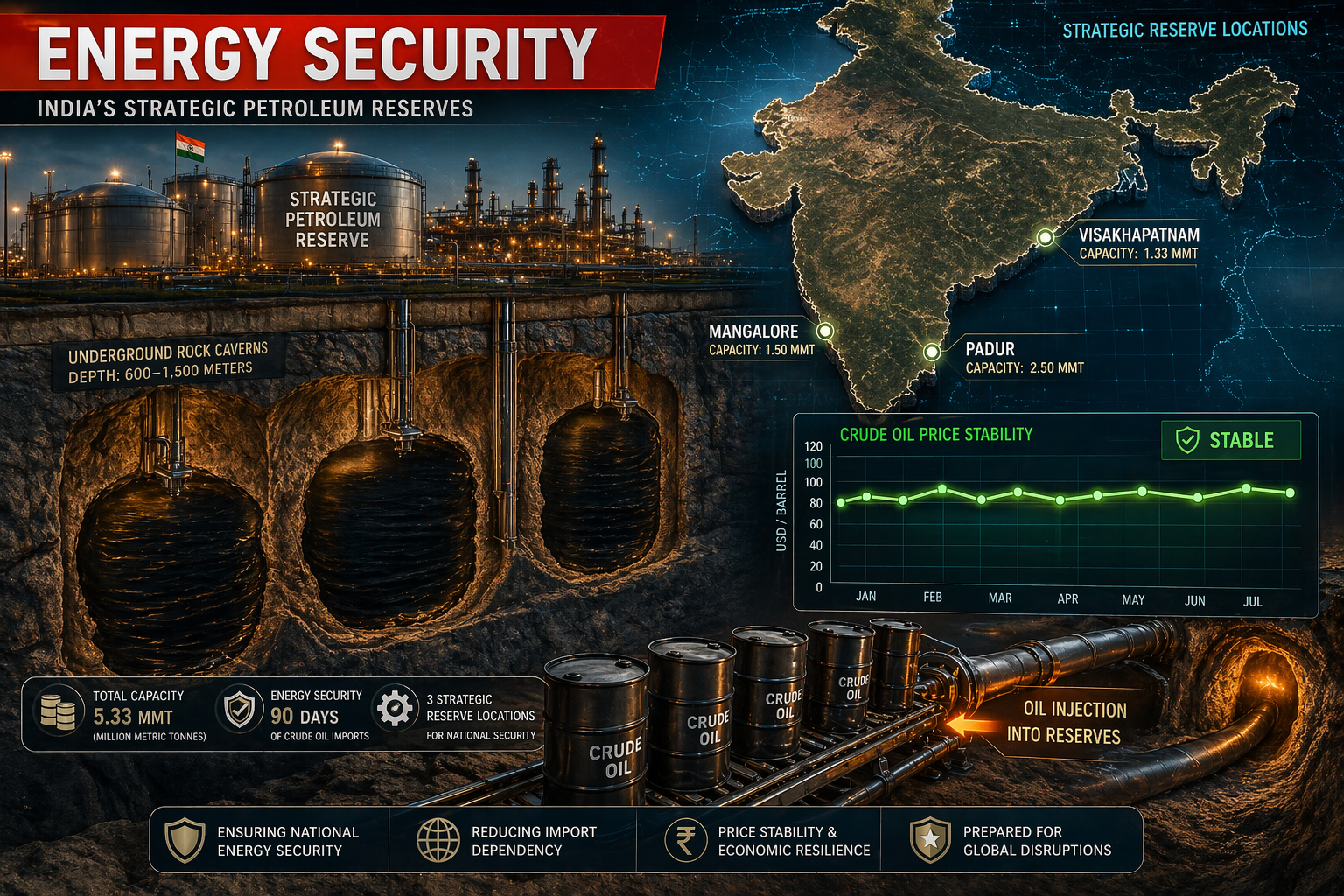
The release is being coordinated through the Indian Strategic Petroleum Reserves Limited (ISPRL), which manages India’s massive underground storage facilities.
- Key Locations: The oil is being drawn from the strategic salt caverns and storage facilities located in Visakhapatnam, Mangalore, and Padur.
- Current Capacity: Before this release, India’s SPR held enough crude to sustain the country’s needs for approximately 9.5 days. While 5 million barrels is a significant amount, officials have assured that the remaining “buffer” is still sufficient to handle a short-to-medium-term total supply cutoff.
3. Global Coordination and Future Outlook
India is not acting alone. This move is part of a coordinated effort with other major oil-consuming nations (like Japan and South Korea) to stabilize the global energy market.
- Replenishment Strategy: The Ministry of Petroleum has indicated that it will look to refill these reserves as soon as the geopolitical tensions in the Middle East ease and prices return to a more manageable level.
- Shift to Diversification: This crisis has further accelerated the government’s plan to increase its SPR capacity and look for alternative oil suppliers in Africa and South America to reduce dependence on the volatile Middle Eastern routes.
Detailed Q&A: The SPR Release and Your Wallet
Q1. Will this move make petrol and diesel cheaper? No, it won’t necessarily make it cheaper, but it is designed to prevent it from getting much more expensive. The release acts as a “dam” against the flood of rising global prices. Without this, fuel prices could have jumped significantly this week.
Q2. Is 5 million barrels enough for India? India consumes about 5 million barrels of oil per day. So, this release represents exactly one day’s worth of national consumption. While it seems small, when combined with the existing refinery stocks, it provides the necessary time for diplomatic efforts to reopen the shipping routes.
Q3. Where exactly is this oil stored? It is stored in massive, unlined rock caverns deep underground. These are highly secure, fire-proof, and earthquake-resistant facilities. They are essentially India’s “emergency energy bank.”
Q4. Does the government do this often? No. Strategic reserves are only touched during extreme national emergencies or severe global supply disruptions. The last major coordinated release happened during the initial stages of the Russia-Ukraine conflict.
Copyright: © news.aambublog.com (2026)