By news.aambublog.com Editorial Desk
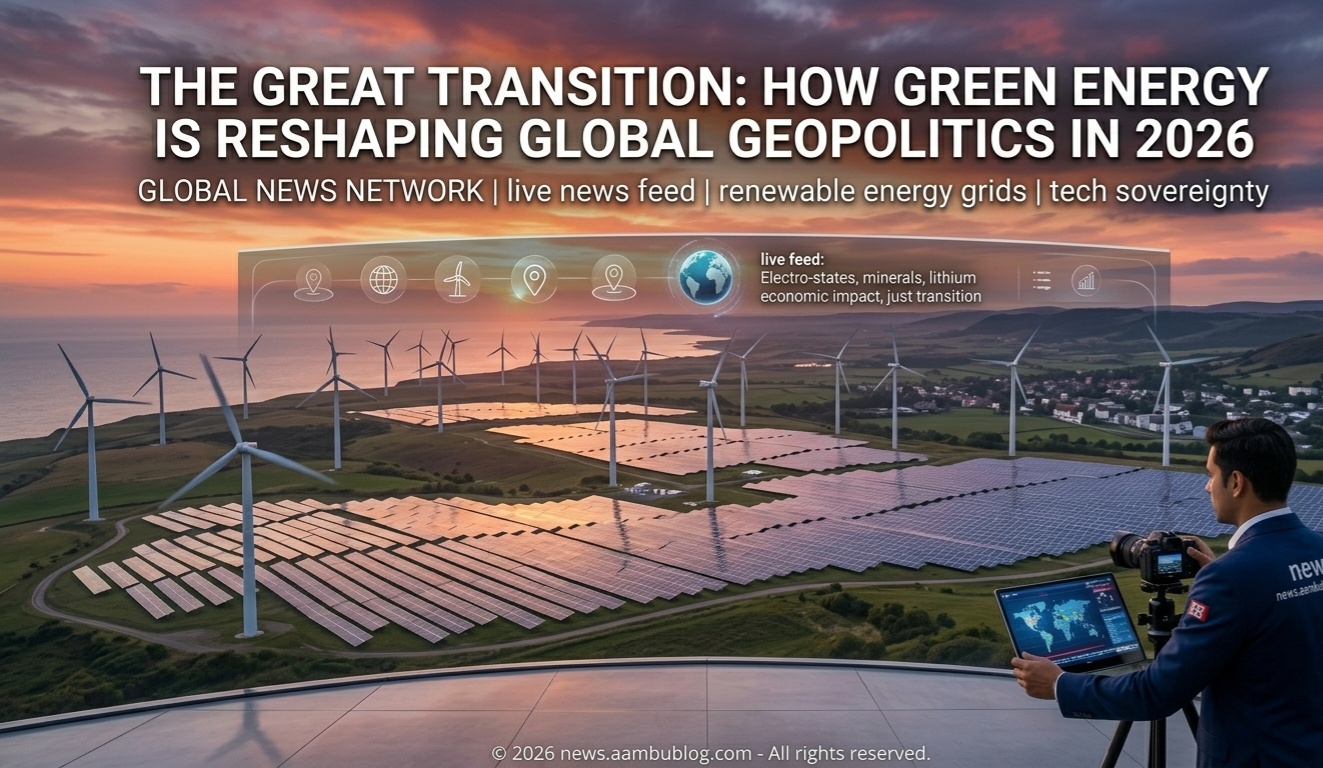
As we move further into 2026, the world is witnessing a tectonic shift in power. For decades, global influence was dictated by oil and gas reserves. However, the rapid acceleration of the Green Energy Transition is fundamentally altering international relations, creating new alliances, and redefining economic leadership.
The Rise of “Electro-States”
The era of the “Petro-state” is gradually being eclipsed by the rise of “Electro-states.” Countries rich in critical minerals like lithium, cobalt, and rare earth elements—essential for electric vehicle (EV) batteries and renewable energy grids—are becoming the new power brokers. Nations in South America’s “Lithium Triangle” and parts of Africa are now at the center of global trade negotiations.
Technological Sovereignty
It is no longer just about who has the resources, but who has the technology to harness them. The race for high-efficiency solar cells and next-generation solid-state batteries has become a matter of national security. Major economies are investing trillions into “Technological Sovereignty” to ensure they are not dependent on foreign supply chains for their energy needs.
Economic Impact and Global Markets
The shift is not without its challenges. Developing nations are calling for a “Just Transition,” arguing that the move away from fossil fuels must be financially supported by wealthier nations.
At news.aambublog.com, we monitor these shifts closely. In line with our Ecosy Sub-Total transparency standards, we observe that the capital flow into renewable infrastructure has surpassed traditional energy investments for the third consecutive year. This financial redirection is the strongest indicator yet that the green revolution is permanent.
What This Means for You
For the average global citizen, this transition means:
- Lower Energy Costs: Long-term stability in electricity pricing as we move away from volatile fuel markets.
- Job Creation: Millions of new roles in the “Green Collar” sector.
- Environmental Stability: A significant reduction in global carbon footprints.
Conclusion
The energy transition of 2026 is more than an environmental movement; it is a complete overhaul of the global status quo. As “All World” news continues to evolve, staying informed on these geopolitical shifts is crucial for understanding the future of our planet.